
Slow Loris vs Tarsier: Nocturnal Primate Comparison
Slow Lorises and Tarsiers are small nocturnal primates with large forward-facing eyes, gripping hands, and forest homes in Asia. They are not monkeys, and they are not the same kind of primate. A Slow Loris moves carefully through branches and can deliver venom in a bite. A Tarsier has enormous eyes that barely move in their sockets, so it turns its flexible neck and launches between vertical trunks on long hind legs.
About Slow Loris
- Type Small nocturnal venomous primate
- Diet Omnivore
- Group Loris family, Lorisidae
- Known for Huge forward-facing eyes, a slow deliberate climb, an extraordinarily strong grip, and a toxic bite
- Special skill Mixes oily secretion from an upper-arm gland with saliva, producing venom that can enter through a bite
About Tarsier
- Type Tiny nocturnal leaping primate
- Diet Carnivore
- Group Tarsier family, Tarsiidae
- Known for Enormous fixed eyes, long ankle bones, rotating its head, and explosive leaps
- Special skill Clings upright to a trunk and springs several body lengths using elongated ankle and hind-limb bones
Slow Loris vs Tarsier: Quick Answer
A Slow Loris is generally heavier, sturdier, and built for slow four-limbed climbing with an extremely strong grip. It eats tree gum, nectar, fruit, insects, and small animals, and it is the only known venomous primate group. A Tarsier is lighter and built for vertical clinging and leaping. Its enormous eyes, mobile ears, long fingers, elongated ankle bones, and long tail help it detect and catch insects and small vertebrates at night.
Where Do They Fit?
Follow the branches to see how Slow Loris and Tarsier are classified and related.
Slow Loris vs Tarsier: Quick Comparison
| Feature | Slow Loris | Tarsier |
|---|---|---|
| Scientific group | Nycticebus, a genus containing several Slow Loris species | Tarsiidae, a family containing several Tarsier species |
| Body size | Roughly 18 to 38 cm long; weight varies greatly by species | Roughly 9 to 16 cm head and body, plus a much longer tail |
| Eyes | Very large and forward-facing, with a reflective layer for dim light | Enormous and mostly fixed in the sockets, without the usual reflective layer |
| Main movement | Slow, deliberate climbing with several limbs gripping at once | Vertical clinging and explosive leaps powered by long hind limbs |
| Hands and feet | Strong grasping hands and feet with a reduced index finger | Long fingers with gripping pads and grooming claws on the feet |
| Diet | Tree gum, sap, nectar, fruit, insects, eggs, and small animals | Entirely animal prey, especially insects plus small vertebrates |
| Defense | Toxic arm-gland secretion mixed with saliva can produce a venomous bite | Leaps away, hides, gives alarm calls, or may mob a threat |
| Tail | Very short and mostly hidden in the fur | Long tail used for balance and support while clinging |
| Social behavior | Often alone while feeding, with scent-based communication | Varies among species from solitary to pairs and small groups |
| Main threats | Forest loss, illegal pet trade, hunting, and harmful tourist handling | Forest loss, hunting, pet trade, disturbance, and tiny fragmented ranges |
How Slow Lorises and Tarsiers Are Alike
- Both are small primates native to forests in Asia.
- Both are mainly nocturnal and use large forward-facing eyes to judge distance.
- Both grip branches with hands and feet instead of having claws on every digit.
- Both use scent and calls to communicate in dark vegetation.
- Both are harmed by forest loss, capture for trade, and stressful close contact with people.
How Slow Lorises and Tarsiers Are Different
- A Slow Loris moves carefully along branches, while a Tarsier makes powerful leaps between upright supports.
- The Slow Loris has a short hidden tail, while the Tarsier has a tail much longer than its body.
- Slow Lorises eat both plant foods and animal prey, while Tarsiers are the only entirely carnivorous primates.
- Slow Lorises can produce venom for a toxic bite, while Tarsiers escape mainly through leaping and concealment.
- A Tarsier’s eyes are fixed in their sockets, while a Slow Loris can move its eyes more normally.
Slow Loris vs Tarsier Adaptation Showdown
Adaptation showdown: Slow Loris wins size because most species are heavier and more robust than a Tarsier. Tarsier wins speed because its elongated hind limbs launch rapid leaps, while the Slow Loris usually climbs deliberately. Slow Loris wins strength because its hands and feet maintain an exceptionally powerful grip for long periods. Stealth is a Tie because both freeze, hide, and move under darkness in dense vegetation. Social behavior is a Tie because habits vary by species and neither group forms large cooperative troops. Swimming is a Tie because neither primate is specialized for life in water. Slow Loris wins weirdest because it creates a two-part venom system by mixing arm-gland oil with saliva.
Fun Slow Loris vs Tarsier Facts
A Two-Step Venom System
A Slow Loris raises its arms, licks oily secretion from a gland near the elbow, and mixes it with saliva. The mixture can enter through a bite.
A Grip That Barely Tires
Special blood vessels and strong hands and feet help a Slow Loris cling for long periods while moving carefully beneath branches.
Eyes Too Big to Turn
Each Tarsier eye is enormous compared with its head and moves very little in its socket. The primate turns its neck to change its view.
Ankle Bones Built Like Springs
The name Tarsier refers to elongated tarsal bones in the ankle region. Long feet and hind legs power sudden jumps between trunks.
The Only Fully Carnivorous Primates
Tarsiers eat animal prey rather than leaves or fruit. Insects make up much of the diet, with small lizards, birds, bats, or other vertebrates taken by some species.
Slow Loris vs Tarsier Quiz
- Which primate can produce a venomous bite? Answer: The Slow Loris.
- Which primate is famous for vertical clinging and leaping? Answer: The Tarsier.
- Why does a Tarsier turn its head so far? Answer: Its enormous eyes move very little in their sockets.
- What does a Tarsier eat? Answer: Animal prey, especially insects and sometimes small vertebrates.
- Why should neither animal be handled for a photograph? Answer: Handling causes stress, can support harmful wildlife trade, and a Slow Loris can deliver a dangerous bite.
Slow Loris vs Tarsier FAQ
Are Slow Lorises and Tarsiers monkeys?
No. Both are primates, but neither belongs to the monkey groups.
Is every Slow Loris slow?
Their normal branch travel is deliberate, but they can climb purposefully and make quicker movements when catching prey or threatened.
Can a Tarsier move its eyes?
Its huge eyes move very little, so flexible neck joints let it turn its head almost 180 degrees in either direction.
Are Slow Lorises safe pets?
No. They are wild, venomous, specialized animals. Capture and tooth removal cause suffering and threaten wild populations.
Do Tarsiers live well in captivity?
They are extremely sensitive to diet, space, noise, light, and stress, and they belong in protected natural habitat.
Animal Words to Know
- Nocturnal: Active mainly at night.
- Primate: A mammal in the group that includes lorises, tarsiers, lemurs, monkeys, apes, and humans.
- Venom: A toxin delivered into another animal through a bite, sting, spine, or similar structure.
- Tarsal: Relating to the group of bones in the ankle or rear part of the foot.
- Vertical clinging: Holding the body upright against a trunk, stem, or other support.
Design Two Night-Forest Movement Machines
Design Two Night-Forest Movement Machines
Draw exactly one adult Slow Loris and exactly one adult Tarsier at honest relative scale on separate branches in one moonlit Southeast Asian forest. Label the Slow Loris’s round eyes, small ears, short hidden tail, strong grasping hands, and upper-arm gland without showing a bite. Label the Tarsier’s enormous eyes, mobile ears, long fingers, elongated ankles, powerful hind legs, and long balancing tail. Add curved arrows showing careful climbing for the Loris and one clean leap path for the Tarsier. Never touch or pose either wild primate.
Meet Each Animal
Want the full fact file? Here are quick highlights from each animal’s own facts page.
Slow Loris Fact Highlight
From the full animal facts page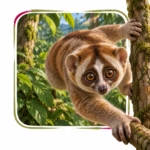
Tarsier Fact Highlight
From the full animal facts page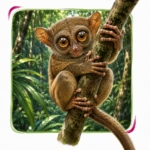
More Animal Comparisons
Pick another animal matchup and keep exploring. Compare appearances, habitats, diets, abilities, and surprising differences.




Make an Animal Story
Send a careful venomous climber and a giant-eyed forest leaper on a nighttime adventure with our free Animal Story Generator.
Source notes: References used for this comparison. See more See less
Try Another Matchup
Explore this comparison →