
Snow Leopard vs Leopard: Living Panthera Big Cat Species Comparison
Snow leopards and leopards are genuine big-cat cousins in the genus Panthera, but a snow leopard is not simply a leopard living in snow. The snow leopard is a pale, thick-furred specialist of cold Central Asian cliffs with huge furry paws and an extraordinarily thick balancing tail. The leopard is a more muscular, widespread African and Asian generalist with golden rosetted fur, powerful tree-climbing shoulders, broad habitat tolerance, and a remarkably varied diet. Their ranges approach one another in parts of Asia but their core adaptations are very different.
About Snow Leopard
- Type Mammal
- Diet Carnivore feeding mainly on blue sheep, argali, ibex, other wild goats and sheep, marmots, pikas, hares, rodents, game birds, and sometimes livestock where natural prey has declined
- Group Snow Leopard (Panthera uncia; Family Felidae)
- Known for Medium-sized mountain cat with smoky pale-gray or cream coat, dark solid spots on head and limbs, large open black-gray rosettes on body, dense insulating fur, small rounded ears, broad short nose with large nasal cavity, powerful hindquarters, extremely wide furred paws, and an exceptionally long thick tail
- Special skill Crossing steep snow and rock with wide furry snowshoe paws, powerful jumping legs, enlarged nasal space, dense coat, and a near-body-length tail used for balance and wrapped around the face for warmth
About Leopard
- Type Mammal
- Diet Highly flexible carnivore taking antelope, deer, wild pigs, monkeys, hares, rodents, birds, reptiles, fish, and many other locally available animals
- Group Leopard (Panthera pardus; Family Felidae)
- Known for Muscular spotted big cat with golden, tan, pale, or regionally grayish coat, dark solid spots on face and legs, flower-shaped open rosettes on body without the central dots typical of jaguars, powerful shoulders and jaws, retractable claws, broad paws, long balancing tail, and occasional all-dark melanistic form called a black panther
- Special skill Stalking silently across many habitats, bursting into a pounce, swimming well, climbing trees with exceptional strength, and hauling food into branches away from competing scavengers and larger predators
Snow Leopard vs Leopard: Quick Answer
A snow leopard has pale smoky fur, broad furry paws, a short wide nose, and a very long thick tail for cold mountain travel. A leopard usually has a warmer golden or tan coat, smaller paws, a shorter and thinner tail relative to its body, and powerful shoulders for hauling food into trees. Both belong to Panthera, carry rosettes, live mostly alone, and are globally Vulnerable, but they are separate species.
Where Do They Fit?
Follow the branches to see how Snow Leopard and Leopard are classified and related.
Snow Leopard vs Leopard: Quick Comparison
| Feature | Snow Leopard | Leopard |
|---|---|---|
| Scientific name | Panthera uncia | Panthera pardus |
| Typical adult mass | Commonly about 25–55 kg, with exceptional males heavier | About 21–75 kg in widely used zoo ranges, varying strongly by sex and region |
| Coat | Smoky gray or cream, extremely dense, with large blurred rosettes | Usually golden or tan with crisp dark rosettes; black forms occur |
| Paws | Exceptionally broad and furred underneath like snowshoes | Strong climbing and stalking paws without extreme snowshoe width |
| Tail | Very thick, about 80–100 cm, sometimes nearly body length | Long but slimmer, about 64–99 cm |
| Main habitat | Cold steep mountains above or near the tree line | Forest, savanna, scrub, mountain, grassland, and desert edge |
| Range | High mountains of 12 Asian countries | Fragmented areas across Africa and Asia |
| Signature movement | Long leaps and sure-footed travel over cliffs and snow | Stealthy stalking and powerful climbing with carried food |
| Voice | Cannot roar; chuffs, mews, growls, moans, yowls, and purrs | Raspy sawing calls, coughs, growls, purrs, and occasional roars |
| Global conservation status | Vulnerable | Vulnerable, with some subspecies at much greater risk |
How Are Snow Leopards and Leopards Alike?
- Both are mammalian carnivores in Felidae, Pantherinae, and the genus Panthera.
- Both have spotted and rosetted coats, round pupils, retractable claws, sensitive whiskers, strong jaws, padded feet, and long balancing tails.
- Both stalk and pounce rather than depending on a long high-speed chase.
- Both are mainly solitary and use scent, scrapes, calls, and claw marks to communicate across large ranges.
- Both raise helpless cubs, need abundant wild prey and connected habitat, and are globally classified as Vulnerable.
How Are Snow Leopards and Leopards Different?
- Snow leopards are cold-mountain specialists; leopards occupy a far wider variety of warm, temperate, forested, open, and rocky habitats.
- A snow leopard has pale dense fur and blurred gray-black rosettes; a leopard usually has shorter golden-tan fur and sharper black rosettes.
- Snow leopards have wider fur-covered paws and a much thicker tail for snow, cliffs, balance, and warmth.
- Leopards are generally more powerfully built through the shoulders and regularly haul food into trees.
- Snow leopards mainly take mountain ungulates and smaller highland animals; leopards exploit an exceptionally broad menu across two continents.
- Snow leopards cannot roar and often chuff; leopards produce famous rasping sawing calls and can make limited roars.
Snow Leopard vs Leopard Adaptation Showdown
Spotted-cat adaptation showdown: Leopard wins maximum typical size, short-burst running speed, muscular tree-hauling strength, and swimming through its highly adaptable lowland-and-forest body. Stealth is a tie: snow leopards vanish into pale scree while leopards dissolve into leaves, trunks, and grass. Social skill is also a tie because both are mostly solitary scent communicators and attentive mothers. Snow leopard wins weirdest adaptation for its tail-sized winter blanket, snowshoe paws, and inability to roar despite belonging to Panthera. These categories compare adaptations, not combat.
Fun Snow Leopard vs Leopard Facts
They Share Panthera but Not a Species
Genetic and anatomical work places both cats in Panthera alongside lions, tigers, and jaguars. Snow leopard is Panthera uncia and leopard is Panthera pardus. Their similar names reflect real kinship, but millions of years of separate evolution produced distinct species and ecological roles.
A Snow Leopard Wears Snowshoes and a Scarf
Fur covers the undersides of a snow leopard’s enormous paws, insulating them and spreading body weight across snow. Its thick tail may nearly match its body length, counters turns on cliffs, stores fat, and wraps around the resting cat’s nose and body like a scarf.
A Leopard Can Wear Black Without Losing Its Spots
A black panther in Africa or Asia is usually a melanistic leopard with unusually abundant dark pigment. Strong light may still reveal its rosette pattern beneath the black coat. Black leopards are not a separate species, and melanism is especially frequent in some humid forest populations.
Their Rosettes Work in Different Backgrounds
Snow-leopard rosettes are large, gray-black, widely spaced, and softly blurred against pale rock and snow shadows. Leopard rosettes are generally smaller, darker, and crisper against gold, tan, or brown. Each individual’s pattern is unique enough to help camera-trap researchers identify it.
The Snow Leopard Has a Silent Roar
Snow leopards cannot make a full roar because of their throat anatomy. They communicate with mews, hisses, growls, moans, yowls, purrs, and a friendly closed-mouth puff called a chuff. Leopards are usually quiet but advertise with rough coughing or sawing calls and occasional limited roars.
Snow Leopard vs Leopard Quiz
- Which cat has extremely wide furry paws? Answer: The snow leopard.
- Which cat regularly carries food into trees? Answer: The leopard.
- Do both cats belong to Panthera? Answer: Yes, but they are separate species.
- What is a black panther in Africa or Asia usually? Answer: A melanistic leopard.
- Can a snow leopard roar? Answer: No; it chuffs, mews, growls, moans, and yowls.
Snow Leopard vs Leopard FAQ
Is a snow leopard a type of leopard?
It is a close Panthera relative, but not the same species or a subspecies of Panthera pardus. Its scientific name is Panthera uncia.
Which is bigger, a snow leopard or leopard?
Adult masses overlap, but the largest typical male leopards are generally heavier. Region, sex, age, prey, and measurement source all affect size.
Why is a snow leopard’s tail so thick?
It balances jumps and turns, stores fat, and wraps around the resting cat for insulation in extreme cold.
Can ordinary leopards live in snow?
Some leopard populations, especially Amur and Persian leopards, experience snowy winters, but they lack the snow leopard’s extreme high-mountain adaptations.
Would these cats naturally fight?
They generally avoid other large cats and people. This page compares adaptations rather than predicting a fight, and wild cats should always be observed from a safe distance.
Animal Words to Know
- Rosette: A flower-like ring or cluster of spots on an animal’s coat.
- Melanism: Inherited production of unusually dark pigment, creating a black leopard or black panther.
- Alpine: Relating to high mountain environments above or near the tree line.
- Crepuscular: Most active around dawn and dusk.
- Chuff: A friendly non-threatening puffing sound made through a closed mouth.
Snow Leopard and Leopard Camouflage Activity
Snow Leopard and Leopard Camouflage Activity
Draw a snow leopard in a cold rocky mountain and a leopard in a forest or grassland. Give the snow leopard pale smoky fur, large soft-edged rosettes, small rounded ears, wide furry paws, and a very thick tail. Give the leopard a golden coat, crisp open rosettes, strong climbing paws, and a slimmer tail. Label rosettes, paws, tail, mountain, forest, and camouflage.
Meet Each Animal
Want the full fact file? Here are quick highlights from each animal’s own facts page.
Snow Leopard Fact Highlight
From the full animal facts page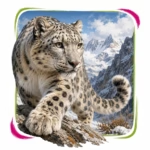
Leopard Fact Highlight
From the full animal facts page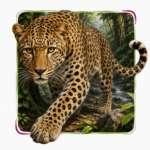
More Animal Comparisons
Pick another animal matchup and keep exploring. Compare appearances, habitats, diets, abilities, and surprising differences.




Make an Animal Story
Turn this snow leopard vs leopard comparison into a two-continent camouflage adventure with our free Animal Story Generator.
Source notes: References used for this comparison. See more See less
Try Another Matchup
Explore this comparison →