
Titanoboa vs Anaconda: Extinct vs Living Giant Snake Comparison
Titanoboa and the green anaconda were both nonvenomous South American boas with heavy bodies and strong aquatic associations, but Titanoboa lived about 58–60 million years ago and was vastly larger. Fossil vertebrae and skull pieces support an estimated length near 13 metres and mass around 1,135 kilograms for Titanoboa. Green anacondas are the heaviest living snakes, yet verified individuals are usually far shorter and lighter than the biggest popular claims.
About Titanoboa
- Type Extinct Reptile
- Diet Carnivore; large fish and other aquatic or waterside vertebrates are leading possibilities, but no stomach contents preserve a complete menu
- Group Titanoboa (Titanoboa cerrejonensis; Family Boidae)
- Known for An estimated 13-metre body, mass exceeding one tonne in the original reconstruction, enormous vertebrae, broad boa-like skull, recurved teeth, flexible snake jaws, powerful muscles, and probable semiaquatic adaptations reconstructed from incomplete fossils
- Special skill Reaching the greatest well-supported body size known for a snake and probably ambushing prey in warm tropical water
About Anaconda
- Type Reptile
- Diet Carnivore; fish, turtles, birds, capybaras, deer, caimans, and other available animals depending on the snake’s age and size
- Group Green Anaconda (Eunectes murinus; Family Boidae)
- Known for Heavy muscular body, olive-green camouflage with dark oval spots, eyes and nostrils high on the head, heat-sensitive facial pits, flexible jaws, recurved teeth, strong constricting coils, live birth, excellent swimming, and extreme female-biased size difference
- Special skill Moving almost invisibly through shallow water before gripping prey and tightening muscular coils that stop circulation
Titanoboa vs Anaconda: Quick Answer
Titanoboa was the larger snake by an enormous margin: its fossils were used to estimate a body about 13 metres long and more than one tonne in mass. The green anaconda is the heaviest living snake and a superb swamp swimmer, but most scientifically documented animals are much smaller than Titanoboa. Both were boas rather than venomous snakes, although Titanoboa’s exact diet, behavior, speed, and hunting method remain fossil-based reconstructions.
Where Do They Fit?
Follow the branches to see how Titanoboa and Anaconda are classified and related.
Titanoboa vs Anaconda: Quick Comparison
| Feature | Titanoboa | Green Anaconda |
|---|---|---|
| Scientific name | Titanoboa cerrejonensis | Eunectes murinus |
| Status | Extinct; lived about 58–60 million years ago | Living South American boa |
| Family | Boidae | Boidae |
| Length | Estimated near 13 m from fossil vertebrae, with uncertainty | Large females commonly remain below 6 m; reports approaching 9 m are exceptional and difficult to verify |
| Mass | Original reconstruction about 1,135 kg | Exceptionally reported up to about 250 kg, though most are far lighter |
| Habitat | Paleocene tropical river and swamp system in present-day Colombia | Modern tropical swamps, flooded forests, marshes, and slow waterways |
| Food evidence | Skull anatomy, teeth, associated fauna, and ecological reconstruction | Direct observation, stomach contents, field studies, and captive records |
| Reproduction | Unknown | Live-bearing, with females producing litters of young |
| Hunting | Probably aquatic ambush; exact prey-handling behavior is uncertain | Observed aquatic ambush followed by gripping and constriction |
| Main evidence | Incomplete skull material, jaws, ribs, and many large vertebrae | Living animals, skeletons, genetics, tracking, measurements, and behavior |
How Were Titanoboa and Anacondas Alike?
- Both belonged to Boidae, the boa family, and were nonvenomous snakes.
- Both had muscular elongated bodies, flexible skulls, recurved teeth, forked tongues, and strong chemical senses.
- Both were associated with warm South American tropical waterways and probably hunted from concealment.
- Both could swallow large food whole by moving flexible jaw bones around it; neither needed to dislocate its jaw.
- Both were large-bodied predators, although Titanoboa occupied a size class far beyond any living snake.
How Were Titanoboa and Anacondas Different?
- Titanoboa is extinct and lived during the Paleocene; green anacondas live today.
- Titanoboa was estimated near 13 metres and more than one tonne, while even exceptional anacondas are far smaller.
- Titanoboa is known only from fossils, so its color, reproduction, speed, social life, and exact hunting behavior remain unknown.
- Green anacondas have observed olive-and-black camouflage, live birth, strong swimming, constriction, and female-biased size differences.
- Titanoboa lived in the ancient Cerrejón ecosystem, while green anacondas occupy several modern South American river basins and wetlands.
Titanoboa vs Anaconda Showdown
Giant-snake showdown: Titanoboa wins size and whole-body strength because its estimated mass was several times that of even an exceptional green anaconda. The anaconda wins speed, stealth, and swimming because its maneuvering, camouflage, and aquatic performance are directly observed, whereas Titanoboa’s performance is reconstructed. Social behavior is a tie because anacondas are usually solitary and Titanoboa’s social life is unknown. Titanoboa takes the weirdest-fact prize because a handful of giant vertebrae helped scientists rebuild a snake nearly as long as a bus.
Fun Titanoboa vs Anaconda Facts
Giant Vertebrae Built the Size Estimate
Titanoboa did not leave a complete skeleton. Researchers compared the width of its fossil vertebrae with corresponding bones in living boas, then used scaling relationships to estimate total length and mass. The famous 13-metre and 1,135-kilogram figures are scientific estimates with uncertainty, not direct tape-and-scale measurements.
Titanoboa Lived After the Non-Bird Dinosaurs
Titanoboa lived about 58–60 million years ago, roughly six to eight million years after the end-Cretaceous extinction. It never met Tyrannosaurus rex, which lived earlier and far to the north. Its world contained a hot rainforest, giant turtles, fish, early mammals, and crocodile relatives.
Its Use as a Fossil Thermometer Is Debated
The original study linked Titanoboa’s maximum size to very warm tropical temperatures because snakes depend on environmental heat. Other researchers argued that body-temperature behavior, scaling choices, and the snake’s enormous thermal inertia complicate that calculation. The rainforest was warm, but one snake cannot provide a perfect thermometer.
Anaconda Jaws Do Not Detach
A green anaconda does not pop its jaw out of place. The left and right lower jaws are joined by stretchy tissue, while several skull bones move at flexible joints. The snake alternately advances the sides of its mouth over food, and elastic skin and ligaments allow a very wide gape.
Titanoboa’s Exact Menu Remains Open
Its semiaquatic habitat and skull features support a strong role for fish and other aquatic prey. Crocodile relatives and giant turtles shared the ecosystem and were possible food, but association alone does not prove a meal. No preserved stomach contents show every species Titanoboa ate.
Titanoboa vs Anaconda Quiz
- Which snake was larger? Answer: Titanoboa.
- About when did Titanoboa live? Answer: About 58–60 million years ago.
- What living species is used for the anaconda side? Answer: The green anaconda.
- How did scientists estimate Titanoboa’s size? Answer: Mainly by scaling its fossil vertebrae against those of living snakes.
- Do anacondas dislocate their jaws to swallow food? Answer: No; connected but highly flexible jaw bones, ligaments, and skin spread widely.
Titanoboa vs Anaconda FAQ
Was Titanoboa bigger than an anaconda?
Yes. Titanoboa was estimated near 13 metres and about 1,135 kilograms, several times the mass of even an exceptionally large green anaconda.
Was Titanoboa an anaconda?
No. Both belong to the boa family, but Titanoboa was its own extinct genus and species. Its exact position among boas is studied from incomplete fossils.
Did Titanoboa squeeze its prey?
It may have used boa-like constriction, but the fossils do not record the behavior directly. Its skull and watery habitat also suggest that fish and aquatic feeding were important.
Could Titanoboa eat a human?
Humans did not exist when Titanoboa lived. Its great size suggests it could handle large prey, but specific menu claims require fossil evidence.
Did Titanoboa live with dinosaurs?
Not with famous non-bird dinosaurs such as Tyrannosaurus. Titanoboa appeared millions of years after the end-Cretaceous extinction, although birds are living dinosaurs.
Animal Words to Know
- Boid: A member of the boa family, Boidae.
- Paleocene: The geological epoch from about 66 to 56 million years ago.
- Semiaquatic: Spending substantial time in both water and on land.
- Constriction: Tight muscular coiling that stops a prey animal’s circulation.
- Vertebra: One bone in the backbone; vertebrae supplied much of Titanoboa’s fossil evidence.
Titanoboa and Anaconda Scale Activity
Titanoboa and Anaconda Scale Activity
Draw a reconstructed Titanoboa outline beside a large female green anaconda using the same scale bar. Make Titanoboa about 13 metres long, but use a dotted outline and label the size as an estimate based mainly on fossil vertebrae. Give the anaconda an olive coat with dark oval spots in a modern South American wetland. Leave Titanoboa’s exact colors and head details unknown. Label vertebra, estimate, fossil, wetland, extinct, and living.
Meet Each Animal
Want the full fact file? Here are quick highlights from each animal’s own facts page.
Titanoboa Fact Highlight
From the full animal facts page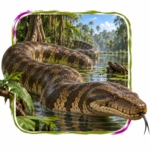
Anaconda Fact Highlight
From the full animal facts page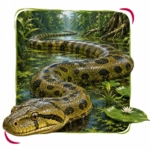
More Animal Comparisons
Pick another animal matchup and keep exploring. Compare appearances, habitats, diets, abilities, and surprising differences.




Make an Animal Story
Turn this Titanoboa vs anaconda comparison into a fossil-solving rainforest adventure with our free Animal Story Generator.
Source notes: References used for this comparison. See more See less
Try Another Matchup
Explore this comparison →