
Fin Whale Facts for Kids
The Fin Whale, Balaenoptera physalus, is a sleek baleen whale found in every major ocean. It is the second-largest living animal after the Blue Whale and can grow longer than a large passenger airplane. Fin Whales have long streamlined bodies, narrow V-shaped heads, tall curved dorsal fins, pale chevrons behind the head, and unusually asymmetrical jaw coloring. They feed by lunging through krill and schools of fish, then filtering prey through hundreds of baleen plates.
Quick Fin Whale Facts
- Animal Type: Mammal
- Group: Rorqual baleen whale in the family Balaenopteridae
- Known For: Second-largest body, fast swimming, asymmetrical jaws, expandable throat pleats, lunge feeding, low-frequency calls, and worldwide range
- Habitat: Deep offshore waters, continental slopes, productive temperate seas, polar feeding areas, and some enclosed seas
- Diet: Krill, copepods, small schooling fish, and squid
What You’ll Learn
Learn 10 enormous fin whale facts for kids about giant size, fast swimming, baleen, feeding, migration, and ocean life, plus a quiz, glossary, and activity
These simple facts are written for kids, parents, teachers, and curious young minds.
10 Fun Fin Whale Facts for Kids
1. It Is the Second-Largest Living Animal
Only the Blue Whale grows larger. Adult Fin Whales commonly reach roughly 23 to 26 metres, and females average slightly longer than males in many populations.
Kid Decode: The ocean’s silver medal for size still belongs to an animal longer than many airliners.
2. A Streamlined Body Supports Fast Swimming
The long narrow body, pointed head, and powerful tail reduce drag. Fin Whales are among the fastest large whales and were once difficult for sailing-era whalers to catch.
Kid Decode: The giant is shaped less like a floating barrel and more like a living ocean torpedo.
3. The Face Has Two Different Color Schemes
The left side of the lower jaw is dark, while the right side is white. Inside the mouth, the tongue carries the opposite arrangement, and the right-side baleen can also appear paler.
Kid Decode: One whale wears night on one side of its smile and daylight on the other.
4. Baleen Replaces Teeth
Hundreds of flexible baleen plates hang from each side of the upper jaw. Fringed inner edges trap krill and fish while water is pushed back out of the mouth.
Kid Decode: A curtain made from fingernail-like keratin turns seawater into a giant filtered meal.
5. Throat Pleats Expand Like an Accordion
Between about 50 and 100 grooves run along the throat and belly. During a feeding lunge, they unfold so the mouth can balloon around an enormous volume of prey-filled water.
Kid Decode: The slim throat suddenly opens into a temporary grocery bag larger than a room.
6. Lunge Feeding Uses Speed and Timing
A Fin Whale accelerates toward a dense prey patch, opens its mouth, slows under the drag of the engulfed water, closes the jaws, and filters the catch. It may roll to one side while feeding.
Kid Decode: The hunt combines a sprint, a parachute-sized mouth, and one perfectly timed gulp.
7. One Whale Can Eat Tons in a Day
Summer feeding focuses on krill, copepods, squid, herring, capelin, sand lance, and other schooling prey. A large whale may consume around two tons of food during a productive day.
Kid Decode: A cloud of tiny animals becomes a meal measured with truck-sized numbers.
8. Low Calls Travel Through the Ocean
Fin Whales produce powerful low-frequency pulses and patterned songs that travel long distances underwater. Hydrophones let researchers detect whales that may be far beyond visual range.
Kid Decode: The whale sends bass notes through a dark ocean hall wider than any concert arena.
9. Migration Is Complicated
Many Fin Whales move between high-latitude feeding regions and lower-latitude winter areas, but routes vary. Some populations or individuals remain year-round in places such as the Mediterranean Sea or Gulf of California.
Kid Decode: The global map contains travelers, local residents, and ocean routes scientists are still untangling.
10. A Calf Is Already Enormous
After about 11 to 12 months of pregnancy, a female usually gives birth to one calf. A newborn can be around 5.5 metres long and weigh roughly two to three metric tons before months of nursing and rapid growth.
Kid Decode: The newborn arrives longer than a family car and still has decades of growing ahead.
The Weirdest Fin Whale Fact
The lower jaw is dark on the left and white on the right, while the tongue shows the reverse pattern, giving the whale one of the most dramatically asymmetrical faces in the animal kingdom.
Try This Fin Whale Activity
Fin Whale Ocean-Racer Activity
Draw a Fin Whale beside a Blue Whale and a human-sized boat for scale. Add a streamlined body, V-shaped head, tall curved dorsal fin, pale chevrons, dark left jaw, white right jaw, reversed tongue colors, baleen plates, 50–100 expanding throat pleats, a lunge through krill and fish, low-frequency call waves reaching hydrophones, a mother with one calf, migration routes, and ship-strike and entanglement safety panels.
Quick Fin Whale Quiz
- Which animal is larger than the Fin Whale? Answer: The Blue Whale.
- Does a Fin Whale have teeth? Answer: No, it has baleen plates.
- Which side of the lower jaw is white? Answer: The right side.
- What do throat pleats do? Answer: Expand so the whale can engulf huge amounts of prey-filled water.
- What is its global IUCN category? Answer: Vulnerable.
Mini Glossary
- Rorqual: A baleen whale with expandable throat pleats used during engulfment feeding.
- Baleen: Flexible keratin plates that filter food from water.
- Lunge Feeding: Accelerating into prey with the mouth open and engulfing a large volume of water.
- Chevron: A pale V-shaped marking behind a fin whale’s head.
- Hydrophone: An underwater microphone used to record whale calls and ocean sounds.
 Thomson's Gazelle Facts for Kids
 Woodpecker Facts for Kids
 Falcon Facts for Kids
 Laysan Rail Facts for Kids
More Animal Facts for Kids
Visit the full animal facts library or explore a focused animal group.
More Extinct Animal Facts for Kids
Discover dinosaurs, Ice Age giants, prehistoric sea creatures, recently extinct species, and other animals from the past.
Fact check note: Fact checked with NOAA Fisheries’ Fin Whale species profile updated June 2026, the International Whaling Commission’s fin-whale conservation account, current Balaenoptera physalus taxonomy, and marine-mammal research on asymmetric pigmentation, lunge feeding, baleen, acoustics, migration, reproduction, historical whaling, ship strikes, entanglement, and population recovery.

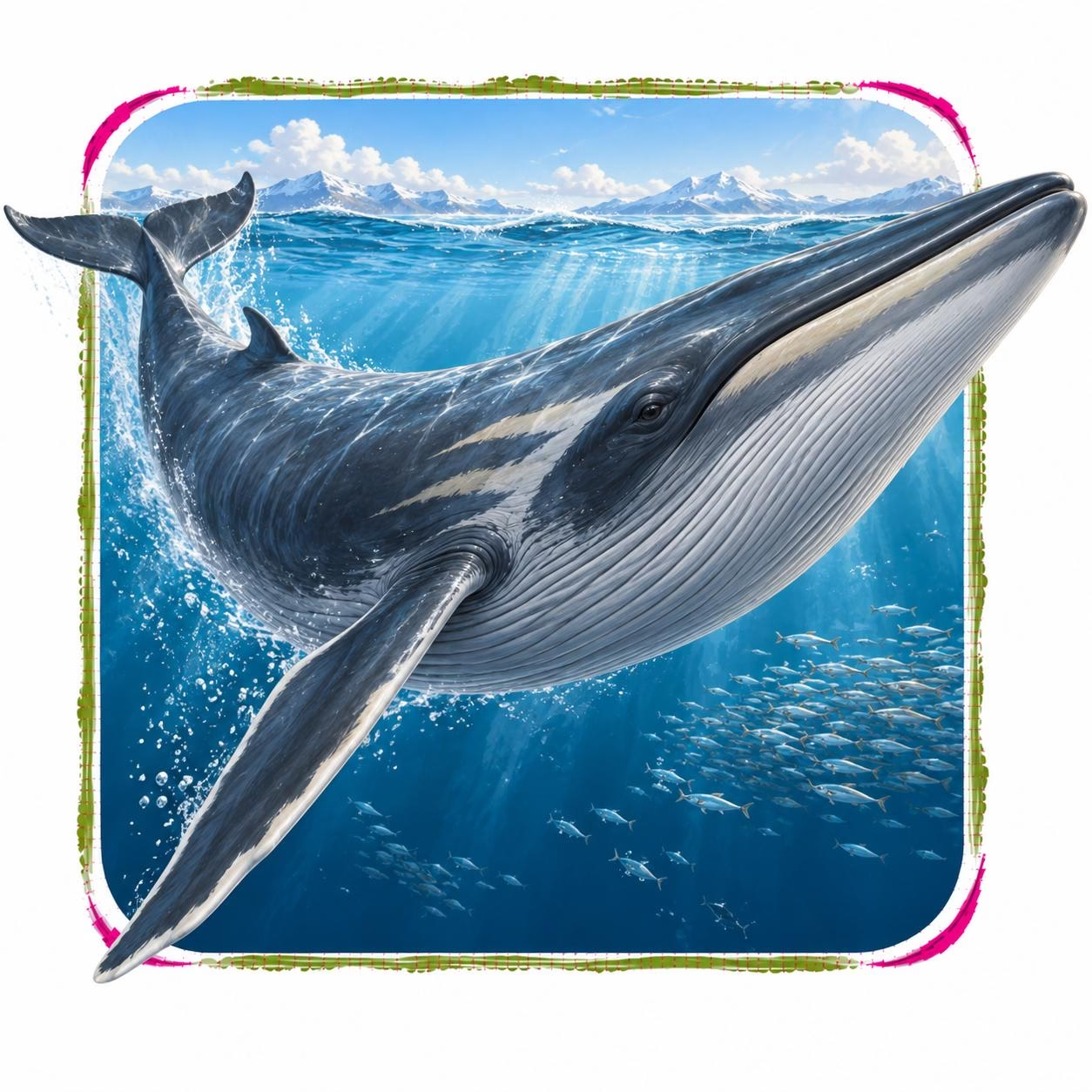
Fin Whale in its natural Deep offshore waters, continental slopes, productive temperate and polar seas, migration corridors, and some resident enclosed-sea habitats across all major oceans habitat