
Great Cormorant Facts for Kids
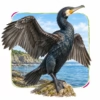
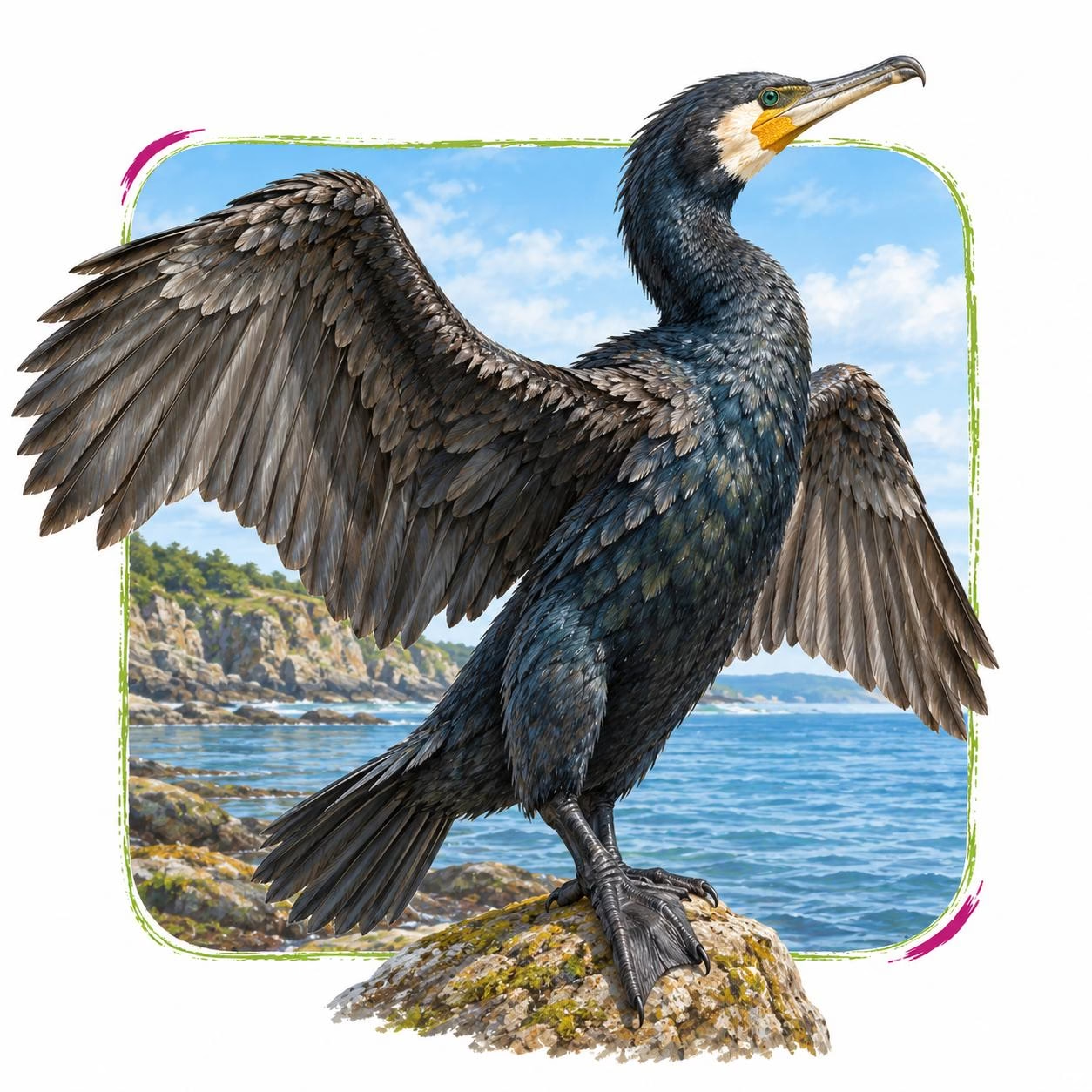
The Great Cormorant, Phalacrocorax carbo, is a large dark water bird found across a huge Old World range and parts of the North Atlantic and Australasia. It lives beside coasts, estuaries, lakes, reservoirs, rivers, wetlands, and other fish-rich waters. Great Cormorants dive from the surface and chase fish underwater using their large webbed feet for propulsion while the wings stay mostly folded. Their plumage can become partly wetted during dives, reducing buoyancy, and they are famous for standing with wings spread after leaving the water. Adults nest colonially in trees, on cliffs, rocky islands, or the ground depending on place. The species is globally Least Concern, but local populations can create complicated conservation and fishery-management debates.
Quick Great Cormorant Facts
- Animal Type: Bird
- Scientific Name: Phalacrocorax carbo
- Known For: Foot-powered pursuit diving, wettable plumage, spread-wing drying posture, hooked bill, four fully webbed toes, colonial nesting, and fish-rich diet
- Habitat: Sea coasts, estuaries, rivers, lakes, reservoirs, lagoons, wetlands, rocky islands, cliffs, and inland waters
- Diet: Mostly fish, with occasional crustaceans, amphibians, and other aquatic prey depending on region
What You’ll Learn
Discover 10 fun Great Cormorant facts for kids with accurate species science, quick facts, a quiz, glossary, drawing activity, and water-bird links.
These simple facts are written for kids, parents, teachers, and curious young bird watchers.
10 Fun Great Cormorant Facts for Kids
1. It Is a Large Old World Cormorant
Great Cormorants belong to the family Phalacrocoracidae and retain the scientific name Phalacrocorax carbo in the current IOC World Bird List. Several geographic subspecies differ in average size, plumage details, range, migration, and breeding timing.
Kid Decode: One species stretches across a map so large that its local outfits and travel plans change along the way.
2. Four Toes Share One Webbed Paddle
All four toes on each foot are connected by webbing, a condition called totipalmate feet. Great Cormorants use these large feet as the main engines during underwater pursuit, while the wings are held close to the body.
Kid Decode: The bird dives with two four-toed paddles bolted beneath its body.
3. Partly Wet Feathers Help It Dive
Cormorant feathers trap some air but can become wetted during deeper dives. Lower trapped air reduces buoyancy and can make underwater swimming easier, while the bird later needs to restore and dry its plumage after surfacing.
Kid Decode: A little less trapped air means less invisible life-jacket pushing the diver upward.
4. The Famous Wing Spread Helps Dry Plumage
After fishing, Great Cormorants often perch with both wings extended. Research supports drying as an important function, although the posture can also interact with temperature regulation and other behaviours, so it is more than a simple ‘their feathers are not waterproof’ story.
Kid Decode: The riverside bird becomes a living black drying rack.
5. Feet Power the Underwater Chase
Great Cormorants dive from the surface, tuck their wings, and kick with the feet while steering with the tail and body. They usually hunt in relatively shallow water but can dive deeper, with dive time and depth changing with prey and habitat.
Kid Decode: Underwater, the wings clock out and the feet take over the chase.
6. A Hooked Bill Grips Slippery Fish
The long bill ends in a strong hooked tip that helps seize fish. Small prey may be swallowed underwater, while larger fish are often brought to the surface, repositioned, and swallowed head-first.
Kid Decode: The bill tip works like a tiny fish hook attached to a whole bird.
7. Fish Dominate the Menu
Great Cormorants are mainly piscivorous and often take locally abundant fish, especially species they can catch efficiently. Diet varies strongly among regions and seasons, and occasional prey can include crustaceans, amphibians, and other animals.
Kid Decode: The menu changes from lake to lake, but fish keep the biggest section.
8. They Can Hunt Alone or in Teams
Some Great Cormorants forage alone, while others gather in fishing flocks that pursue schooling fish together. The balance between solitary and group feeding depends on prey behaviour, season, habitat, and local population.
Kid Decode: One bird can fish solo, or a whole black fleet can dive into the same shoal.
9. Colonies Can Fill Trees, Cliffs, and Islands
Great Cormorants breed in colonies and place stick nests in trees, on cliff ledges, artificial structures, rocky islands, or the ground. Clutches are commonly three to five pale blue-green eggs with a chalky outer coating, and both parents incubate and feed the chicks.
Kid Decode: The nursery may be a treetop apartment block or a cliffside bird city.
10. Salt Glands Help at Sea
Great Cormorants can drink seawater and remove excess salt using specialised salt glands above the eyes. This helps a species that feeds in both marine and freshwater habitats, although inland birds obtain much of their water from freshwater and prey.
Kid Decode: A hidden head gland turns salty drinking water into a problem the bird can solve.
The Weirdest Great Cormorant Fact
Great Cormorants incubate their eggs partly with their large webbed feet, pressing the warm foot webbing against the clutch rather than using a broad bare belly patch like many other birds.
Try This Great Cormorant Activity
Great Cormorant Dive-and-Dry Activity
Draw a cutaway lake or estuary with a Great Cormorant standing on a rock above water and another chasing fish below. Add glossy black plumage with bronze-green highlights, a long neck, hooked gray bill, pale throat and cheek patch, green eye, four fully webbed toes, folded wings underwater, foot-powered swimming, fish swallowed head-first, a spread-wing drying posture, a salt-gland icon, and a nesting colony with stick nests, pale blue-green eggs, and both parents feeding chicks.
Quick Great Cormorant Quiz
- What is the Great Cormorant’s scientific name? Answer: Phalacrocorax carbo.
- What mainly powers the bird underwater? Answer: Its large webbed feet.
- Why can partly wetted feathers help a diving cormorant? Answer: They reduce trapped air and buoyancy.
- What food makes up most of its diet? Answer: Fish.
- What is the species’ global conservation category? Answer: Least Concern.
Mini Glossary
- Totipalmate: Having all four toes connected by webbing.
- Buoyancy: The upward force that makes an object or animal tend to float in water.
- Piscivore: An animal that eats mainly fish.
- Colony: A group of birds nesting close together.
- Salt Gland: A specialised organ that removes extra salt from the body.
 Sea Butterfly Facts for Kids
 Chinkara Facts for Kids
 Goldfinch Facts for Kids
 Cuban Macaw Facts for Kids
More Animal Facts for Kids
Visit the full animal facts library or explore a focused animal group.
More Extinct Animal Facts for Kids
Discover dinosaurs, Ice Age giants, prehistoric sea creatures, recently extinct species, and other animals from the past.
Fact check note: Fact checked with IOC World Bird List version 15.2 taxonomy for Phalacrocorax carbo, BirdLife International’s Great Cormorant species overview and global Least Concern assessment, Animal Diversity Web’s Phalacrocorax carbo account for foot-propelled diving, fish diet, reproduction and salt glands, and peer-reviewed feather-wettability research showing that cormorant plumage can wet during typical dives and that wing spreading can assist drying.

Great Cormorant in its natural Sea coasts, estuaries, sheltered bays, rivers, lakes, reservoirs, lagoons, wetlands, rocky islands, cliffs, and other fish-rich marine and freshwater habitats habitat