
Hispaniolan Solenodon Facts for Kids
The Hispaniolan Solenodon, Solenodon paradoxus, is a strange nocturnal mammal found naturally nowhere except Hispaniola, the Caribbean island shared by Haiti and the Dominican Republic. It has coarse brownish fur, a long almost hairless tail, strong digging claws, tiny eyes, and an unusually long flexible snout supported near the tip by a small proboscis bone. Solenodons hunt mostly invertebrates in leaf litter and soil and are among the very few living venomous mammals. Venomous saliva is delivered through a groove in a lower incisor. The species survived on Hispaniola for millions of years without many mammalian predators, but introduced dogs, cats, mongooses, habitat loss, and persecution created serious pressures. A 2024 IUCN assessment now lists it as Least Concern, so older sources that still call it Endangered are out of date.
Quick Hispaniolan Solenodon Facts
- Animal Type: Mammal
- Scientific Name: Solenodon paradoxus
- Known For: Long flexible snout, venomous saliva, grooved lower incisor, powerful digging claws, nocturnal foraging, ancient island lineage, and unusual shrew-like appearance
- Habitat: Forest, woodland, scrub, rocky country, caves, leaf litter, hollow logs, agricultural edges, and other areas with cover and invertebrate prey
- Diet: Mainly insects, millipedes, earthworms, snails, and other invertebrates, with other small foods reported
What You’ll Learn
Discover 10 Hispaniolan Solenodon facts for kids with current conservation science, quick facts, a quiz, glossary, drawing activity, and Caribbean wildlife links.
Easy explanations make them fun for children, families, teachers, and curious young wildlife explorers.
10 Fun Hispaniolan Solenodon Facts for Kids
1. It Lives Only on Hispaniola
The Hispaniolan Solenodon is endemic to Hispaniola, the island divided between Haiti and the Dominican Republic. Different populations survive in separated forested and rocky regions, making connected habitat important even though the species is more widespread than scientists once thought.
Kid Decode: The entire natural world range of this mammal fits onto one Caribbean island.
2. It Is One of the Few Venomous Mammals
Solenodons produce toxic saliva in glands beneath the lower jaw. The venom helps subdue prey and makes the Hispaniolan Solenodon part of a very small club of living mammals known to use venom.
Kid Decode: This furry night hunter carries a chemical weapon where most mammals carry only saliva.
3. A Grooved Tooth Delivers the Venom
The second lower incisor has a groove along it that helps channel venomous saliva into a bite. This is different from a snake’s hollow fang and should not be illustrated as a giant needle-like tooth.
Kid Decode: The delivery system is a tiny tooth gutter rather than a hollow snake fang.
4. Its Nose Has an Extra Support Bone
The long mobile snout is supported near its tip by an unusual bone called the os proboscis. The snout and whiskers help explore leaf litter, soil, crevices, and burrows while searching for food in darkness.
Kid Decode: The twitching nose comes with a tiny built-in support beam.
5. Night Is Its Main Working Shift
Hispaniolan Solenodons are mainly nocturnal. They rest by day in burrows, hollow logs, caves, rock crevices, or other shelters and emerge after dark, relying strongly on smell, touch, and hearing.
Kid Decode: When daylight clocks out, the long-nosed forest detective begins its patrol.
6. Powerful Forefeet Dig for Dinner
The front limbs are strong and carry long claws that rake through soil, rotting wood, and leaf litter. Solenodons uncover beetles, insect larvae, millipedes, worms, snails, and other small prey hidden below the surface.
Kid Decode: Five digging claws turn a patch of forest floor into a midnight treasure hunt.
7. It Belongs to an Ancient Mammal Lineage
Solenodons represent a very old branch of placental mammal evolution that has survived in the Caribbean while many related forms disappeared. Ancient lineage does not mean the modern species has remained completely unchanged through time.
Kid Decode: This animal carries a very old family story without being a frozen copy of the past.
8. Mothers Raise Very Small Litters
Females have only two teats positioned unusually far back near the rump, and litters are small. Young are born poorly developed and depend heavily on their mother before becoming independent.
Kid Decode: A solenodon nursery is tiny, with room for only a few demanding passengers.
9. Introduced Predators Changed Island Life
Hispaniola originally lacked many of the mammalian predators familiar elsewhere. Domestic and feral dogs and cats, along with introduced mongooses, can kill solenodons, while roads and habitat clearing add further pressure.
Kid Decode: The biggest danger arrived on the island long after the solenodon’s ancestors did.
10. Its Conservation Status Recently Improved
The 2024 IUCN assessment lists Solenodon paradoxus as Least Concern, replacing the Endangered label found in many older books and websites. The change reflects better knowledge of its distribution and status, not the disappearance of habitat loss or introduced-predator threats.
Kid Decode: A better Red List category is good news, but it is not a permission slip to stop protecting the island.
The Weirdest Hispaniolan Solenodon Fact
Its second lower incisor has a special groove that carries venomous saliva into a bite, giving this shaggy Caribbean mammal a delivery system found in almost no other living mammals.
Try This Hispaniolan Solenodon Activity
Hispaniolan Solenodon Night-Hunter Activity
Draw a Hispaniolan Solenodon exploring Caribbean forest leaf litter at night. Add coarse brown fur, tiny eyes, rounded ears, a long flexible pinkish snout, whiskers, strong front claws, a long mostly hairless tail, beetles, millipedes, earthworms, snails, a burrow and rock crevice, and a close-up showing the os proboscis and the groove in the second lower incisor. Add Haiti and the Dominican Republic on an island map and a conservation panel showing native forest beside threats from dogs, cats, mongooses, roads, and clearing.
Quick Hispaniolan Solenodon Quiz
- Where does the Hispaniolan Solenodon naturally live? Answer: Only on the island of Hispaniola.
- What unusual substance does it deliver in a bite? Answer: Venomous saliva.
- Which tooth carries the venom groove? Answer: The second lower incisor.
- When is it mainly active? Answer: At night.
- What is its current IUCN category? Answer: Least Concern.
Mini Glossary
- Endemic: Naturally found only in a particular place.
- Venom: A toxic substance actively delivered by a bite, sting, or other structure.
- Incisor: A front tooth used for biting or cutting.
- Nocturnal: Mainly active at night.
- Proboscis: An elongated nose or snout used for sensing, feeding, or other tasks.
 Macaque Facts for Kids
 Orangutan Facts for Kids
 Eastern Grey Kangaroo Facts for Kids
 Riojasaurus Facts for Kids
More Animal Facts for Kids
Visit the full animal facts library or explore a focused animal group.
More Extinct Animal Facts for Kids
Discover dinosaurs, Ice Age giants, prehistoric sea creatures, recently extinct species, and other animals from the past.
Fact check note: Fact checked with the American Society of Mammalogists Mammal Diversity Database account for Solenodon paradoxus, which records its distribution in Haiti and the Dominican Republic and the 2024 IUCN Least Concern status; Animal Diversity Web for the os proboscis, grooved second lower incisor, venom gland, nocturnal burrowing, claws, diet, small litters and unusual teat placement; and Smithsonian National Museum specimen records confirming adult body proportions and Hispaniolan provenance. Older Endangered labels were not carried forward because the current 2024 IUCN treatment lists Least Concern.

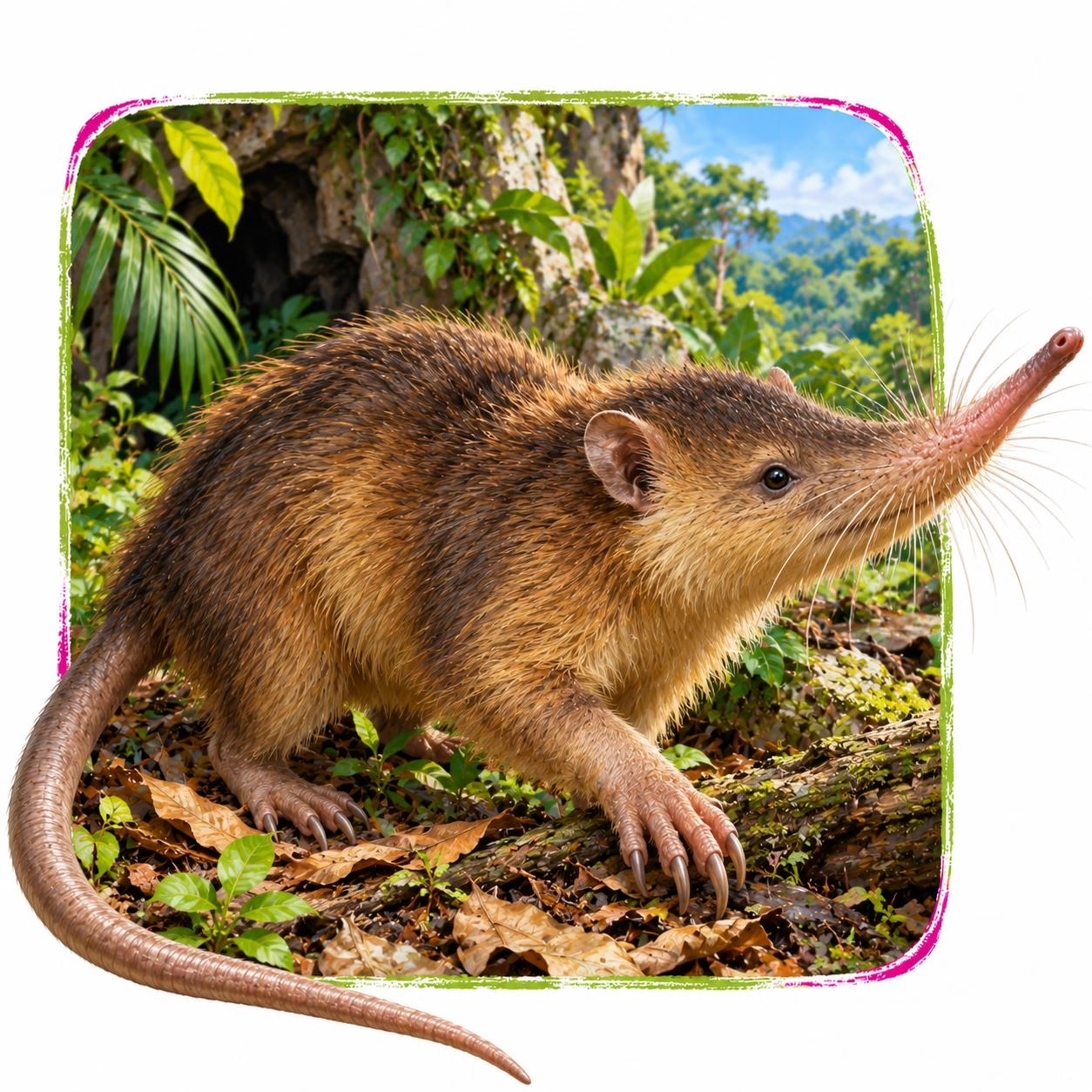
Hispaniolan Solenodon in its natural Tropical and subtropical forest, woodland, scrub, rocky terrain, caves, leaf litter, hollow logs, burrows, and agricultural edges with protective cover habitat