
Solenodon Facts for Kids
Solenodons are rare, nocturnal Caribbean mammals with long flexible snouts, powerful claws, scaly tails, and venomous saliva. Only two species survive: the Hispaniolan solenodon on Hispaniola and the Cuban solenodon, or almiquí, in eastern Cuba. They are not rodents and are not true shrews, but belong to an ancient branch of the mammal group that also contains shrews, moles, and hedgehogs.
Quick Solenodon Facts
- Scientific Group: Family Solenodontidae in order Eulipotyphla
- Living Species: Hispaniolan solenodon, Solenodon paradoxus, and Cuban solenodon, Atopogale cubana
- Animal Type: Mammal, vertebrate, nocturnal forager, and one of very few venomous mammals
- Body: Long mobile snout, small eyes, coarse fur, large clawed feet, and a long nearly naked tail
- Size: Roughly 28–39 centimetres from head to body, plus a long tail, depending on species
- Range: Native only to Cuba and Hispaniola in the Caribbean
- Habitat: Tropical and subtropical forest, limestone areas, plantations, caves, burrows, logs, and rocky shelters
- Diet: Mainly insects, worms, centipedes, and other invertebrates, plus small vertebrates, fruit, roots, and fungi
- Young: Small litters, usually one to three, develop slowly and depend on the mother
- Conservation: The Cuban solenodon is endangered; both species face habitat damage and introduced dogs, cats, mongooses, and other threats
What You’ll Learn
Explore 10 unusual solenodon facts for kids about long snouts, venomous saliva, nighttime hunting, island habitats, and ancient mammal features, with a quiz, glossary, and activity
Easy explanations make them fun for children, families, teachers, and young animal explorers.
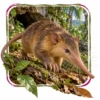
10 Fun Solenodon Facts for Kids
1. Only Two Species Survive
The Hispaniolan solenodon lives on the island shared by Haiti and the Dominican Republic. The Cuban solenodon, now often placed in the genus Atopogale, survives in restricted forested regions of eastern Cuba.
Kid Decode: The entire living solenodon family fits on just two Caribbean islands.
2. They Are Not Giant Shrews
A solenodon resembles a large shrew or long-nosed rat, but it is neither a rodent nor a true shrew. Solenodons form their own family within Eulipotyphla, a mammal order that also contains shrews, moles, hedgehogs, and desmans.
Kid Decode: The familiar-looking body belongs to a family found nowhere else alive.
3. Their Branch Is Extremely Ancient
Genetic studies indicate that the solenodon lineage separated from the ancestors of its closest living relatives tens of millions of years ago, possibly during the age of dinosaurs. Its species still evolved over time, so “living fossil” is only a nickname.
Kid Decode: A solenodon is modern wildlife growing on a very old branch of the mammal tree.
4. A Special Bone Supports the Snout
The snout is long, narrow, and mobile, and an unusual bone called the os proboscidis helps support its tip. The animal pokes it into soil, leaf litter, cracks, and rotting wood while smelling and touching for prey.
Kid Decode: The bendy nose has a tiny built-in support beam.
5. Grooved Teeth Deliver Venomous Saliva
Modified salivary glands produce venomous saliva that flows along grooves in the lower second incisors. Solenodons use this unusual system while subduing prey, making them members of a very small club of venomous mammals.
Kid Decode: The venom travels through channels in lower teeth instead of snake-like hollow fangs.
6. Night Hunting Uses Several Senses
Small eyes provide limited vision, so smell, hearing, whiskers, and the sensitive snout are especially important. A solenodon snuffles and probes noisily through the forest floor, then digs or tears wood with strong claws.
Kid Decode: A dark forest becomes a map of smells, rustles, and nose taps.
7. The Menu Is Broader Than Insects
Earthworms, beetles, crickets, centipedes, millipedes, spiders, snails, and other invertebrates form much of the diet. Solenodons may also eat small frogs or reptiles, carrion, fruit, roots, and fungi when available.
Kid Decode: This insect hunter may add fruit or fungi to the night’s tasting menu.
8. Burrows Become Daytime Bedrooms
Solenodons shelter by day in burrows, hollow logs, caves, rock crevices, tree-root spaces, and other protected places. They usually emerge after dark and may travel along familiar paths while foraging.
Kid Decode: A hollow log can be the front door to a solenodon’s daylight bedroom.
9. Babies Hold Tight to Their Mother
Females have only a few teats positioned unusually far back near the rump. Young solenodons can remain attached while their mother shifts position, and small litters plus slow development limit how quickly populations replace lost adults.
Kid Decode: A baby’s milk station sits so far back that it may hang on while Mum moves.
10. Introduced Predators Changed Island Life
Caribbean solenodons evolved without cats, dogs, and mongooses. These introduced hunters, together with forest loss, roads, fires, agriculture, and accidental killing, can harm populations that reproduce slowly.
Kid Decode: Protecting forest and controlling introduced predators give this ancient family room to survive.
The Weirdest Solenodon Fact
The name solenodon comes from words meaning “grooved tooth.” Its venom-delivery groove runs along a lower incisor, and the toxic saliva enters a bite through that channel. This upside-down-looking arrangement is unlike the upper fangs people usually picture when they hear the word venomous.
Try This Solenodon Activity
Map the Last Two Solenodons
Draw a Caribbean map with one habitat panel for eastern Cuba and another for Hispaniola. Add accurate profiles of both living species and label the mobile snout, os proboscidis, whiskers, small eyes, coarse fur, clawed feet, nearly naked tail, salivary gland, and grooved lower incisor. Build a night food web and add safe forest corridors away from dogs, cats, and mongooses.
Quick Solenodon Quiz
- How many solenodon species survive? Answer: Two.
- On which islands do they live? Answer: Cuba and Hispaniola.
- Are solenodons rodents? Answer: No.
- What unusual bone supports the snout? Answer: The os proboscidis.
- Which teeth carry venomous saliva? Answer: Grooved lower incisors.
Mini Glossary
- Eulipotyphla: The mammal order containing solenodons, shrews, moles, hedgehogs, and relatives.
- Endemic: Naturally found only in one particular place.
- Os proboscidis: A small unusual bone supporting the solenodon’s snout tip.
- Incisor: A front tooth used for biting or cutting.
- Venom: A toxin delivered through a bite, sting, or other specialized structure.
 Black-Backed Jackal Facts for Kids
 Tenrec Facts for Kids
 European Hornet Facts for Kids
 Hyracodon Facts for Kids
More Animal Facts for Kids
Visit the full animal facts library or explore a focused animal group.
More Extinct Animal Facts for Kids
Discover dinosaurs, Ice Age giants, prehistoric sea creatures, recently extinct species, and other animals from the past.
Fact check note: Fact checked against American Museum of Natural History solenodon research; Smithsonian and University of Michigan Animal Diversity Web accounts for Solenodontidae and Solenodon paradoxus; Zoonomia Project field-study resources; Zoological Society of London EDGE of Existence materials; IUCN and IUCN Small Mammal Specialist Group conservation information; U.S. Fish and Wildlife Service Cuban solenodon profile; and peer-reviewed studies of solenodon phylogeny, taxonomy, os proboscidis anatomy, venom proteins, feeding, reproduction, and island threats. Current usage of Atopogale cubana was cross-checked against modern mammal taxonomy.

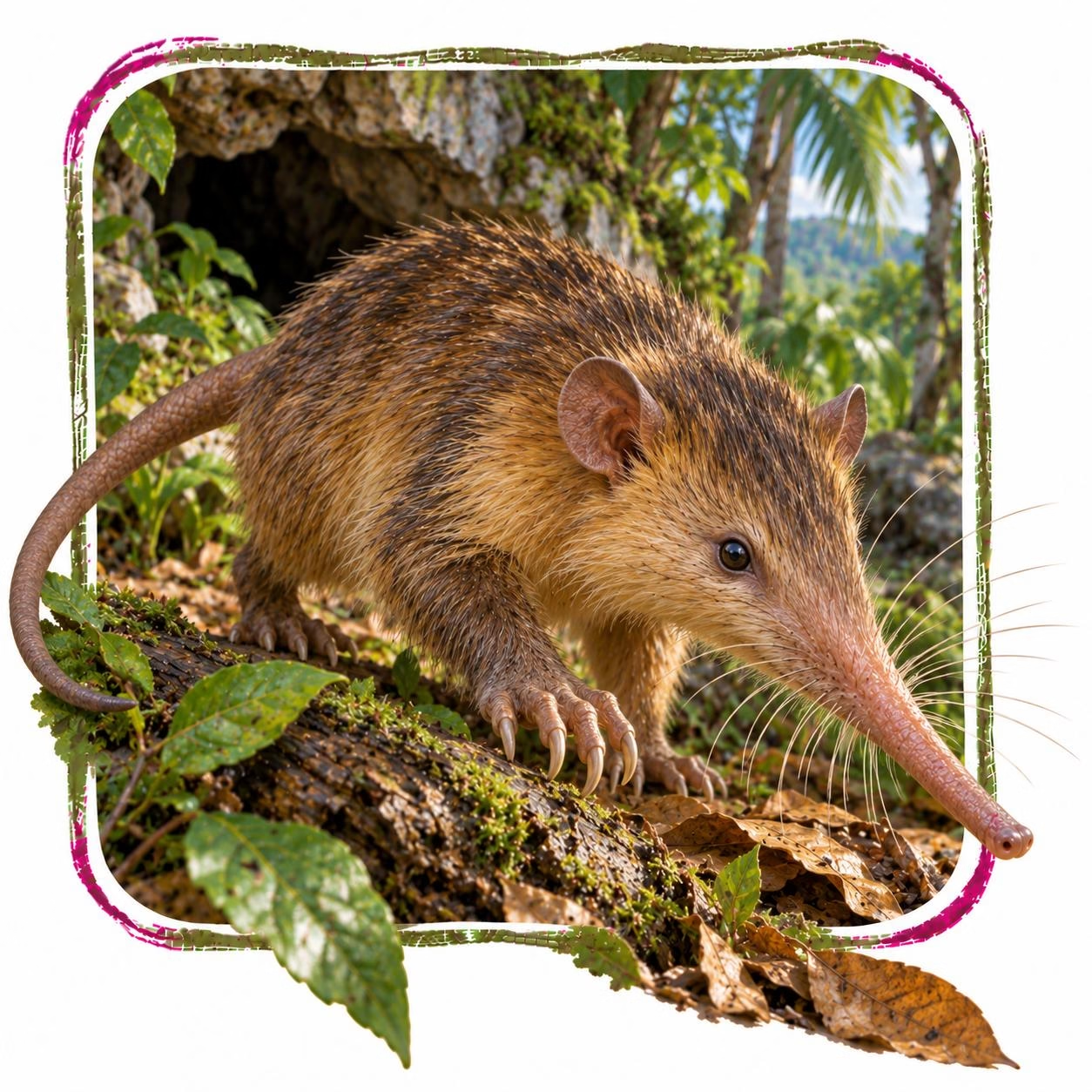
Solenodon in its natural Tropical and subtropical forests, limestone landscapes, plantations, caves, burrows, hollow logs, and rocky shelters in Cuba and Hispaniola habitat