
Kirk’s Dik-dik Facts for Kids
Kirk’s Dik-dik, Madoqua kirkii, is a tiny antelope of dry bush, thorn scrub, and open woodland in eastern Africa. Under the current Mammal Diversity Database treatment, the species itself is restricted to Kenya and Somalia; animals once lumped into a much broader Kirk’s Dik-dik are now split into species such as Madoqua cavendishi, Madoqua thomasi, and Madoqua damarensis. Kirk’s Dik-diks have huge dark eyes, large ears, a flexible elongated snout, slender legs, and a grizzled gray-brown back with warmer tan sides. Only males grow the short pointed horns, often partly hidden by a forehead crest. Pairs defend territories with dung, urine, and secretions from large glands in front of the eyes. They browse nutrient-rich leaves and shoots, obtain much of their water from plants, and usually produce a single fawn. The species is currently listed as Least Concern.
Quick Kirk’s Dik-dik Facts
- Animal Type: Mammal and dwarf antelope
- Scientific Name: Madoqua kirkii
- Known For: Tiny size, large eyes and ears, flexible cooling nose, facial scent glands, pair bonds, low drinking-water needs, and sharp alarm calls
- Habitat: Dry thorn scrub, bushland, open woodland, rocky savanna, and other habitats with low shrubs and protective cover
- Diet: Mainly leaves, shoots, buds, flowers, herbs, and fruit, with relatively little grass
What You’ll Learn
Discover 10 Kirk’s Dik-dik facts for kids with current antelope taxonomy, quick facts, a quiz, glossary, drawing activity, and East African wildlife links for curious young animal explorers.
Easy-to-understand facts make them great for kids, parents, teachers, and young African wildlife explorers.
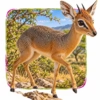
10 Fun Kirk’s Dik-dik Facts for Kids
1. Current Taxonomy Gives It a Smaller Range
Older sources used Kirk’s Dik-dik for a broad set of populations from eastern to southwestern Africa. Current Mammal Diversity Database taxonomy splits several of those forms into separate species, leaving Madoqua kirkii itself in Kenya and Somalia.
Kid Decode: The animal did not move; scientists redrew the species boundaries around it.
2. It Is One of the World’s Smallest Antelopes
Kirk’s Dik-diks stand only around 35 to 45 centimetres at the shoulder and have extremely slender legs and tiny cloven hooves. Females are often slightly larger than males, which is unusual compared with many antelopes.
Kid Decode: A full-grown antelope can stand lower than the seat of many classroom chairs.
3. Only Males Grow Horns
Adult males carry short straight or slightly backward-pointing horns. A tuft or crest of forehead hair can partly hide the horns, while females remain hornless.
Kid Decode: The male’s little horns can disappear inside his own hairstyle.
4. Its Long Nose Works as a Cooling System
The elongated flexible snout contains a richly supplied nasal surface. Fast nasal breathing during heat can help cool blood and reduce body temperature, an important adaptation in hot dry country.
Kid Decode: The dik-dik carries a miniature air-conditioning system on the front of its face.
5. Facial Glands Leave Scent Messages
Large preorbital glands sit just in front of the eyes and release a dark sticky secretion. Dik-diks press these glands against twigs and vegetation, combining scent marks with dung and urine to advertise their territory.
Kid Decode: A tiny black spot below the eye works like a chemical marker pen.
6. They Can Go Long Periods Without Drinking
Kirk’s Dik-diks choose moist, nutritious plant parts and can obtain much of the water they need from food and dew. They will drink when water is available, but they can survive for long periods without visiting open water.
Kid Decode: Breakfast leaves can double as the day’s water bottle.
7. Pairs Often Share a Territory
A male and female commonly form a long-lasting pair and use the same small territory, although social arrangements are not absolutely identical in every population. The pair spends much of its time close enough to coordinate feeding, scent marking, and defense.
Kid Decode: Two tiny antelopes can run a shared neighborhood with invisible scented borders.
8. One Fawn Is the Normal Birth
After a pregnancy of roughly five and a half months, the female usually gives birth to a single well-developed fawn. The youngster hides quietly in vegetation for its first weeks while the mother returns to nurse it.
Kid Decode: The newborn’s first survival skill is not running fast but disappearing into the bushes.
9. The Alarm Call Helped Give Dik-diks Their Name
When startled, dik-diks can dash toward dense cover in zigzag movements while producing sharp whistling alarm calls often written as dik-dik or zik-zik. The exact sound varies, but it inspired the group’s common name.
Kid Decode: This antelope practically shouts its own name while escaping.
10. Least Concern Still Does Not Mean Threat-Free
The current Mammal Diversity Database lists Madoqua kirkii as Least Concern. Hunting and habitat fragmentation can still affect local populations, and keeping its current narrower species limits in mind is important when comparing older population information.
Kid Decode: A safe global label works best when scientists are talking about the right species.
The Weirdest Kirk’s Dik-dik Fact
The dark spot in front of each eye is not a tear stain but a large scent gland that can smear sticky chemical messages onto twigs around the dik-dik’s tiny territory.
Try This Kirk’s Dik-dik Activity
Kirk’s Dik-dik Tiny-Territory Activity
Draw a dry Kenya-Somalia thorn-scrub scene with one male and one female Kirk’s Dik-dik. Add large eyes, oversized ears, elongated flexible noses, tiny cloven hooves, a gray-brown back, warmer tan sides, and short horns only on the male. Show a preorbital scent gland marking a twig, a dung-marking site, leafy browse, dew as a water source, a hidden single fawn, and a zigzag escape into thorny cover with a dik-dik alarm call.
Quick Kirk’s Dik-dik Quiz
- What is Kirk’s Dik-dik’s scientific name? Answer: Madoqua kirkii.
- Which sex normally has horns? Answer: Males.
- What does the elongated nose help with? Answer: Cooling the body and selecting food.
- What do the glands in front of the eyes produce? Answer: Scent used in communication and territory marking.
- What is the current IUCN category? Answer: Least Concern.
Mini Glossary
- Dik-dik: A very small African antelope in the genus Madoqua.
- Browser: An animal that feeds mainly on leaves, shoots, buds, and other non-grass plant parts.
- Preorbital Gland: A scent gland located in front of the eye.
- Territory: An area an animal or pair marks and defends against rivals.
- Thermoregulation: Control of body temperature.
 Piranha Facts for Kids
 Bilby Facts for Kids
 Pigeon Facts for Kids
 Dodo Facts for Kids
More Animal Facts for Kids
Visit the full animal facts library or explore a focused animal group.
More Extinct Animal Facts for Kids
Discover dinosaurs, Ice Age giants, prehistoric sea creatures, recently extinct species, and other animals from the past.
Fact check note: Fact checked with the American Society of Mammalogists Mammal Diversity Database version 2.5 account for Madoqua kirkii, which lists the species as Least Concern, restricts the current country range to Kenya and Somalia, and notes that M. cavendishi, M. thomasi and M. damarensis were previously included; Animal Diversity Web for long-term pairs, territory size, single young, roughly 169-to-174-day gestation and browse-heavy diet; and current zoo husbandry and educational accounts from Frankfurt, Marwell, Denver and San Diego for the elongated thermoregulatory nose, preorbital scent marking, low drinking-water needs, paired territorial life and alarm calling.

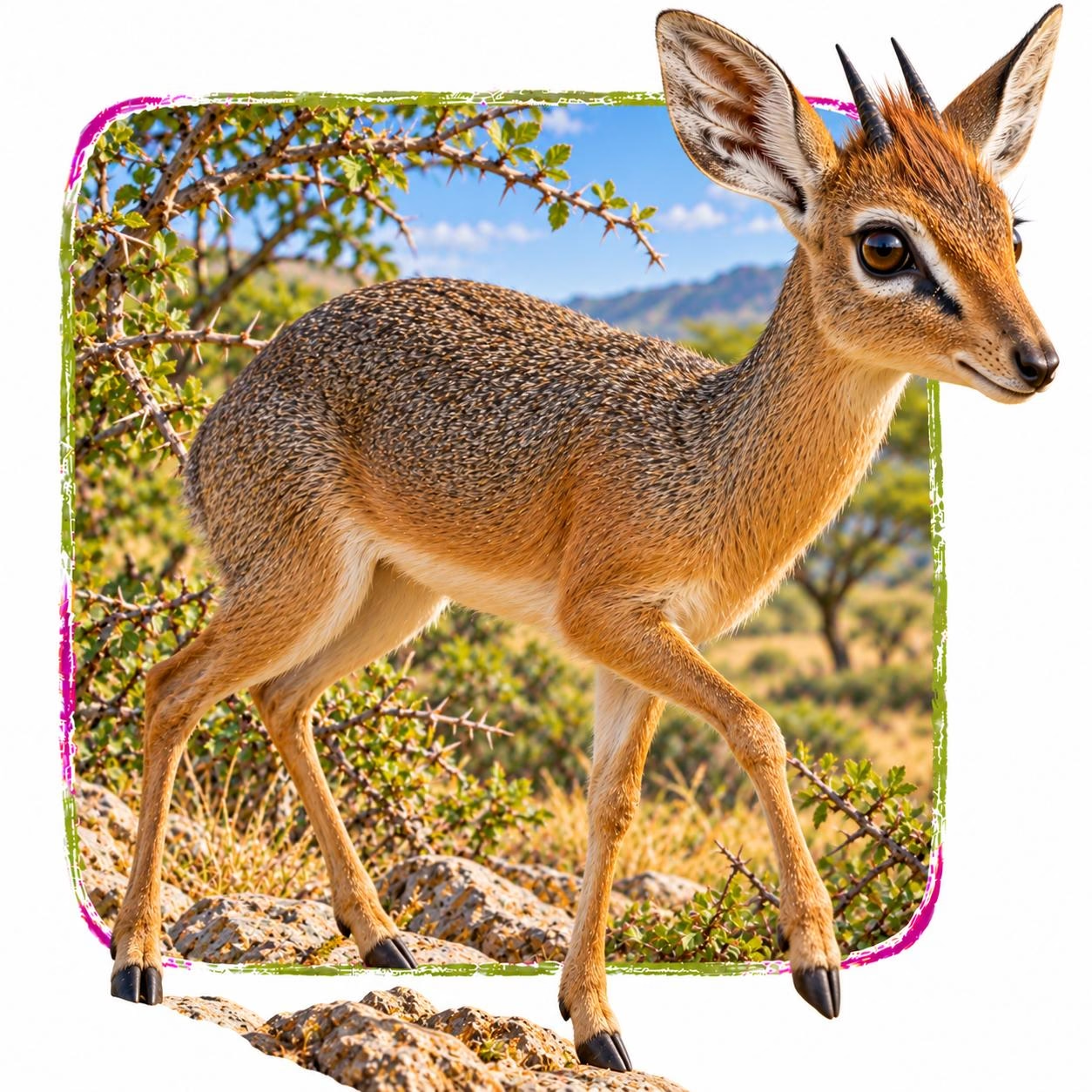
Kirk’s Dik-dik in its natural Dry thorn scrub, bushland, open woodland, rocky savanna, and other semi-arid habitats with low shrubs and dense escape cover in Kenya and Somalia habitat