
Leafy Seadragon Facts for Kids
The Leafy Seadragon, Phycodurus eques, is an extraordinary marine fish found only in the temperate waters of southern Australia. It is a close relative of seahorses and pipefishes, but its body is covered with elaborate leaf-shaped appendages that make it look astonishingly like drifting seaweed. Those leafy flaps are mainly camouflage rather than paddles. The fish actually moves using small nearly transparent fins on its back and near the neck. Leafy Seadragons suck tiny crustaceans such as mysids through a long tubular toothless snout and have bodies protected by bony plates rather than ordinary overlapping fish scales. During breeding, the female transfers hundreds of pink eggs onto a specialised brood area under the male’s tail, where he carries them until they hatch. The species is currently listed as Least Concern but is protected in Australian waters and remains vulnerable to habitat degradation, pollution, illegal collection, and disturbance.
Quick Leafy Seadragon Facts
- Animal Type: Marine fish
- Scientific Name: Phycodurus eques
- Known For: Leaf-like camouflage, bony body plates, tiny transparent fins, tubular snout, suction feeding, slow swimming, male egg carrying, and resemblance to drifting seaweed
- Habitat: Kelp-covered rocky reefs, seaweed beds, seagrass meadows, sand patches beside reefs, jetties, artificial structures, and other temperate southern Australian coastal habitats
- Diet: Mysids and other tiny shrimp-like crustaceans, planktonic animals, and very small prey
What You’ll Learn
Discover 10 fun Leafy Seadragon facts for kids with accurate Australian marine science, quick facts, a quiz, glossary, drawing activity, and ocean wildlife links.
These simple facts are written for children, families, teachers, and curious young marine-life fans.
10 Fun Leafy Seadragon Facts for Kids
1. It Is a Fish Disguised as Seaweed
Leafy Seadragons are true bony fishes in the seahorse and pipefish family Syngnathidae. Long skin-covered appendages grow from the head and body and closely resemble pieces of kelp or other seaweed.
Kid Decode: The dragon costume is so convincing that the fish can disappear while sitting in plain sight.
2. The Leafy Flaps Do Not Do the Swimming
The decorative appendages mainly break up the animal’s outline for camouflage. Propulsion comes from a small transparent dorsal fin along the back, while small pectoral fins near the neck help steer and stabilize the fish.
Kid Decode: The giant fake leaves are scenery; the real motor is almost invisible.
3. Bony Plates Replace Ordinary Fish Scales
Like other syngnathids, the body is encased in hard bony rings and plates rather than covered by the flexible overlapping scales seen on many familiar fishes. This armor gives the body its stiff angular shape.
Kid Decode: Under the seaweed disguise is a fish wearing a fitted suit of bony armor.
4. A Tube Snout Works Like a Tiny Vacuum
The long narrow snout ends in a very small toothless mouth. When prey comes close, the seadragon rapidly expands the mouth cavity and sucks in mysids and other tiny crustaceans.
Kid Decode: The dragon does not chew lunch; it slurps tiny shrimp through a living drinking straw.
5. Camouflage Includes the Way It Moves
Leafy Seadragons are slow swimmers and can sway as they drift through seagrass and seaweed. Body colour, stripes, spots, appendages, and gentle movement combine to make the fish resemble vegetation moving in currents.
Kid Decode: Looking like seaweed works even better when you dance with the water like seaweed.
6. They Live Only in Southern Australian Waters
The species is endemic to temperate southern Australia and is strongly associated with South Australian and south-western Australian coastal habitats. It uses rocky reefs, kelp, seagrass, sand-edge habitat, jetties, and other structures carrying marine growth.
Kid Decode: To find a wild leafy dragon, the world map shrinks to one cool-water Australian coastline.
7. The Female Gives the Eggs to the Male
During courtship, a female transfers hundreds of bright pink eggs onto a specialised spongy brood area beneath the male’s tail. The eggs settle into small cups or pits and are fertilised as they are transferred.
Kid Decode: The mother produces the eggs, then dad becomes the swimming nursery.
8. Dad Carries Hundreds of Eggs
A male commonly carries roughly 250 to 300 eggs for about seven to nine weeks, depending on population and conditions. Unlike many seahorses, leafy seadragons do not hide the developing eggs inside a fully enclosed pouch.
Kid Decode: Hundreds of bright eggs ride openly beneath one carefully camouflaged tail.
9. The Babies Are Independent Immediately
Newly hatched seadragons are only around two centimetres long and receive no extended parental care. They already resemble miniature adults and must find tiny prey and avoid predators on their own.
Kid Decode: The tiny dragon leaves dad’s tail and starts ocean life without a babysitter.
10. Least Concern Still Needs Protection
FishBase currently lists the Leafy Seadragon as Least Concern, and the species is legally protected in South Australian waters. Coastal pollution, habitat damage, illegal collection, entanglement, and disturbance by divers or boats can still harm local populations.
Kid Decode: A reassuring global label does not make a delicate coastal dragon disturbance-proof.
The Weirdest Leafy Seadragon Fact
The male grows a specialised egg-carrying surface on his tail, receives hundreds of bright pink eggs from the female, and then swims around disguised as seaweed while the embryos develop in plain view.
Try This Leafy Seadragon Activity
Leafy Seadragon Camouflage Activity
Draw a Leafy Seadragon drifting through a southern Australian kelp reef. Add golden-brown and olive colours, white body stripes, many leafy appendages, tiny transparent dorsal and pectoral fins, bony body rings, a long tubular snout sucking up mysids, seagrass and kelp, a male carrying rows of bright pink eggs beneath his tail, tiny newly hatched seadragons, and a diver staying at least two metres away without touching or chasing the animal.
Quick Leafy Seadragon Quiz
- What is the Leafy Seadragon’s scientific name? Answer: Phycodurus eques.
- What are the leaf-like appendages mainly used for? Answer: Camouflage.
- What does the fish use to suck up tiny prey? Answer: Its long tubular snout and small mouth.
- Which parent carries the developing eggs? Answer: The male.
- What is its current global IUCN category? Answer: Least Concern.
Mini Glossary
- Camouflage: Colours, shapes, or behaviour that help an animal blend into its surroundings.
- Syngnathid: A member of the fish family containing seahorses, pipefishes, and seadragons.
- Mysid: A small shrimp-like crustacean eaten by many marine animals.
- Brood Patch: A specialised area where a parent carries developing eggs.
- Endemic: Naturally found only in a particular geographic region.
 Corn Snake Facts for Kids
 King Snake Facts for Kids
 Purple Finch Facts for Kids
 Moeritherium Facts for Kids
More Animal Facts for Kids
Visit the full animal facts library or explore a focused animal group.
More Extinct Animal Facts for Kids
Discover dinosaurs, Ice Age giants, prehistoric sea creatures, recently extinct species, and other animals from the past.
Fact check note: Fact checked with the Australian Museum’s 2026-updated Phycodurus eques account for taxonomy, leafy camouflage, snout, dorsal and pectoral fins, rocky-reef habitat, southern Australian distribution and male tail egg carrying; Government of South Australia seadragon fact sheets and monitoring materials for bony plates, mysid diet, body size, slow swimming, 250 to 300 eggs, brood patch, roughly seven-to-nine-week brooding, independent hatchlings, protected status and responsible-diving guidance; and FishBase version 2025-2 for the current Least Concern category.

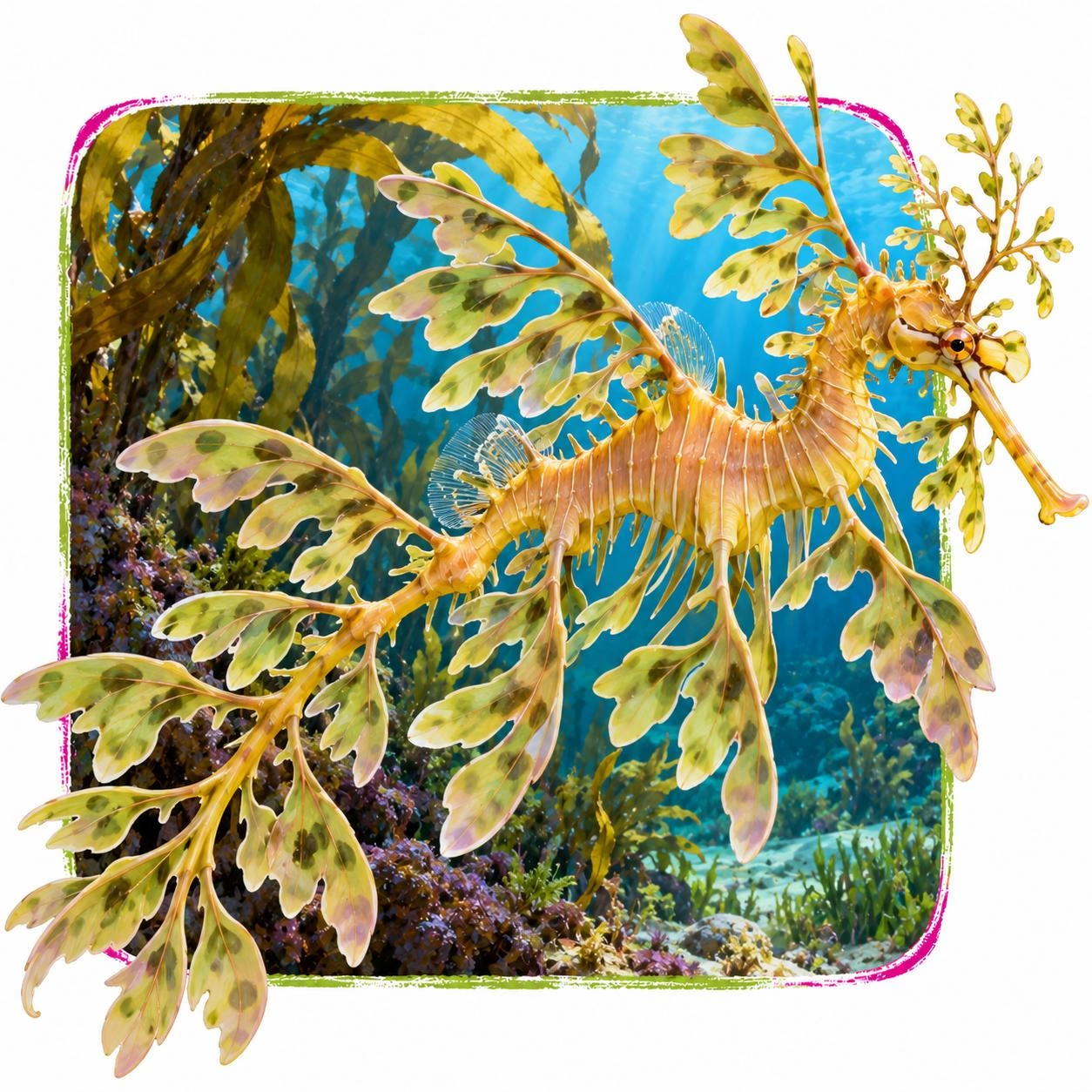
Leafy Seadragon in its natural Temperate southern Australian kelp-covered rocky reefs, seaweed beds, seagrass meadows, sand patches beside reefs, jetties, artificial reefs, and other structures colonised by marine vegetation habitat