
Weedy Seadragon Facts for Kids
The Weedy Seadragon, Phyllopteryx taeniolatus, is a spectacular marine fish found only in temperate southern Australian waters. In Australia it is also officially called the Common Seadragon. It is related to seahorses and pipefishes but has a long rigid body, tubular snout, small mouth, colorful stripes and spots, and several leaf-like appendages that help it blend among kelp and other seaweed. It has fewer extravagant appendages than the Leafy Seadragon. The decorative flaps do not provide most of the propulsion; nearly transparent dorsal and pectoral fins do the swimming. Weedy Seadragons suck up mysids and other tiny crustaceans and are relatively poor swimmers. During breeding, the female attaches eggs to a specialized area under the male’s tail. He carries them openly for about eight weeks rather than enclosing them in a seahorse-style pouch. The species is currently listed as Least Concern.
Quick Weedy Seadragon Facts
- Animal Type: Marine fish
- Scientific Name: Phyllopteryx taeniolatus
- Also Called: Common Seadragon in Australian standard usage
- Known For: Kelp camouflage, colorful bars and spots, tubular snout, tiny transparent fins, poor swimming, suction feeding, and male egg carrying
- Diet: Mysids and other tiny crustaceans and planktonic animals
What You’ll Learn
Discover 10 fun Weedy Seadragon facts for kids with accurate Australian marine science, quick facts, a quiz, glossary, drawing activity, and ocean wildlife links for curious young ocean explorers.
Clear explanations make them enjoyable for children, families, teachers, and young marine-life fans.
10 Fun Weedy Seadragon Facts for Kids
1. It Is a Seahorse Relative, Not a Seaweed Plant
Weedy Seadragons belong to the family Syngnathidae with seahorses and pipefishes. Their long snout, rigid body covering, tiny mouth, and unusual reproductive system reveal the family connection even though the overall shape looks very different.
Kid Decode: The drifting ribbon of seaweed is actually a close cousin of a seahorse.
2. Its Body Is a Moving Camouflage Pattern
Adults can carry red, orange, yellow, brown, purple, blue, and white bars or spots, together with leaf-shaped appendages. The exact colors vary, helping individuals blend with different rocky reefs, kelp, sponge growth, and seagrass.
Kid Decode: The fish wears an underwater camouflage painting instead of one fixed uniform.
3. It Has Fewer Leaves Than a Leafy Seadragon
Both species use plant-like body appendages as camouflage, but the Weedy Seadragon has fewer and less elaborate leafy flaps than Phycodurus eques, the Leafy Seadragon. Its stronger color bars and longer streamlined body create a different disguise.
Kid Decode: One dragon copies a whole leafy branch; the other chooses a sleeker strip of weed.
4. Tiny Transparent Fins Do the Real Swimming
The appendages are mainly decorative camouflage. A small rapidly beating dorsal fin provides much of the forward movement, while pectoral fins near the neck help with steering and balance.
Kid Decode: The visible fake leaves get the attention while nearly invisible fins quietly run the engine.
5. A Tube Snout Vacuums Up Tiny Prey
The long narrow snout ends in a small toothless mouth. When a mysid or other tiny crustacean comes close, the seadragon rapidly expands the mouth area and sucks the prey inside.
Kid Decode: Lunch disappears through a living drinking straw before the shrimp knows what happened.
6. Poor Swimming Makes Camouflage Extra Important
Weedy Seadragons are not powerful long-distance swimmers. They drift and maneuver through relatively sheltered coastal habitats, and storms can sometimes strand individuals on beaches.
Kid Decode: When speed is not your superpower, disappearing into the scenery becomes much more valuable.
7. They Live Only Around Southern Australia
The species is endemic to temperate Australian marine waters, occurring from the central New South Wales coast around southern Australia to southwestern Western Australia. It uses kelp-covered rocky reefs from shallow estuaries to offshore reef habitat.
Kid Decode: The wild map wraps like a coastal ribbon around the cool southern edge of Australia.
8. The Female Attaches Eggs to the Male
During courtship, the female transfers fertilized eggs to a specialized area on the underside of the male’s tail. The eggs remain visibly attached rather than disappearing into a fully enclosed brood pouch.
Kid Decode: Mom supplies the eggs, then dad wears the nursery on the outside of his tail.
9. Dad Carries the Eggs for About Eight Weeks
The male protects and oxygenates the developing eggs until they hatch, typically after about eight weeks. A brood can produce up to roughly 250 fully formed young, although brood size and timing vary.
Kid Decode: Hundreds of tiny dragons can begin life attached beneath one father’s tail.
10. Least Concern Still Comes With Legal Protection
The most recent IUCN assessment lists Phyllopteryx taeniolatus as Least Concern. The species is protected in New South Wales and Tasmanian waters, and local populations can still be affected by habitat degradation, pollution, accidental capture, disturbance, severe storms, and illegal collection.
Kid Decode: A globally reassuring label does not turn a delicate coastal fish into an unlimited resource.
The Weirdest Weedy Seadragon Fact
A male Weedy Seadragon carries hundreds of eggs visibly glued to the underside of his tail for around two months, even though his close seahorse relatives usually brood eggs inside a much more enclosed pouch.
Try This Weedy Seadragon Activity
Weedy Seadragon Camouflage Activity
Draw a southern Australian kelp-covered rocky reef with one Weedy Seadragon blending into the vegetation. Add a long striped red-orange-brown body, blue and white markings, modest leaf-like appendages, a tubular snout sucking up mysids, nearly transparent dorsal and pectoral fins, a comparison silhouette of the more extravagantly leafy Leafy Seadragon, and a male carrying rows of eggs beneath his tail. Add tiny newly hatched seadragons and a respectful-diving symbol showing no touching or chasing.
Quick Weedy Seadragon Quiz
- What is the Weedy Seadragon’s scientific name? Answer: Phyllopteryx taeniolatus.
- What is its standard Australian name? Answer: Common Seadragon.
- Do the leaf-like appendages provide most of its swimming power? Answer: No, small dorsal and pectoral fins do most of the swimming.
- Which parent carries the eggs? Answer: The male.
- What is its current global IUCN category? Answer: Least Concern.
Mini Glossary
- Seadragon: An Australian marine fish related to seahorses and pipefishes.
- Camouflage: Colors, shapes, or behavior that help an animal blend into its surroundings.
- Mysid: A small shrimp-like crustacean that forms important prey for many fishes.
- Suction Feeding: Capturing food by rapidly pulling water and prey into the mouth.
- Brood Area: A specialized body surface where a parent carries developing eggs.
 Panda Facts for Kids
 Bittern Facts for Kids
 Dolphin Facts for Kids
 Concavenator Facts for Kids
More Animal Facts for Kids
Visit the full animal facts library or explore a focused animal group.
More Extinct Animal Facts for Kids
Discover dinosaurs, Ice Age giants, prehistoric sea creatures, recently extinct species, and other animals from the past.
Fact check note: Fact checked with the Australian Museum’s Common Seadragon account for Phyllopteryx taeniolatus taxonomy, Australian standard name, 30-to-45-centimetre size, leaf-like camouflage, pipe-like snout, kelp-covered rocky reef habitat, endemic southern Australian distribution, mysid feeding, poor swimming, male tail egg carrying, roughly eight-week incubation, broods of up to about 250 young, legal protection in New South Wales and Tasmania, and current Least Concern status; and Australian Museum educational material confirming that male seadragons carry eggs externally beneath the tail rather than inside a seahorse-style brood pouch.

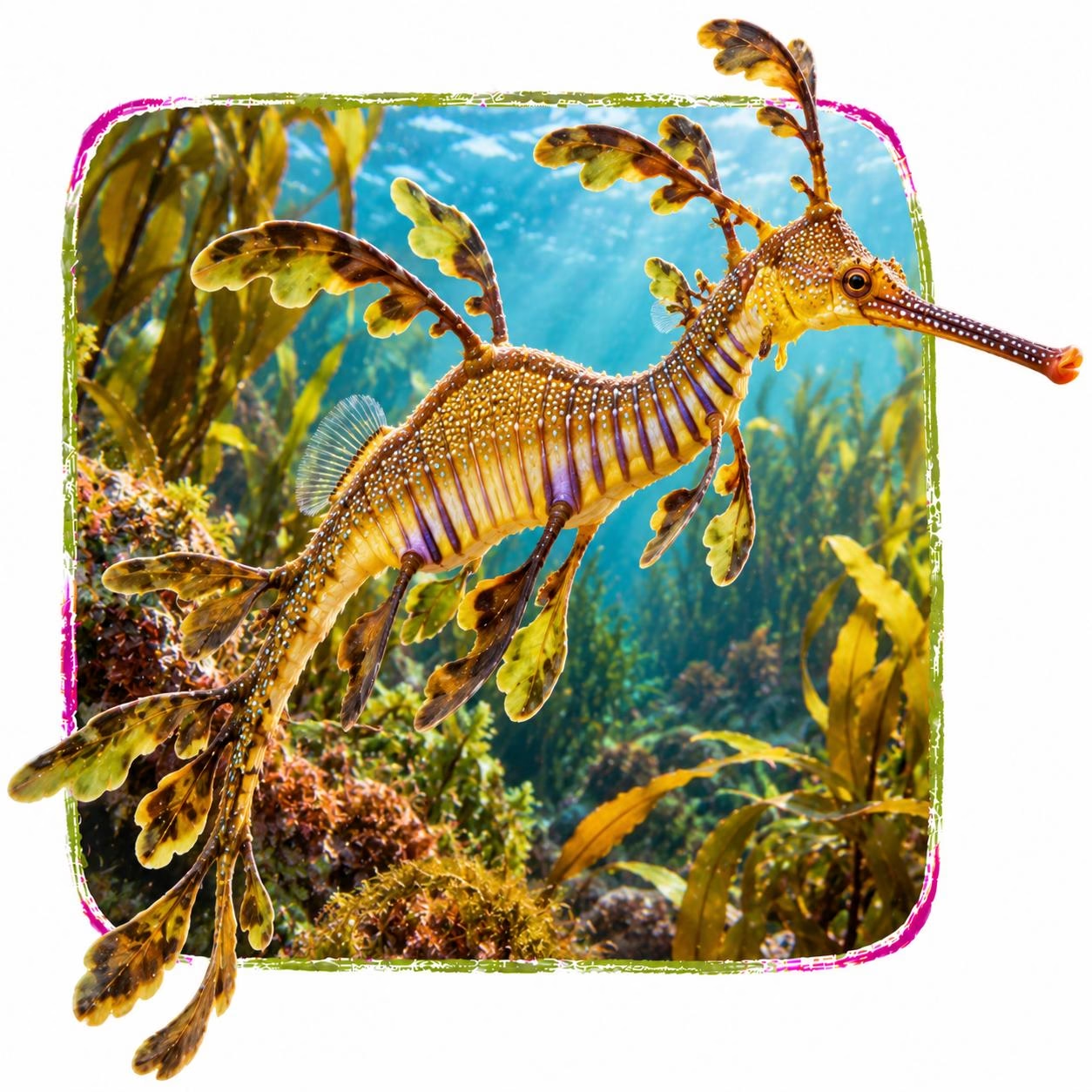
Weedy Seadragon in its natural Temperate southern Australian kelp-covered rocky reefs, seaweed beds, seagrass, shallow estuaries, sheltered coastal reefs, and deeper offshore rocky reefs habitat