
Leech Facts for Kids
Leeches are segmented annelid worms commonly grouped in Hirudinea or the modern order Hirudinida. Roughly 700 species live around the world in freshwater, oceans, damp forests, caves, mountains, and other habitats. Most true leeches have a strong rear sucker and a smaller front sucker, but they vary enormously in size, color, eyes, mouthparts, and diet. Some drink blood from vertebrates, while many others hunt worms, insect larvae, snails, crustaceans, or other small animals. Leeches are relatives of earthworms, not insects or flatworms.
Quick Leech Facts
- Animal Type: Invertebrate
- Group: Segmented clitellate annelids commonly called Hirudinea or Hirudinida
- Known For: Front and rear suckers, flexible bodies, looping locomotion, swimming, predatory feeding, blood feeding in some species, cocoons, parental care, and medical use
- Habitat: Freshwater ponds, lakes, rivers, wetlands, moist forests, soil, caves, estuaries, oceans, and extreme mountain or polar habitats
- Diet: Worms, insect larvae, snails, crustaceans, small vertebrates, body fluids, or blood depending on species
What You’ll Learn
Explore 10 fascinating leech facts for kids about suckers, swimming, feeding, freshwater habitats, and the many different kinds of leeches, with a quiz, glossary, and activity
Easy explanations make them great for children, families, teachers, and young nature fans.
10 Fun Leech Facts for Kids
1. Leeches Are Segmented Worms
They belong to Annelida with earthworms and marine bristle worms. Their body cavity is greatly reduced, allowing dense layers of muscle to stretch, flatten, shorten, and twist the body.
Kid Decode: The squishy ribbon is built on the same ancient segmented blueprint as an earthworm.
2. Visible Rings Do Not Equal True Segments
Each internal body segment may be divided externally into several smaller rings called annuli. Counting every line on the skin therefore exaggerates the number of real segments.
Kid Decode: The body wears many decorative rings over a much simpler hidden floor plan.
3. Two Suckers Work as Feet and Anchors
Most true leeches use a broad rear sucker and a smaller front sucker to grip surfaces. The rear often provides the strongest anchor, while the front contains or supports the mouth.
Kid Decode: One animal carries a suction cup at each end and no legs in between.
4. They Crawl Like Living Measuring Tapes
A leech anchors the rear, stretches forward, attaches the front, releases the rear, and pulls the body into a loop. Many aquatic species can also swim with smooth side-to-side waves.
Kid Decode: The worm measures the pond floor one stretchy body length at a time.
5. Many Leeches Are Hunters
Predatory species swallow small worms, insect larvae, snails, crustaceans, or other invertebrates whole or suck their soft tissues. Blood feeding is only one branch of leech life.
Kid Decode: The famous vampire has hundreds of cousins running tiny underwater hunting businesses.
6. Blood Feeders Use Specialized Saliva
Some species cut or pierce skin and release compounds that reduce clotting, pain, inflammation, or blood-vessel narrowing. Hirudin is famous, but different species use different chemical mixtures.
Kid Decode: The meal arrives with a microscopic pharmacy mixed into the saliva.
7. A Large Meal Can Last for Months
The crop of a blood-feeding leech expands enormously and stores food while microbes and enzymes process it slowly. The animal may wait a long time before feeding again.
Kid Decode: One enormous breakfast can remain on the calendar for an entire season.
8. They Are Hermaphrodites but Usually Need Partners
Each leech possesses male and female reproductive organs, yet two individuals normally exchange sperm. A temporary clitellum then produces protective cocoons for the eggs.
Kid Decode: Both partners bring the same reproductive toolkit to the meeting.
9. Some Parents Carry Their Young
Parental care ranges from guarding cocoons to carrying eggs and hatchlings under the belly. A few species capture prey and pass food to their attached offspring.
Kid Decode: The pond worm can become nursery, backpack, shield, and food-delivery service.
10. Hospitals Still Use Medicinal Leeches
After reconstructive surgery, incoming arterial blood may reach tissue before veins can drain it. Certified leeches can temporarily remove congested blood while new drainage pathways develop.
Kid Decode: An ancient animal sometimes solves a circulation problem that modern machinery cannot handle as gently.
The Weirdest Leech Fact
Some freshwater leech parents glue cocoons beneath their bodies, carry hatchlings on their bellies, and even capture food for their attached young.
Try This Leech Activity
Leech Diversity Laboratory
Draw several leech species instead of one stereotype. Add a flattened freshwater predator swallowing a worm, a jawed medicinal leech, a proboscis-feeding leech, a marine fish leech, and a terrestrial forest leech. Label the front and rear suckers, true internal segments versus many external annuli, skin breathing, looping inchworm movement, swimming waves, eyes ranging from absent to several pairs, a hermaphroditic pair, a clitellum making cocoons, a parent carrying eggs and young, and a hospital panel showing controlled medicinal use by trained professionals.
Quick Leech Quiz
- Which animal phylum contains leeches? Answer: Annelida.
- Do all leeches drink blood? Answer: No, many are predators.
- What body parts help many leeches attach and crawl? Answer: Front and rear suckers.
- Are leeches male or female? Answer: Each individual is a hermaphrodite with male and female reproductive organs.
- Why are medicinal leeches used in hospitals? Answer: They can relieve dangerous venous congestion after certain reconstructive operations.
Mini Glossary
- Annelid: A segmented worm related to earthworms and bristle worms.
- Sucker: A muscular attachment disc used for gripping, movement, or feeding.
- Annulus: One of the visible rings around a leech’s body.
- Anticoagulant: A substance that slows or prevents blood clotting.
- Cocoon: A protective case containing developing eggs.

 Goldfinch Facts for Kids
 Markhor Facts for Kids
 Hispaniolan Solenodon Facts for Kids
 Caribbean Monk Seal Facts for Kids
More Animal Facts for Kids
Visit the full animal facts library or explore a focused animal group.
More Extinct Animal Facts for Kids
Discover dinosaurs, Ice Age giants, prehistoric sea creatures, recently extinct species, and other animals from the past.
Fact check note: Fact checked with the 2024 review of current leech classification reporting roughly 700 species, a peer-reviewed review of leeches in extreme habitats, Smithsonian leech research and medical-use resources, and studies of annelid segmentation, suckers, looping and swimming locomotion, predatory and blood-feeding diets, anticoagulant saliva, hermaphroditism, cocoons, parental care, nervous-system ganglia, and controlled microsurgical use.

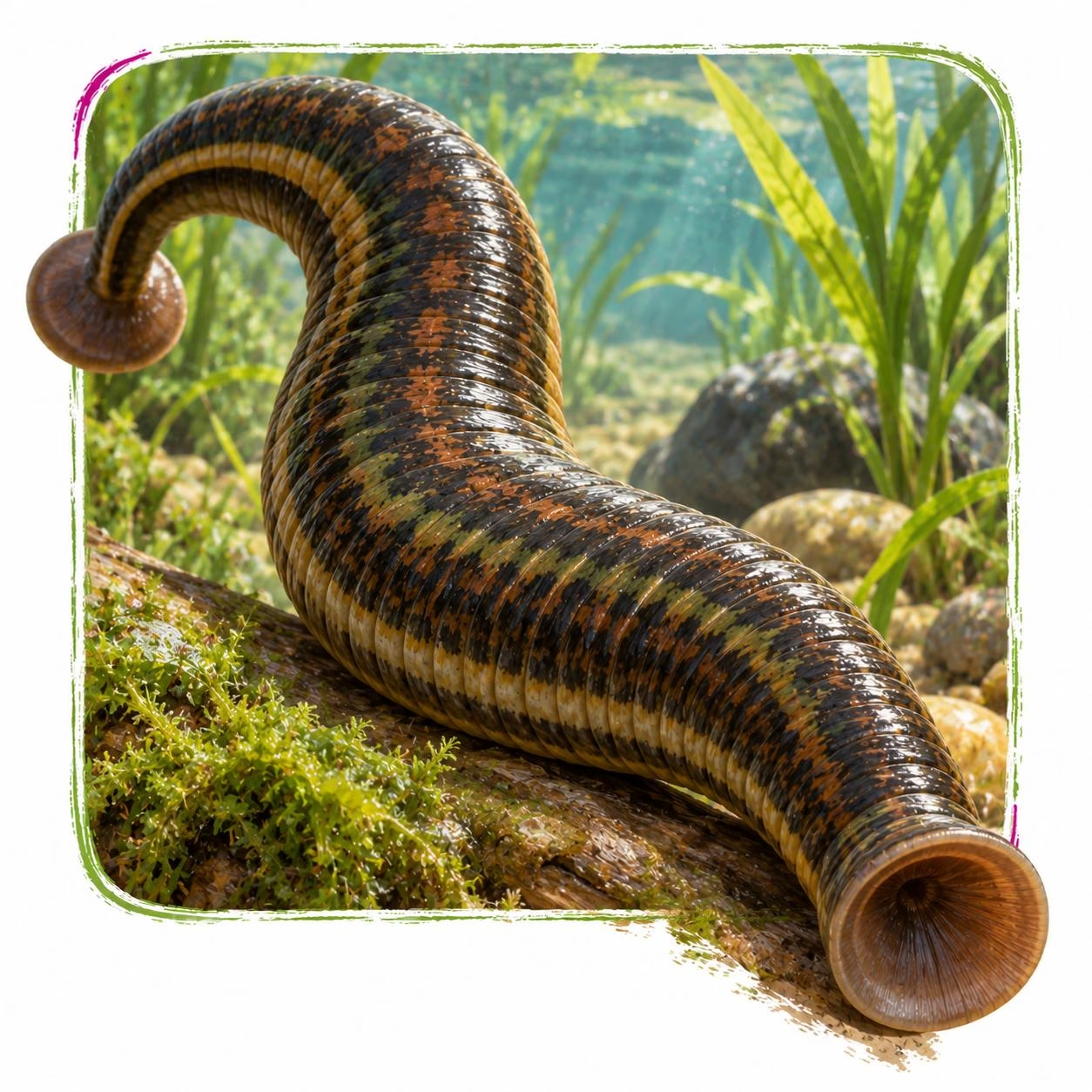
Leech in its natural Freshwater ponds, lakes, rivers, wetlands, moist forests, soils, caves, estuaries, oceans, mountains, and other damp habitats worldwide habitat