
Monocled Cobra Facts for Kids
The monocled cobra is a highly venomous snake from South and Southeast Asia. Its scientific name is Naja kaouthia, and its famous hood often carries a single round mark that looks like an old-fashioned monocle. This cobra is impressive, but it must always be admired from a safe distance.
Quick Monocled Cobra Facts
- Scientific name: Naja kaouthia
- Animal group: Reptile; elapid snake
- Range: Parts of South and Southeast Asia
- Habitat: Forests, scrub, wetlands, rice fields, farms, and settlement edges
- Diet: Rodents, frogs, fish, lizards, birds, and other snakes
- Size: Commonly about 1.2–1.5 m (4–5 ft), though unusually large individuals can exceed 2 m
- Activity: Often most active from dusk through the night
- Young: Hatch from eggs
- Conservation status: Least Concern in the most recent IUCN assessment
What You’ll Learn
Discover 10 fascinating monocled cobra facts for kids about its round hood mark, fixed front fangs, venom, rodent hunting, and Asian habitats, plus a quiz, glossary, and activity
These facts are explained simply for kids, parents, teachers, and curious little fact-finders.
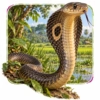
10 Fun Monocled Cobra Facts for Kids
1. A One-Ring Hood Mark
Many monocled cobras have an O-shaped mark on the back of the hood. It resembles one round eyeglass, or monocle, which inspired the snake’s English name. The mark can vary in shape, brightness, or even be missing.
Kid Decode: A monocled cobra does not actually have an eye on its hood—the circle is a scale pattern.
2. Ribs Build the Hood
A cobra’s hood is not a flap or a second head. Long, movable ribs in its neck swing outward and stretch the loose skin when the snake feels threatened. When the ribs fold back, the neck looks narrow again.
Kid Decode: The hood works like a folding warning sign powered by neck ribs.
3. A Warning Before a Strike
When alarmed, a monocled cobra may lift the front of its body, spread its hood, hiss, and face the danger. This display means it wants space. Like many snakes, it usually benefits from avoiding a risky fight.
Kid Decode: If any wild snake raises a hood, back away slowly and tell an adult—never approach or try to move it.
4. Venom Through Front Fangs
Monocled cobras belong to the elapid family and have short, fixed fangs at the front of the mouth. Their venom contains toxins that can disrupt nerves and damage tissue. A suspected bite is a medical emergency requiring immediate professional treatment.
Kid Decode: Never handle a cobra, even if it seems still or small; young cobras can also deliver venom.
5. Some Can Spray Venom
The species is not uniformly specialized for spitting, but researchers have documented venom-spraying behavior in some monocled cobra populations. The ability varies geographically and between individuals. This is another reason to keep far away from any unidentified cobra.
Kid Decode: Distance protects both eyes and skin, so leave venomous snakes to trained wildlife experts.
6. A Hunter After Dark
Monocled cobras are often crepuscular or nocturnal, becoming active around dusk and at night. They follow scent trails and investigate burrows, field banks, and vegetation. Their forked tongue carries scent particles to a sensory organ in the roof of the mouth.
Kid Decode: Each tongue flick brings the cobra a tiny chemical map of its surroundings.
7. Rodents Are Important Prey
Adults often hunt rats and mice, while frogs, fish, lizards, birds, and other snakes may also be eaten. Juveniles tend to take more amphibians. A cobra swallows prey whole because its jaws and skull are highly flexible.
Kid Decode: By eating rodents, monocled cobras play a useful predator role in Asian food webs.
8. At Home Near Water
This adaptable cobra occurs in forests, shrublands, wetlands, mangroves, and agricultural areas. It is especially associated with watery places such as rice paddies, where rodents hide in earthen banks. Food and shelter can also draw it near villages and cities.
Kid Decode: A rice-field bank can offer a cobra both a rodent burrow and a nearby hunting ground.
9. Eggs in a Hidden Nest
Monocled cobras lay eggs rather than giving birth to live young. A female chooses a warm, sheltered place such as leaf litter, a burrow, or a pile of plant material. Zoo records commonly report clutches of roughly 10–30 eggs that incubate for about two months.
Kid Decode: A hatchling is small, independent, and already equipped with working venom glands.
10. A Cobra, Not a King Cobra
The monocled cobra belongs to the true-cobra genus Naja. The king cobra belongs to a different genus, Ophiophagus, and is the world’s longest venomous snake. Similar hoods do not make the two snakes the same species.
Kid Decode: The word cobra describes several hood-spreading snakes, but their scientific family tree has different branches.
Its ‘Monocle’ Can Disappear
The feature that named the species is not guaranteed: some monocled cobras have a crisp O, others have a smudged or oddly shaped mark, and a few lack the circle altogether. Experts use many body features—not one marking alone—to identify a snake.
Try This Monocled Cobra Activity
Build a Folding Cobra Hood
You will need: paper, pencil, crayons, scissors, and glue. Ask an adult to help with scissors.
- Draw a front-facing cobra head and a wide hood on paper.
- Draw several curved lines from the neck toward each hood edge to represent the elongated ribs.
- Add an O-shaped mark, then color the scales in natural browns, olives, grays, or black.
- Cut out the hood and gently accordion-fold its sides so they can open and close.
- Label the hood, neck ribs, scales, tongue, and eyes.
Safety reminder: This is a paper model only. Never search for, approach, or handle a wild snake.
Quick Monocled Cobra Quiz
- What forms a cobra’s hood?
A. Inflatable cheeks
B. Movable neck ribs and loose skin
C. Feathers
Answer: B - When is a monocled cobra often active?
A. Around dusk and at night
B. Only at noon
C. Only in winter
Answer: A - What should you do if you see a wild cobra?
A. Touch its hood
B. Try to catch it
C. Keep away and alert an adult or wildlife professional
Answer: C - How are its young born?
A. They hatch from eggs
B. They grow from buds
C. They arrive in pouches
Answer: A - What does the forked tongue help detect?
A. Scent particles
B. Moonlight
C. Music
Answer: A
Mini Glossary
- Elapid
- A member of a venomous snake family that includes cobras, mambas, coral snakes, and taipans.
- Hood
- The widened neck display a cobra makes by spreading special ribs.
- Neurotoxin
- A toxin that interferes with the nervous system.
- Nocturnal
- Most active at night.
- Oviparous
- Reproducing by laying eggs.
 Ferret Facts for Kids
 Solenodon Facts for Kids
 Ram Facts for Kids
 Daeodon Facts for Kids
More Animal Facts for Kids
Visit the full animal facts library or explore a focused animal group.
More Extinct Animal Facts for Kids
Discover dinosaurs, Ice Age giants, prehistoric sea creatures, recently extinct species, and other animals from the past.
Fact check note: Fact-checked against The Reptile Database species account for Naja kaouthia (taxonomy and range), Toronto Zoo’s Monocled Cobra account (reproduction), the IUCN Red List assessment summarized by those references (Least Concern), and peer-reviewed toxinology literature on Asian cobra venom and venom-spraying variation. Range wording stays broad because species boundaries and mapped limits have been revised. Accessed July 2026.

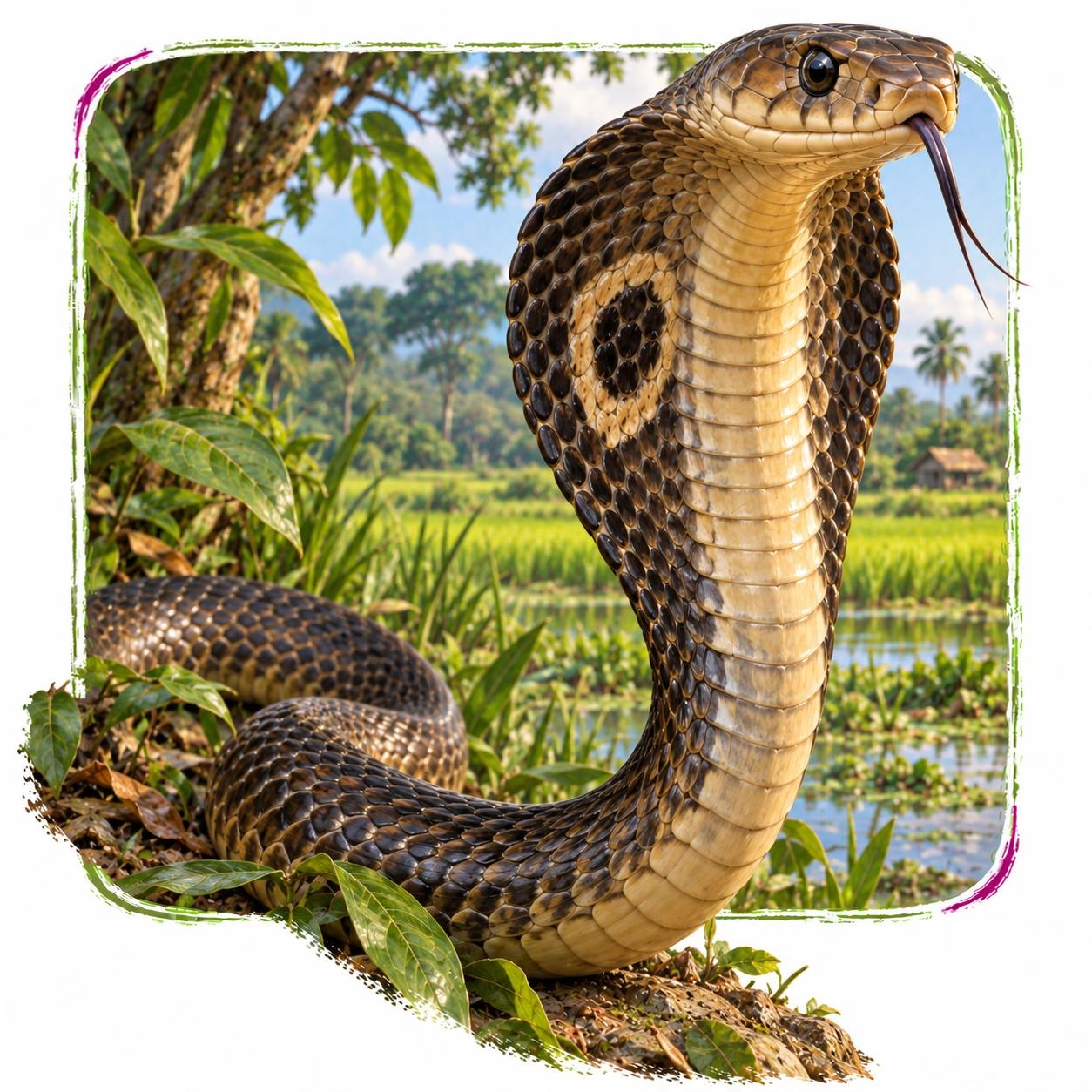
Monocled Cobra in its natural Forests, scrublands, wetlands, rice fields, farmland, and settlement edges habitat