
Olive Baboon Facts for Kids
The Olive Baboon, Papio anubis, is a large Old World monkey with one of the broadest ranges of any baboon. It lives across much of central sub-Saharan Africa in savannas, grasslands, open woodland, scrub, agricultural landscapes, and even some forest habitats. Its coat looks olive-gray because individual hairs contain alternating dark and yellow-brown bands. Olive Baboons have long dog-like muzzles, powerful jaws, non-prehensile tails, and strong hands and feet. Males are much larger than females and develop especially large canine teeth and a shaggy mane around the shoulders. They live in complex multi-male, multi-female troops, eat an extremely flexible omnivorous diet, groom one another to maintain social relationships, and usually sleep together in trees, cliffs, or other protected sites. The species is currently listed as Least Concern.
Quick Olive Baboon Facts
- Animal Type: Mammal and Old World monkey
- Scientific Name: Papio anubis
- Known For: Olive-gray fur, dog-like muzzle, large canine teeth in males, complex troops, grooming, cheek pouches, flexible diet, and life across many African habitats
- Habitat: Savanna, grassland, steppe, scrub, open woodland, forest, rainforest edge, rocky country, and agricultural landscapes
- Diet: Fruits, grasses, leaves, seeds, roots, tubers, flowers, gums, insects, eggs, small vertebrates, and occasional carrion
What You’ll Learn
Discover 10 fun Olive Baboon facts for kids with accurate primate science, quick facts, a quiz, glossary, drawing activity, and African wildlife links.
These kid-friendly facts are made for kids, parents, teachers, and young primate explorers.
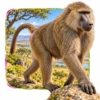
10 Fun Olive Baboon Facts for Kids
1. Its Fur Looks Olive Because Each Hair Is Banded
The Olive Baboon is not covered in truly green fur. Many body hairs have alternating black and yellow-brown bands, and from a distance those colors blend into the grizzled olive-gray coat that gives the species its common name.
Kid Decode: Thousands of striped hairs combine to paint one olive-colored monkey.
2. Males Can Be Much Bigger Than Females
Olive Baboons show strong sexual dimorphism. Adult males commonly weigh around 25 kilograms while females average closer to 14 kilograms, although body size varies geographically. Males also develop a heavier mane and much larger canine teeth.
Kid Decode: A full-grown male can weigh almost twice as much as a female from the same troop.
3. The Tail Is Not a Fifth Hand
Unlike some New World monkeys, baboons cannot wrap the tail around branches to grip them. The tail is non-prehensile and usually arches upward near the base before hanging down behind the animal.
Kid Decode: The tail helps with body language and balance, but it cannot grab a branch.
4. Cheek Pouches Work Like Temporary Food Bags
Olive Baboons can quickly place food inside expandable cheek pouches and carry it away before chewing and swallowing it later. This can be useful when feeding near competitors or moving between food patches.
Kid Decode: A baboon can leave the lunch spot with groceries packed inside its cheeks.
5. They Can Eat an Enormous Variety of Foods
Olive Baboons are adaptable omnivores. They eat fruit, grasses, seeds, leaves, flowers, roots, corms, tubers, tree gums, insects, eggs, and small animals, and their ability to rely heavily on grasses and underground plant parts helps them survive dry seasons.
Kid Decode: The baboon menu can switch from fruit bowl to grass patch to beetle hunt in the same day.
6. Troops Have Complicated Social Networks
Olive Baboons normally live in multi-male, multi-female troops. Females usually remain in the group where they were born and form long-lasting relationships with female relatives, while males commonly leave and join another troop as they mature.
Kid Decode: The troop’s family tree is anchored by generations of related females.
7. Grooming Is About More Than Clean Fur
Baboons use their fingers to pick through one another’s fur, removing dirt and parasites, but grooming is also social currency. It helps build friendships, reduce tension, reinforce alliances, and maintain bonds between troop members.
Kid Decode: A grooming session is part bath, part friendship meeting, and part politics.
8. Nighttime Brings the Troop Together
Troops travel and forage during the day, then gather at a limited set of sleeping places such as large trees, cliffs, or rocky outcrops. Sleeping together and choosing difficult-to-reach sites can reduce danger from predators.
Kid Decode: After roaming all day, dozens of monkeys can clock in at the same treetop hotel.
9. Baboon Babies Start With Dark Fur
A female usually gives birth to one infant after roughly six months of pregnancy. Young Olive Baboons are born with much darker coats than adults and cling closely to their mothers before gradually riding, walking, playing, and exploring more independently.
Kid Decode: A tiny black-coated passenger slowly grows into the troop’s newest explorer.
10. Group Travel Can Be Surprisingly Democratic
A GPS study of one wild Olive Baboon troop in Kenya found that high-ranking individuals did not automatically decide where the group moved. When several animals proposed different directions, troop movement often followed the direction supported by the larger number of individuals.
Kid Decode: In one troop, the travel vote was counted with footsteps rather than ballots.
The Weirdest Olive Baboon Fact
High social rank does not necessarily make a baboon the troop’s travel boss: detailed GPS tracking of one Kenyan troop showed that collective movement could follow a majority-style decision process instead.
Try This Olive Baboon Activity
Olive Baboon Troop Activity
Draw a savanna-and-woodland scene with an Olive Baboon troop. Add a large adult male with an olive-gray grizzled coat, shoulder mane, long dog-like muzzle and large canines; smaller adult females; a dark-coated infant clinging to its mother; cheek-pouch feeding; grooming pairs; fruit, grass, roots and insects; a sleeping tree or cliff; and a simple movement diagram showing several baboons choosing directions while the troop follows the direction supported by more individuals.
Quick Olive Baboon Quiz
- What is the Olive Baboon’s scientific name? Answer: Papio anubis.
- Is its tail prehensile? Answer: No, it cannot grip branches like a hand.
- What can cheek pouches do? Answer: Temporarily store food.
- Which sex usually remains in its birth troop? Answer: Females.
- What is the species’ current IUCN category? Answer: Least Concern.
Mini Glossary
- Old World Monkey: A monkey from Africa or Asia belonging to the family Cercopithecidae.
- Sexual Dimorphism: A consistent difference in size or appearance between males and females.
- Prehensile: Able to grasp or hold objects.
- Troop: A social group of monkeys or baboons.
- Grooming: Cleaning or picking through another animal’s fur, often with an important social role.
 Japanese Spider Crab Facts for Kids
 Alligator Facts for Kids
 Electric Eel Facts for Kids
 Barinasuchus Facts for Kids
More Animal Facts for Kids
Visit the full animal facts library or explore a focused animal group.
More Extinct Animal Facts for Kids
Discover dinosaurs, Ice Age giants, prehistoric sea creatures, recently extinct species, and other animals from the past.
Fact check note: Fact checked with the American Society of Mammalogists Mammal Diversity Database version 2.5 account for Papio anubis and its current Least Concern status and broad central sub-Saharan African range; Animal Diversity Web for sexual dimorphism, olive-gray banded fur, male mane and canines, multi-male multi-female troops, female philopatry, sleeping sites, omnivorous diet, predation and reproduction; African Wildlife Foundation for non-prehensile tails and broad baboon morphology; and Strandburg-Peshkin and colleagues’ GPS work, summarized by the Smithsonian, showing majority-like collective movement decisions in one wild Kenyan Olive Baboon troop.

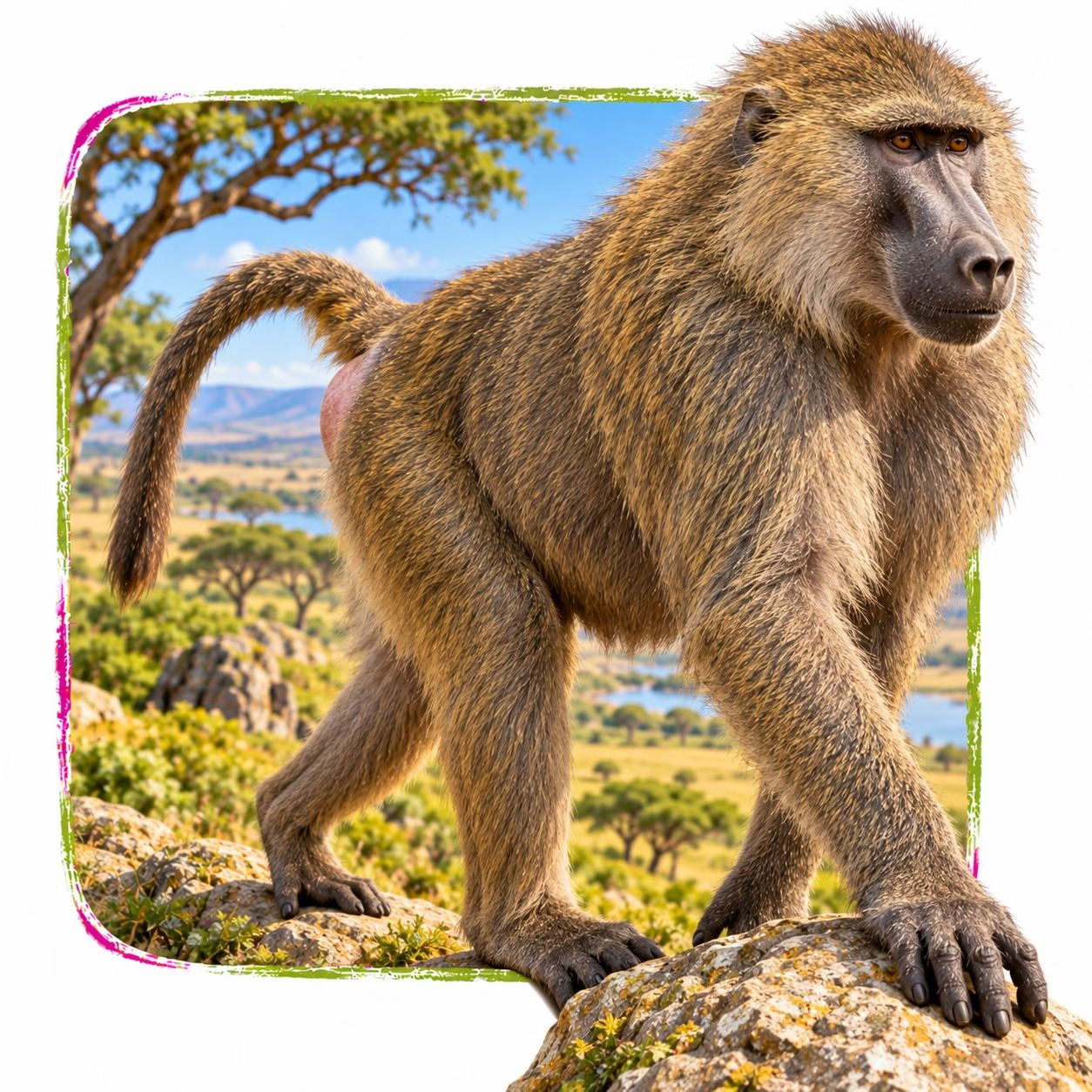
Olive Baboon in its natural Savanna, grassland, steppe, scrub, open woodland, forest, rainforest edge, rocky country, riverine areas, and agricultural landscapes across central sub-Saharan Africa habitat