
Shark Facts for Kids
Sharks are cartilaginous fishes with five to seven gill slits on each side, tooth-like scales, and fins that are not fused to the head. More than 500 living species range from a hand-sized lanternshark to the enormous plankton-eating whale shark. They occupy oceans worldwide, and a few enter or live in rivers, with diets and lifestyles far more varied than movie monsters suggest.
Quick Shark Facts
- Scientific Group: Shark lineages within subclass Elasmobranchii and class Chondrichthyes
- Animal Type: Cartilaginous fish and close relative of rays and skates
- Living Species: More than 500, with new species still being described
- Size: From palm-sized dwarf lanternsharks to whale sharks that can grow about 14 metres long
- Body: Cartilage skeleton, five to seven paired gill slits, replaceable teeth, and dermal denticles
- Range: Worldwide in tropical, temperate, and polar waters
- Habitat: Coral reefs, coasts, open ocean, seafloor, deep sea, estuaries, and a few rivers
- Diet: Species eat plankton, worms, shellfish, fish, turtles, seabirds, or marine mammals
- Young: Depending on species, females lay egg cases or give birth to live pups
- Conservation: Many species are threatened mainly by targeted fishing, accidental bycatch, and slow reproduction
What You’ll Learn
Explore 10 incredible shark facts for kids about cartilage skeletons, teeth, senses, swimming, habitats, and the enormous variety of sharks, with a quiz, glossary, and activity
Easy explanations make them fun for children, families, teachers, and young ocean explorers.
10 Fun Shark Facts for Kids
1. Their Skeletons Have No True Bone
A shark skeleton is made mainly of cartilage, the firm flexible tissue also found in human noses and ears. Mineral deposits strengthen parts that need support, but the skeleton remains lighter than a comparable bony one.
Kid Decode: A shark has jaws and a backbone without a skeleton made of true bone.
2. Shark Diversity Is Enormous
More than 500 species include flat angelsharks, glowing lanternsharks, long-tailed threshers, hammerheads, saw-snouted sawsharks, filter-feeding giants, and many small bottom dwellers. There is no single typical shark lifestyle.
Kid Decode: The shark family includes living hammers, saws, carpets, lanterns, and fox-like threshers.
3. Their Story Began Before Dinosaurs
Shark relatives appeared in ancient seas more than 400 million years ago, long before the first dinosaurs. Modern groups evolved and changed over time, so today’s sharks are not unchanged fossils from that distant past.
Kid Decode: Shark ancestors were swimming in oceans hundreds of millions of years before Tyrannosaurus.
4. Skin Is Covered in Tiny Teeth
Dermal denticles are hard, backward-pointing scales built from tooth-like materials. Their ridged surfaces protect the body and can help water flow smoothly, which is why shark skin feels rough from tail toward head.
Kid Decode: A shark wears thousands of microscopic tooth-like scales on its skin.
5. New Teeth Wait in Rows
Shark teeth are attached in soft tissue rather than deep jaw sockets. When a working tooth breaks or falls out, another rotates forward from rows behind it, and many species replace thousands during a lifetime.
Kid Decode: A shark carries a moving supply shelf of replacement teeth.
6. They Detect Hidden Electricity
Ampullae of Lorenzini are jelly-filled pores concentrated around the snout. They sense weak electric fields produced by muscles and nerves, helping a shark locate prey even when it is buried, camouflaged, or hidden in dark water.
Kid Decode: A buried fish can hide from eyes but not always from a shark’s electric sense.
7. A Side Line Feels Water Motion
The lateral-line system runs along the head and body and detects vibrations and pressure changes. Together with smell, hearing, vision, taste, touch, and electroreception, it gives sharks a detailed picture of nearby movement.
Kid Decode: Invisible ripples can draw a moving map along a shark’s side.
8. Not Every Shark Must Swim Constantly
All sharks need oxygen-rich water flowing across their gills, but they move it in different ways. Some rely heavily on forward swimming, while many bottom-resting species pump water over the gills while staying still.
Kid Decode: A nurse shark can rest on the bottom and still keep water crossing its gills.
9. They Reproduce in Different Ways
Some species lay tough egg cases, while others retain eggs until pups hatch or nourish embryos through placenta-like connections. Shark pups generally develop slowly and are born or hatch as independent miniature hunters.
Kid Decode: A baby shark may leave an egg case or be born alive, depending on its species.
10. People Are the Bigger Threat
Sharks help shape food webs as predators, scavengers, and plankton feeders, yet many reproduce too slowly to withstand heavy fishing. Targeted catch, fin and meat trade, bycatch, habitat loss, and climate change threaten populations.
Kid Decode: For many shark species, fishing boats are far more dangerous than sharks are to people.
The Weirdest Shark Fact
Inside each of a sand tiger shark’s two wombs, the largest early embryo eats unfertilized eggs and smaller developing siblings. Usually only one pup survives in each womb, so the mother gives birth to two exceptionally large, well-developed young.
Try This Shark Activity
Build a Shark Adaptation Lab
Choose three very different sharks, such as a dwarf lanternshark, hammerhead, and whale shark. Draw each in its habitat and compare body size, tooth shape, food, swimming style, and way of having pups. Add close-up panels for cartilage, dermal denticles, replacement tooth rows, lateral line, and electric-sensing pores, then mark one fishing threat and one conservation solution.
Quick Shark Quiz
- What forms most of a shark’s skeleton? Answer: Cartilage.
- What are its tooth-like skin scales called? Answer: Dermal denticles.
- Which organs detect electric fields? Answer: The ampullae of Lorenzini.
- Must every shark swim constantly to breathe? Answer: No.
- What is a young shark called? Answer: A pup.
Mini Glossary
- Cartilage: Strong flexible body tissue that forms a shark’s skeleton.
- Elasmobranch: A cartilaginous fish in the group containing sharks, rays, and skates.
- Dermal denticle: A tiny tooth-like scale covering shark skin.
- Electroreception: The ability to detect weak electric fields.
- Bycatch: An animal caught accidentally during fishing for another species.

 Dugong Facts for Kids
 Butterflyfish Facts for Kids
 Prairie Dog Facts for Kids
 Machairodus Facts for Kids
More Animal Facts for Kids
Visit the full animal facts library or explore a focused animal group.
More Extinct Animal Facts for Kids
Discover dinosaurs, Ice Age giants, prehistoric sea creatures, recently extinct species, and other animals from the past.
Fact check note: Fact checked against Monterey Bay Aquarium’s shark overview; Smithsonian Ocean’s shark resources; NOAA Fisheries shark education; IUCN Shark Specialist Group and global chondrichthyan assessments; Florida Museum shark biology resources; and peer-reviewed research on shark taxonomy, fossils, cartilage, dermal denticles, tooth replacement, sensory systems, ventilation, buoyancy, reproduction, ecology, and fisheries threats. The more-than-500-species count, size extremes, habitat breadth, species-specific diets, varied reproductive modes, and the sand tiger embryo example were cross-checked.

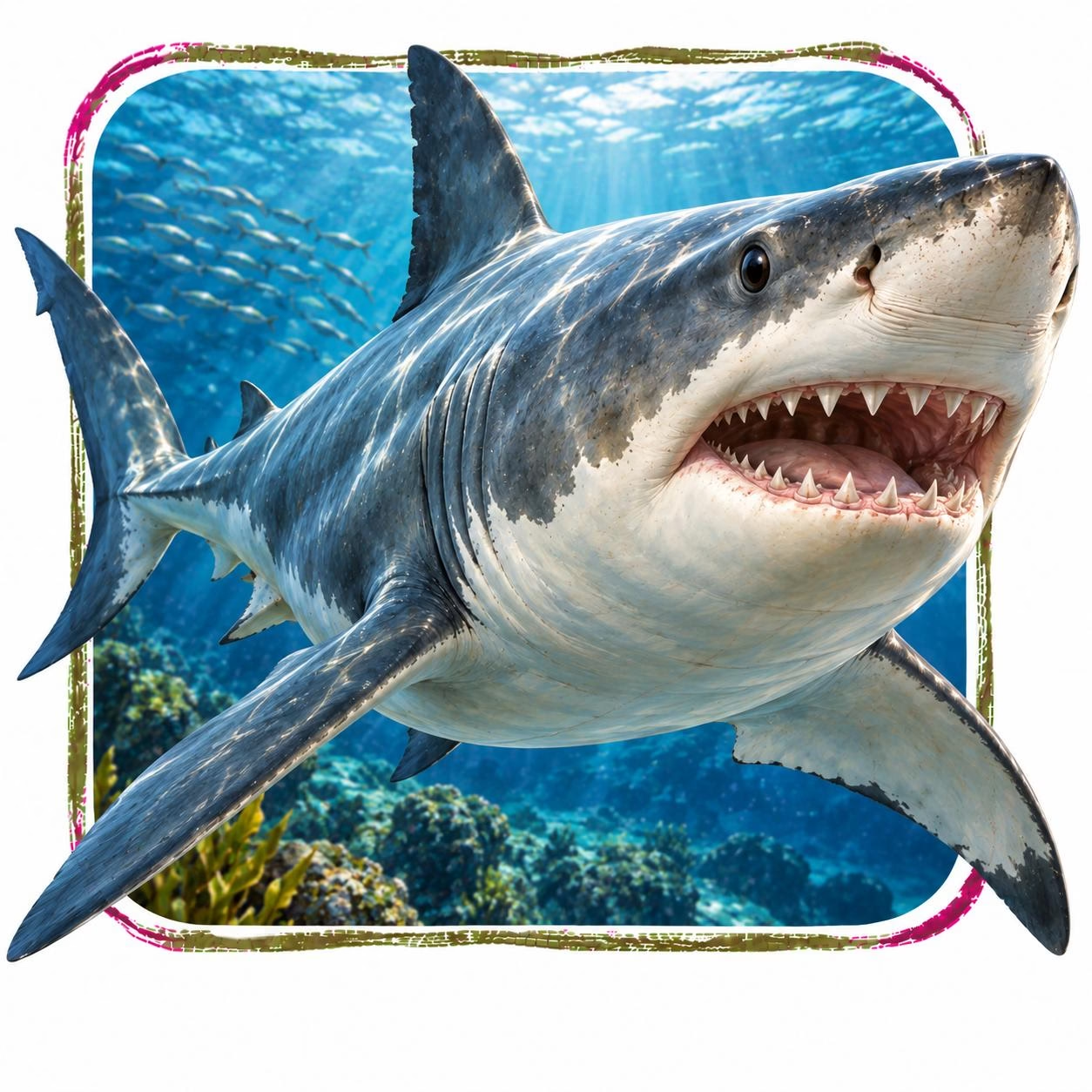
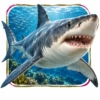
Shark in its natural Oceans worldwide from shallow coasts and coral reefs to open water and the deep seafloor, plus estuaries and a few rivers habitat