
Spider Facts for Kids
Spiders are eight-legged arachnids in the order Araneae. Scientists have described more than 54,000 living species, from tiny leaf-litter hunters to large tropical tarantulas, and new species continue to be named. Every spider can produce silk, but not every spider builds a prey-catching web, and the overwhelming majority pose little or no danger to people.
Quick Spider Facts
- Scientific Group: Order Araneae within class Arachnida
- Animal Type: Invertebrate, arthropod, chelicerate, and arachnid
- Living Species: More than 54,000 described species in over 130 families
- Body: Cephalothorax and abdomen joined by a narrow pedicel, with eight walking legs, pedipalps, fangs, and spinnerets
- Size: From less than 1 millimetre to species with leg spans approaching 30 centimetres
- Known For: Silk, webs, venom, eight legs, vibration sensing, and many hunting styles
- Range: Every continent except Antarctica and nearly every terrestrial habitat
- Habitat: Forests, deserts, grasslands, wetlands, caves, mountains, coasts, farms, gardens, and buildings
- Diet: Mainly insects and other small animals; some also consume nectar, pollen, plant material, or tiny vertebrates
- Young: Spiderlings hatch from silk-wrapped egg sacs and molt repeatedly while growing
What You’ll Learn
Explore 10 amazing spider facts for kids about eight legs, silk, webs, hunting, senses, and the huge variety of spiders, plus a quiz, glossary, and activity
These easy facts are made for kids, parents, teachers, and curious young learners.
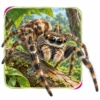
10 Fun Spider Facts for Kids
1. A Spider Is Not an Insect
Spiders have eight walking legs and two main body regions, while adult insects have six legs and three main body regions. Spiders also lack insect antennae and use short leg-like pedipalps near the mouth for sensing, handling food, and reproduction.
Kid Decode: Eight legs plus two body regions equals arachnid, not insect.
2. More Than 54,000 Species Are Named
The World Spider Catalog recognizes more than 54,000 living species, and the total changes as scientists describe, rename, or combine species. Spiders occupy over 130 families with dramatically different shapes and lifestyles.
Kid Decode: A new spider may join the science list while you are learning the old ones.
3. Every Spider Makes Silk
Spinnerets near the rear of the abdomen release liquid silk proteins that harden into threads. Different glands can produce silk for lifelines, egg sacs, shelters, prey wrapping, web frames, sticky capture lines, or travel.
Kid Decode: A spider carries a toolkit of silk recipes inside its abdomen.
4. Many Spiders Never Build a Capture Web
Orb weavers and cobweb spiders trap prey in webs, but jumping spiders stalk and leap, wolf spiders chase, crab spiders ambush flowers, trapdoor spiders wait in burrows, and fishing spiders hunt on water.
Kid Decode: A web is one hunting tool, not the spider family’s universal dinner plate.
5. Venom Usually Targets Small Prey
Most spider families have venom glands connected to the fangs, although a few groups lack them. Venom subdues prey and begins digestion, but only a very small number of species have medically important bites for humans.
Kid Decode: Nearly every garden spider saves its venom for prey much smaller than you.
6. Meals Become Drinkable
Fangs and digestive fluids break down tissues outside the spider’s mouth, and a sucking stomach draws in the liquefied food. Filtering hairs prevent large solid pieces from entering the narrow digestive passage.
Kid Decode: A spider turns solid prey into a protein smoothie before swallowing it.
7. Legs Combine Muscles and Hydraulics
Muscles pull many leg joints inward, while pressure from body fluid helps extend key joints outward. When a spider dies and pressure disappears, the legs often curl underneath the body.
Kid Decode: Each leg works partly like a tiny fluid-powered machine.
8. Hairs Detect a Vibrating World
Sensitive hairs and slit-shaped organs detect air currents, web vibrations, touch, and strain in the exoskeleton. Web builders can often distinguish struggling prey, a mate, falling debris, and danger by the rhythm of a thread.
Kid Decode: To a spider, one silk strand can work like an ear, alarm, and telephone wire.
9. Eyes Vary Between Spider Families
Many spiders have eight simple eyes, but some have six, four, two, or none. Jumping spiders rely on large forward-facing eyes for detailed color vision, while cave and web-dwelling species may depend more strongly on vibration.
Kid Decode: Eight eyes is common, but the spider rulebook allows several different totals.
10. Growing Requires a New Exoskeleton
A spider cannot stretch its hard outer skeleton indefinitely. It forms a larger covering underneath, splits the old skin, pulls free, and expands before the new exoskeleton hardens; missing legs may partly regrow across later molts.
Kid Decode: A young spider steps out of an old body suit and waits for the new one to harden.
The Weirdest Spider Fact
Tiny spiders and spiderlings can release silk into the air and become airborne in a behavior called ballooning. Wind carries the thread, and research suggests atmospheric electric fields can also help lift and guide it. Ballooning spiders have landed on ships, mountaintops, and newly formed volcanic islands far from their starting points.
Try This Spider Activity
Invent a Spider Silk Laboratory
Draw a large spider with exactly eight walking legs and label the cephalothorax, abdomen, pedicel, eyes, chelicerae, fangs, pedipalps, leg hairs, joints, and spinnerets. Around it, test silk designs for a lifeline, egg sac, shelter, orb web, trapdoor, prey wrap, and ballooning thread. Add examples of jumping, wolf, crab, fishing, and web-building spiders.
Quick Spider Quiz
- Which order contains spiders? Answer: Araneae.
- How many walking legs does a spider have? Answer: Eight.
- Which organs release silk? Answer: Spinnerets.
- Do all spiders build capture webs? Answer: No.
- What is silk-powered air travel called? Answer: Ballooning.
Mini Glossary
- Arachnid: An arthropod in the group containing spiders, scorpions, mites, ticks, and relatives.
- Cephalothorax: The fused front body region bearing the eyes, mouthparts, and legs.
- Pedipalp: One of a pair of short appendages beside a spider’s mouth.
- Spinneret: A movable silk-releasing organ near the end of the abdomen.
- Exoskeleton: A hard outer covering that supports and protects the body.
 Jerboa Facts for Kids
 Mulga Snake Facts for Kids
 Whirligig Beetle Facts for Kids
 Hawaiian Rail Facts for Kids
More Animal Facts for Kids
Visit the full animal facts library or explore a focused animal group.
More Extinct Animal Facts for Kids
Discover dinosaurs, Ice Age giants, prehistoric sea creatures, recently extinct species, and other animals from the past.
Fact check note: Fact checked against World Spider Catalog Version 27 for current family and species totals; Smithsonian National Museum of Natural History arachnid resources; Australian Museum, Natural History Museum London, and University of California Museum of Paleontology spider references; and peer-reviewed work on spider anatomy, silk glands, web diversity, venom-gland exceptions, extraoral digestion, hydraulic leg extension, mechanosensory hairs, eye evolution, molting, regeneration, ballooning, and atmospheric electric fields. The species count was rounded because the catalog changes frequently.

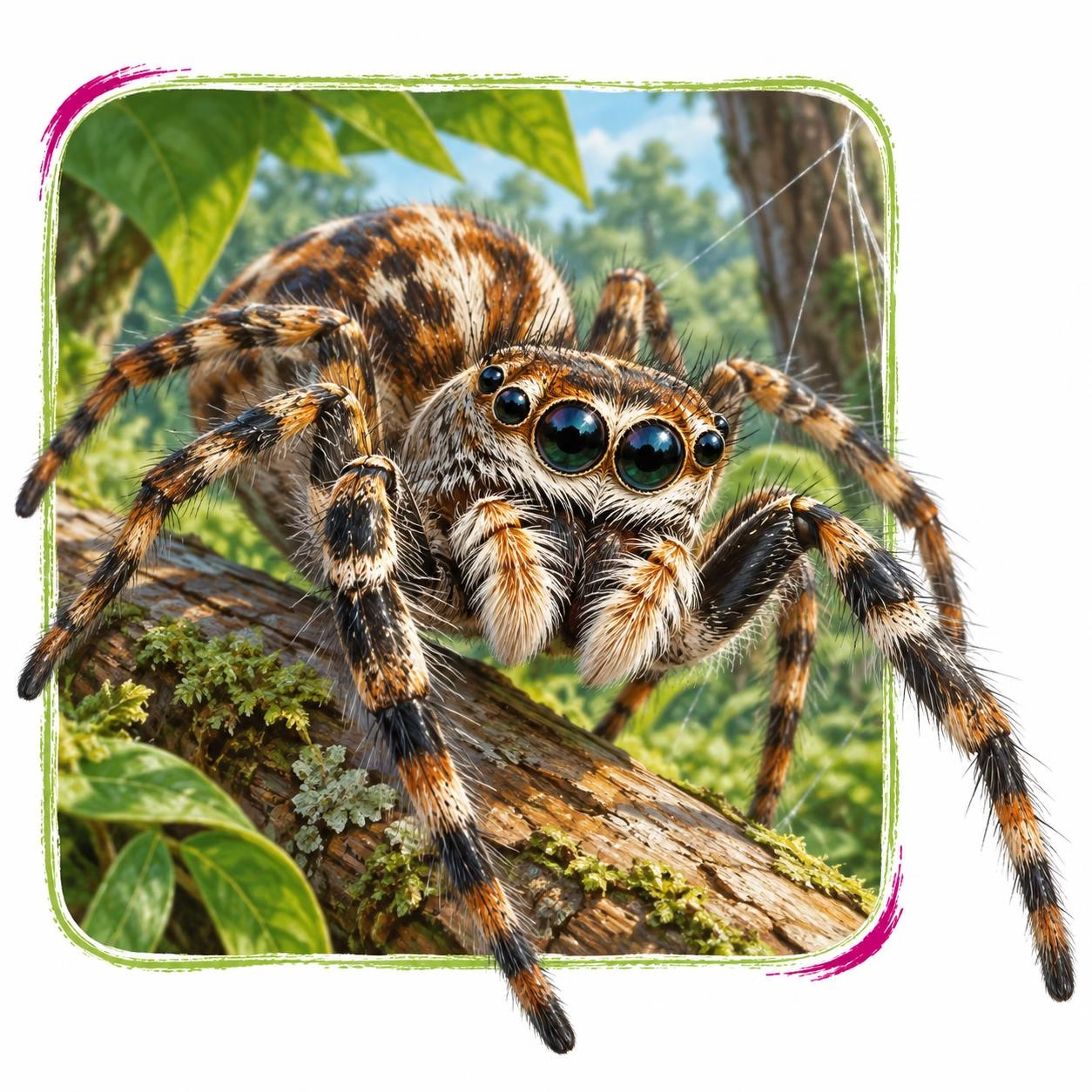
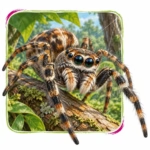
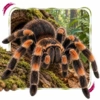
Spider in its natural Forests, deserts, grasslands, wetlands, caves, mountains, coasts, farms, gardens, and buildings on every continent except Antarctica habitat