
White Rhino Facts for Kids
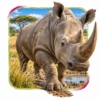
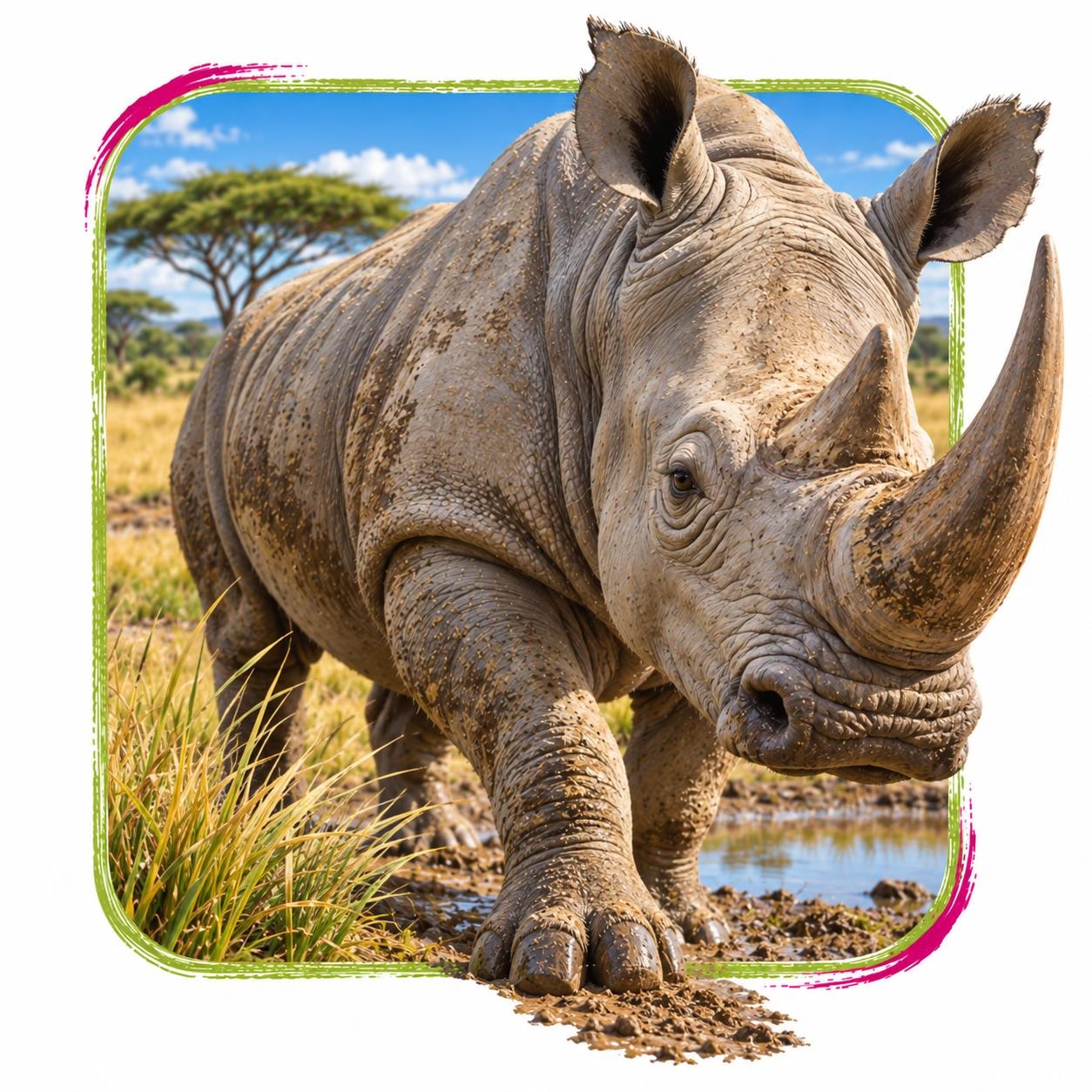
The White Rhino, Ceratotherium simum, is the largest living rhinoceros and a grass-eating giant of African savannas and open woodlands. Its name is misleading because its skin is gray, not white. A wide square-shaped upper lip helps it crop short grass, while two keratin horns, three-toed feet, thick folded skin, strong smell and hearing, mud wallows, and communal dung piles shape its daily life. Most living animals belong to the southern subspecies. Only two northern white rhinos remain, both females, making that subspecies functionally extinct. The species is currently listed as Near Threatened, and the estimated wild population fell to about 15,752 by the end of 2024.
Quick White Rhino Facts
- Animal Type: Mammal
- Scientific Name: Ceratotherium simum
- Known For: Huge size, broad square lip, grass grazing, two keratin horns, social groups, mud wallows, and communal dung middens
- Habitat: Tropical and subtropical grasslands, savannas, open woodlands, bushveld, and areas with water and mud wallows
- Diet: Mainly short grasses and other low vegetation
What You’ll Learn
Explore 10 powerful white rhino facts for kids about two horns, wide grazing lips, huge bodies, African grasslands, and conservation, with a quiz, glossary, and activity
These easy facts are made for kids, parents, teachers, and curious young learners.
10 Fun White Rhino Facts for Kids
1. It Is the Largest Living Rhino
Adult white rhinos are the largest of the five living rhinoceros species. Large males can weigh well over two tonnes, although body size varies with sex, age, region, nutrition, and measurement method.
Kid Decode: This grass eater carries the build of a small armored vehicle.
2. Its Wide Lip Works Like a Lawn Mower
The broad, flat, square-shaped upper lip is specialised for grazing close to the ground. This feature separates the white rhino from the black rhino, whose pointed hooked lip is better suited to browsing shrubs.
Kid Decode: One rhino wears a grass-cutting mouth while its cousin carries a leafy-food grabber.
3. White Rhinos Are Gray, Not White
Their skin is usually gray and may look brown, reddish, or pale after dusting and wallowing in different soils. The exact history of the English name is uncertain, so the popular story that it came only from a mistranslation of a word meaning wide should not be treated as proven.
Kid Decode: The animal changes color with the mud, while its name keeps everyone guessing.
4. Their Horns Are Made of Keratin
White rhinos usually have two horns made mostly of tightly packed keratin, the same protein found in hair and nails. A horn grows from the skin rather than around a bony core and can regrow to some degree if its base remains healthy.
Kid Decode: The giant nose spear is built from hair-like protein, not ivory or bone.
5. Three Toes Carry Each Heavy Foot
Each foot has three weight-bearing toes with broad nails and thick pads. The middle toe bears much of the load while the side toes help steady the animal on uneven ground.
Kid Decode: Three sturdy toe-columns hold up one enormous grass-eating body.
6. They Are More Social Than Many Rhinos
Females and young white rhinos may gather in small groups sometimes called crashes, while adult bulls are more territorial and often live alone. Group size changes with age, sex, habitat, water, and food.
Kid Decode: A few rhinos together make a crash, even while standing perfectly still.
7. Dung Piles Carry Messages
White rhinos repeatedly use communal dung middens. Individuals smell the dung, scrape their feet, and may scatter it to spread chemical information about identity, territory, sex, and breeding condition.
Kid Decode: The neighborhood message board is a carefully maintained pile of droppings.
8. Mud Protects the Skin
Wallowing coats the skin with wet mud that can cool the body and may help reduce biting insects and sun exposure. After the mud dries, rhinos often rub against trees, rocks, or posts.
Kid Decode: A muddy spa treatment becomes sunscreen, cooling coat, and bug shield in one.
9. A Calf Stays With Its Mother for Years
After a pregnancy of roughly sixteen months, a female usually gives birth to one calf. The calf nurses, learns routes and social signals, and may remain with its mother for two to three years before the next calf arrives.
Kid Decode: One baby gets a long private course in being a rhino.
10. Conservation Tells Two Very Different Stories
Southern white rhinos recovered from fewer than one hundred animals in the early twentieth century, but poaching and other pressures caused renewed declines. By the end of 2024, the estimated white-rhino population was about 15,752. Only two northern white rhinos survive, both nonbreeding females.
Kid Decode: One subspecies staged a remarkable comeback while the other reached its final two females.
The Weirdest White Rhino Fact
At a communal midden, a territorial male may kick and drag his feet through dung so the scent clings to his toes and is spread along paths like an invisible boundary marker.
Try This White Rhino Activity
White Rhino Savanna Activity
Draw a southern white rhino grazing on an African savanna. Add a broad square lip close to short grass, two keratin horns, gray folded skin dusted with red-brown mud, three toes on each foot, a mother and calf, a small crash of females, one distant territorial bull, a mud wallow, oxpeckers, a water source, and a communal dung midden with scent trails. Include a comparison bubble showing the black rhino’s pointed hooked lip and a conservation panel showing the southern recovery story, current poaching pressure, and the two remaining northern white rhinos.
Quick White Rhino Quiz
- What is the White Rhino’s scientific name? Answer: Ceratotherium simum.
- What shape is its upper lip? Answer: Broad, flat, and square-shaped for grazing.
- What are rhino horns made mostly from? Answer: Keratin.
- What is a shared rhino dung pile called? Answer: A midden.
- How many northern white rhinos remain? Answer: Two, both females.
Mini Glossary
- Grazer: An animal that feeds mainly on grasses and other low plants.
- Keratin: A tough protein found in hair, nails, claws, and rhino horns.
- Crash: An informal name for a group of rhinoceroses.
- Midden: A repeatedly used pile of dung that can carry scent information.
- Functionally Extinct: A population that still has living members but can no longer reproduce enough to recover naturally.

 Cheetah Facts for Kids
 Rabbit Facts for Kids
 Chameleon Facts for Kids
 Toxodon Facts for Kids
More Animal Facts for Kids
Visit the full animal facts library or explore a focused animal group.
More Extinct Animal Facts for Kids
Discover dinosaurs, Ice Age giants, prehistoric sea creatures, recently extinct species, and other animals from the past.
Fact check note: Fact checked with the International Rhino Foundation’s 2025 State of the Rhino and White Rhino species account, IUCN Red List information for Ceratotherium simum, Mammal Diversity Database taxonomy, and authoritative rhino references on square-lipped grazing, keratin horns, three-toed feet, social crashes, middens, wallowing, reproduction, southern recovery, northern functional extinction, and poaching pressure.

White Rhino in its natural Tropical and subtropical grasslands, savannas, open woodlands, bushveld, grazing lawns, waterholes, and mud-wallow areas habitat