
Arthropleura Facts for Kids
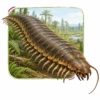
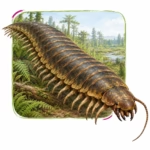
Arthropleura was a giant millipede-line myriapod that lived from the Carboniferous into the Early Permian, roughly 346 to 290 million years ago. It was not an insect, dinosaur, centipede, or modern millipede, although its trunk had the millipede-like feature of two pairs of legs on many body rings. The largest known fossil evidence suggests an animal up to about 2.6 metres long and around 50 kilograms, making Arthropleura the largest known land-dwelling arthropod. For more than a century its head was mysterious, but CT-scanned juvenile fossils described in 2024 finally revealed a rounded head with antennae, mandibles, and a surprising mixture of millipede-like and centipede-like features. Its exact diet is still uncertain.
Quick Arthropleura Facts
- Animal Type: Extinct giant myriapod and millipede-line arthropod
- Group: Arthropleurids, close to the millipede branch of Myriapoda
- Known For: Enormous size, broad armored body rings, many legs, millipede-like double leg pairs, giant trackways, and a head only recently reconstructed from juvenile fossils
- Lived During: Carboniferous to Early Permian, roughly 346 to 290 million years ago
- Diet: Unknown; probably detritus or plant material, but direct gut evidence remains uncertain
What You’ll Learn
Discover 10 Arthropleura facts for kids with updated fossil science, quick facts, a quiz, glossary, drawing activity, and Carboniferous animal links.
10 Fun Arthropleura Facts for Kids
1. It Was the Largest Known Land Arthropod
A giant partial exoskeleton from northern England indicates an Arthropleura that may have reached about 2.63 metres in length, roughly 55 centimetres wide, and around 50 kilograms. These estimates belong to the largest known individual, not every Arthropleura species or age.
Kid Decode: The biggest Arthropleura stretched longer than many sofas while still wearing an arthropod exoskeleton.
2. It Was Not a Giant Insect
Arthropleura belonged to Myriapoda, the branch containing millipedes and centipedes. Its trunk carried millipede-like diplosegments with two pairs of walking legs on many body rings, while its newly known head also preserves features reminiscent of early centipedes.
Kid Decode: This many-legged giant lived on the millipede side of the arthropod family tree, not the insect branch.
3. Its Head Stayed Hidden for More Than a Century
Most large Arthropleura fossils preserve armored body pieces rather than the head. In 2024, CT and synchrotron scans of tiny juvenile fossils from France revealed the first detailed head reconstruction, including antennae, enclosed mandibles, head appendages, and club-shaped eyes.
Kid Decode: The giant’s missing face finally emerged from two youngsters hidden inside rock nodules.
4. Its Eyes Are Still Partly Mysterious
The 2024 juveniles preserve club-shaped eye structures, but their fine internal anatomy is not clear enough to prove exactly what kind of eyes Arthropleura had. Researchers suspect compound eyes based on its relatives, but the evidence is not complete.
Kid Decode: Scientists found where the eyes were, but the ancient camera hardware did not fossilize clearly enough.
5. It Added Body Segments as It Grew
Juvenile fossils have different numbers of trunk segments, suggesting Arthropleura added segments during growth until reaching a maximum. This growth pattern resembles many living millipedes more than centipedes that hatch with their adult segment count.
Kid Decode: Growing up meant adding more body modules to an already very long machine.
6. A Tough Exoskeleton Covered Its Back
Its upper body was protected by strongly hardened plates called tergites. Fossil remains include broad articulated plates and probable moulted exoskeletons, showing that Arthropleura periodically shed its outer covering as it grew.
Kid Decode: The giant had to upgrade its armor whenever the body underneath became too large.
7. Its Footprints Can Survive Without Its Body
Wide fossil trackways called Diplichnites are often linked with giant arthropleurids. Parallel rows of many footprints record large myriapods walking across ancient surfaces even where no body fossil was preserved beside them.
Kid Decode: Sometimes the only Arthropleura left behind is a many-footed road written in stone.
8. It Did Not Need a Giant Coal Swamp
A major English specimen came from sediments formed on a lower delta plain with open woody habitat near river channels and the coast. Arthropleura lived in humid equatorial landscapes, but the evidence shows it was not restricted to dense coal-swamp forest.
Kid Decode: The giant crawler had room beyond the classic steamy swamp postcard.
9. High Oxygen Was Not the Whole Size Story
Arthropleura became gigantic before the highest late-Paleozoic atmospheric oxygen levels. Extra oxygen may have influenced arthropod biology, but timing shows that food supply, climate, evolution, and other factors must also be considered.
Kid Decode: One famous explanation for giant bugs cannot carry this enormous creature all by itself.
10. Its Diet Is Still Uncertain
No universally accepted gut contents prove what Arthropleura ate. The newly reconstructed head lacks centipede-style venom claws or obvious grasping legs, supporting a non-predatory interpretation, perhaps feeding on decaying plant material or vegetation, but the question remains open.
Kid Decode: The biggest mystery may be what powered the biggest land arthropod.
The Weirdest Arthropleura Fact
The fossils that finally revealed Arthropleura’s head were juveniles only about 25 and 40 millimetres long, even though other members of the genus grew to more than two metres.
Try This Arthropleura Activity
Arthropleura Fossil-Detective Activity
Draw a broad Arthropleura crossing an open Carboniferous woodland near a river channel. Add overlapping armored tergites, many short walking legs with two pairs on many body rings, antennae, the newly reconstructed rounded head, club-shaped eye structures, a juvenile beside a giant adult silhouette, a shed exoskeleton, and a Diplichnites-style trackway. Add giant lycopsids, seed ferns, horsetail relatives, fallen plant material, and a mystery-food panel labelled “diet uncertain.”
Quick Arthropleura Quiz
- Was Arthropleura an insect? Answer: No, it was a myriapod on the millipede branch.
- How long could the largest known Arthropleura reach? Answer: About 2.6 metres.
- What new body part was reconstructed in detail in 2024? Answer: The head.
- What are fossil walking traces linked with giant arthropleurids called? Answer: Diplichnites trackways.
- Do scientists know exactly what Arthropleura ate? Answer: No, its diet remains uncertain.
Mini Glossary
- Myriapod: An arthropod from the group containing millipedes, centipedes, and close relatives.
- Diplosegment: A millipede-style body ring formed from fused segments and usually carrying two pairs of legs.
- Tergite: A hardened plate covering the upper side of an arthropod body segment.
- Moult: The shedding of an old outer skeleton so an arthropod can grow.
- Trackway: A series of fossil footprints or movement marks made by an animal.
 Cheetah Facts for Kids
 Oscar Fish Facts for Kids
 Green Iguana Facts for Kids
 Zygomaturus Facts for Kids
More Animal Facts for Kids
Visit the full animal facts library or explore a focused animal group.
More Extinct Animal Facts for Kids
Discover dinosaurs, Ice Age giants, prehistoric sea creatures, recently extinct species, and other animals from the past.
Fact check note: Fact checked with Lhéritier and colleagues’ 2024 Science Advances study and Natural History Museum summary of the first detailed Arthropleura head reconstruction, Davies and colleagues’ Journal of the Geological Society study of the giant Northumberland specimen, University of Cambridge and Sedgwick Museum resources on the 2.63-metre size estimate, open woody lower-delta habitat, exoskeleton, gigantism, trackways, and the continuing uncertainty around diet.

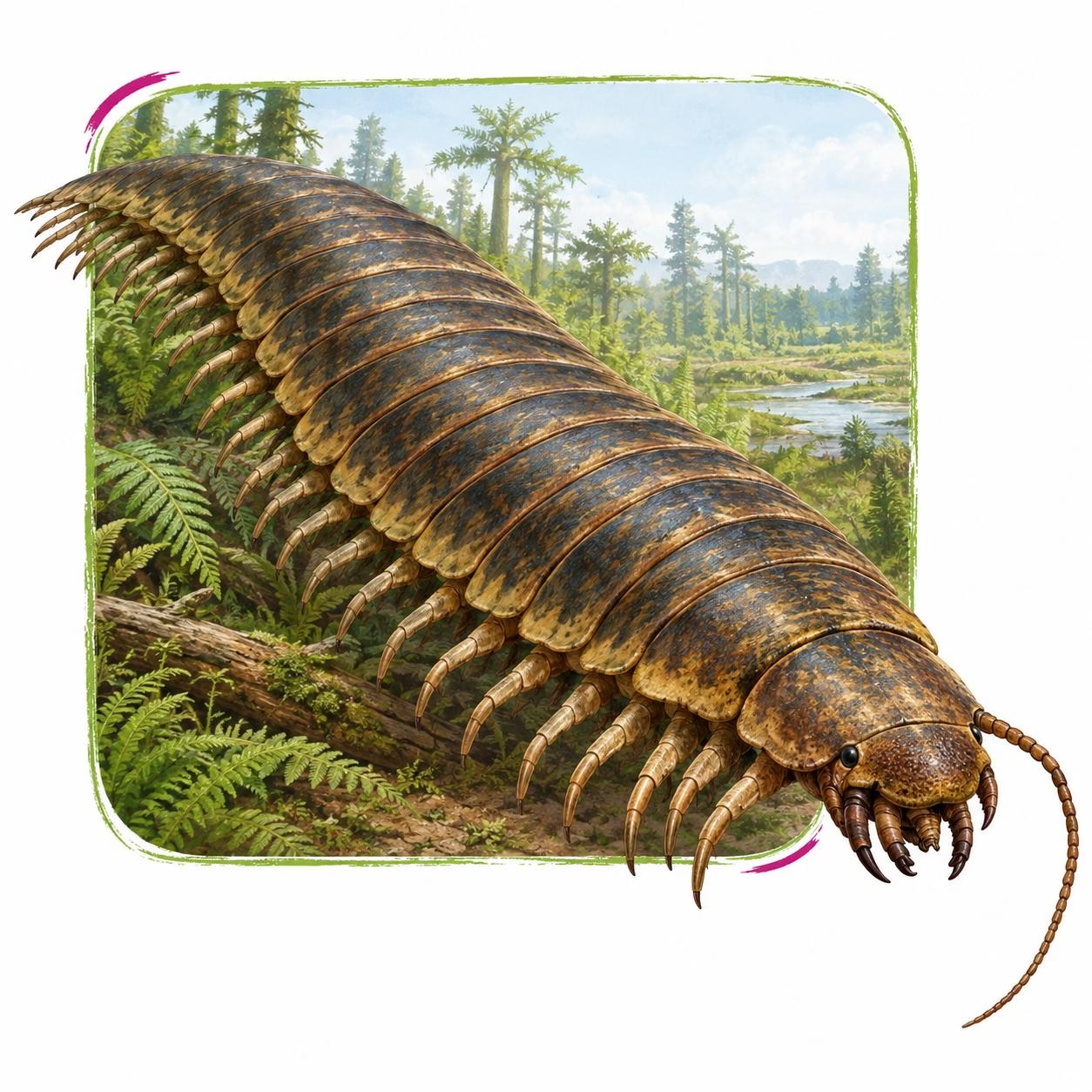
Arthropleura in its natural Humid equatorial open woodlands, lower delta plains, river-channel margins, vegetated lowlands, and other Carboniferous to Early Permian terrestrial habitats habitat