
Beelzebufo Facts for Kids
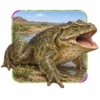
Beelzebufo was a large, heavily built frog that lived in Madagascar near the end of the Cretaceous Period. Its name means devil toad, but it was a true frog, not a toad. A broad skull, rough reinforced bones, small teeth, and powerful jaws suggest that it was a sit-and-wait predator capable of gripping surprisingly large prey.
Quick Beelzebufo Facts
- Animal Type: Extinct frog
- Group: Hyperossified neobatrachian frog, possibly related to horned frogs
- Known For: Broad head, heavily reinforced skull, strong estimated bite, rough bony surface, and devil frog nickname
- Lived During: Late Cretaceous, about 70–66 million years ago
- Diet: Insects, small vertebrates, and other animals it could overpower
What You’ll Learn
Explore 10 giant beelzebufo facts for kids about huge size, powerful jaws, squat bodies, hunting, and Cretaceous Madagascar, plus a quiz, glossary, and activity
These easy facts are made for kids, parents, teachers, and curious young learners.
10 Fun Beelzebufo Facts for Kids
1. Beelzebufo Was a Frog
Beelzebufo was an anuran, the animal group containing frogs and toads. Despite its devil toad nickname, scientists classify it as a frog.
Kid Decode: The nickname says toad; the skeleton files it under frog.
2. It Lived in Madagascar
Its fossils come from the Maevarano Formation of northwestern Madagascar, a seasonally dry Cretaceous landscape crossed by rivers and floodplains.
Kid Decode: This frog shared an island ecosystem with crocodile relatives, snakes, mammals, and dinosaurs.
3. It Was Large but Not Person-Sized
Later skeletal reconstructions indicate a snout-to-vent length of at least about 23 centimetres, far below the oversized movie versions sometimes shown online.
Kid Decode: It was a giant frog, not a saddle-equipped monster.
4. Its Head Was Extremely Wide
Beelzebufo had a short, broad skull that made much of the animal look like a powerful head mounted on stout legs.
Kid Decode: The body plan leaned heavily toward head first, questions later.
5. Its Skull Was Heavily Reinforced
The skull bones were thick and hyperossified, with a rough outer surface and broad flanges at the back corners.
Kid Decode: Its head wore built-in bone armor instead of a helmet.
6. It Had Small Teeth
Small plate-like teeth lined the upper jaws, while the lower jaw probably worked with a strong, wide mouth to grip prey.
Kid Decode: The teeth were modest, but the mouth behind them meant business.
7. It May Have Had a Powerful Bite
Scaling from living horned frogs suggests that large Beelzebufo individuals may have produced bite forces ranging from hundreds to more than 2,000 newtons, depending on body-size assumptions.
Kid Decode: The exact number is modeled, but even the cautious version is a serious frog clamp.
8. It Was Probably an Ambush Predator
Its broad head, strong jaws, and compact body suggest that Beelzebufo waited for prey and attacked suddenly rather than chasing animals over long distances.
Kid Decode: It likely used the classic frog strategy with the volume knob turned up.
9. It Lived Alongside Dinosaurs
Beelzebufo shared its ecosystem with dinosaurs such as Majungasaurus, but there is no direct fossil proof that it ate baby dinosaurs.
Kid Decode: Dinosaur neighbour does not automatically mean dinosaur dinner.
10. Its Closest Relatives Are Debated
Its skull resembles South American horned frogs, yet the exact position of Beelzebufo on the frog family tree remains under discussion.
Kid Decode: This frog crossed ancient geography and modern scientific debates at the same time.
The Weirdest Beelzebufo Fact
Beelzebufo had such a broad reinforced skull that bite-force models suggest the largest individuals may have bitten with forces comparable to some medium-sized mammalian predators.
Try This Beelzebufo Activity
Beelzebufo Drawing Activity
Draw Beelzebufo waiting beside a Late Cretaceous Madagascar riverbank. Add a short wide body, enormous broad head, rough armored skull, small teeth, stout hind legs, insects, a small lizard, dry-season plants, distant Majungasaurus tracks, and a label explaining that dinosaur prey is not proven.
Quick Beelzebufo Quiz
- Was Beelzebufo a dinosaur? Answer: No, it was a frog.
- Where did it live? Answer: Madagascar.
- How large was its body? Answer: At least about 23 centimetres from snout to vent.
- What made its skull unusual? Answer: It was broad, thick, rough, and heavily reinforced.
- Is there proof that it ate baby dinosaurs? Answer: No, that remains speculation.
Mini Glossary
- Anuran: A member of the animal group containing frogs and toads.
- Hyperossified: Having unusually thick or extensive bone growth.
- Ambush Predator: A hunter that waits before making a sudden attack.
- Bite Force: The amount of force produced when an animal closes its jaws.
- Maevarano Formation: A Late Cretaceous rock formation in Madagascar rich in vertebrate fossils.
 Bharal Facts for Kids
 Gentoo Penguin Facts for Kids
 Rattlesnake Facts for Kids
 Kauaʻi ʻŌʻō Facts for Kids
More Animal Facts for Kids
Visit the full animal facts library or explore a focused animal group.
More Extinct Animal Facts for Kids
Discover dinosaurs, Ice Age giants, prehistoric sea creatures, recently extinct species, and other animals from the past.
Fact check note: Fact checked with Evans, Jones and Krause’s 2008 PNAS description, Evans and colleagues’ 2014 PLOS ONE skeletal reconstruction, and Lappin and colleagues’ 2017 bite-force modelling study.

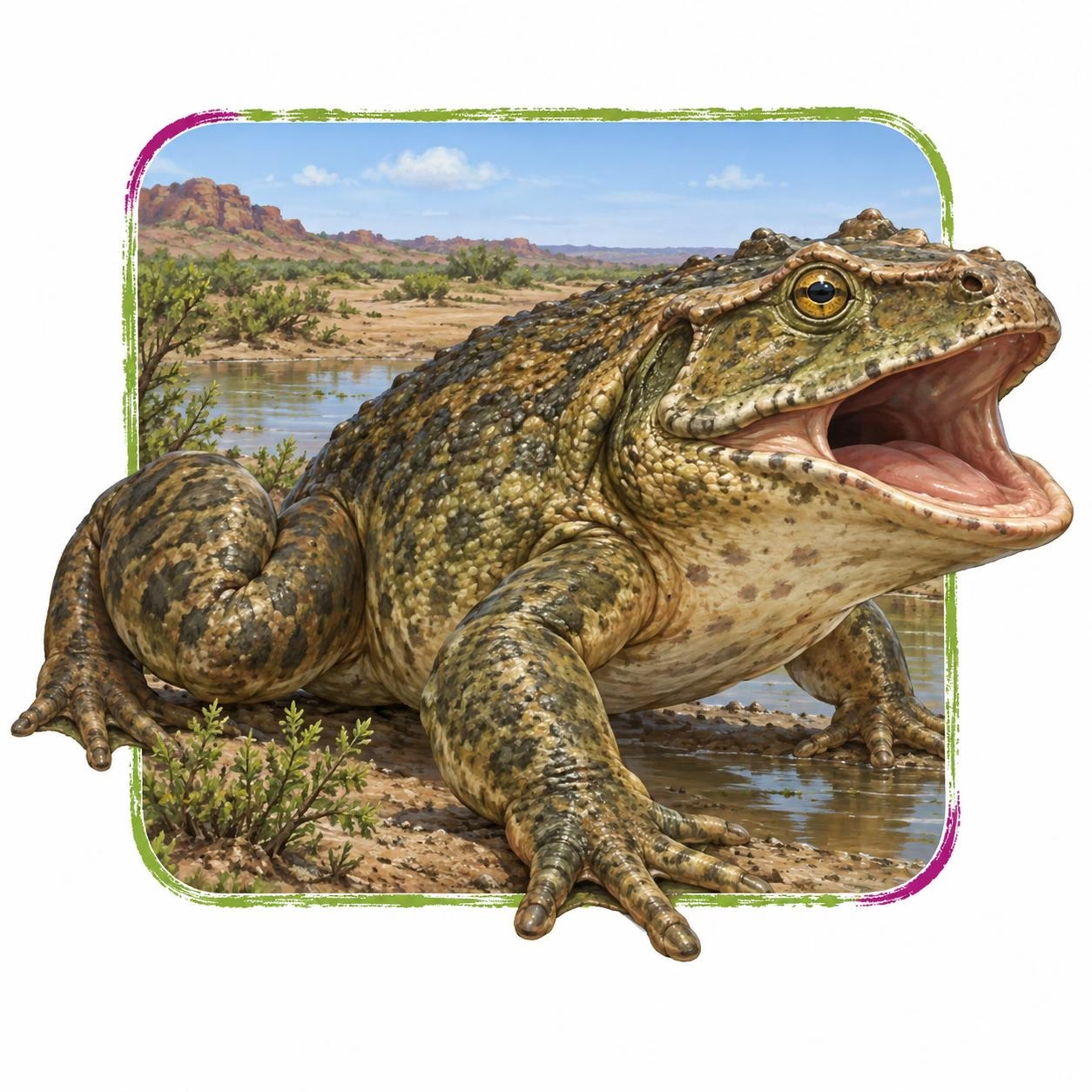
Beelzebufo in its natural Late Cretaceous seasonally dry floodplains, river channels, sandy wetlands, temporary ponds, scrubby vegetation, and semi-arid lowlands of Madagascar habitat