
Beetle vs Cockroach: Insect Order Comparison
Beetles and cockroaches are six-legged insects with chewing mouthparts, but they belong to different orders. Beetles are Coleoptera, protected by hardened forewings called elytra, and they transform from larvae through a pupal stage. Cockroaches belong to Blattodea, usually have flattened bodies and very long antennae, and grow from look-alike nymphs without a pupa. Most cockroach species live outdoors rather than in homes.
About Beetle
- Type Insect
- Diet Varies: herbivore, carnivore, omnivore, fungivore, scavenger, or decomposer
- Group Coleopteran
- Known for Hardened forewings called elytra, immense diversity, chewing mouthparts, complete metamorphosis, and adaptations for nearly every land and freshwater habitat
- Special skill Protecting delicate flight wings beneath elytra and adapting to an extraordinary range of foods and habitats
About Cockroach
- Type Insect
- Diet Mostly omnivore or decomposer
- Group Blattodean
- Known for Flat flexible bodies, very long antennae, fast running, nocturnal activity, egg cases, incomplete metamorphosis, and nutrient recycling
- Special skill Flattening into narrow shelters, sensing the surroundings with long antennae, and sprinting away from danger
Beetle vs Cockroach: Quick Answer
A beetle has hardened forewings called elytra and undergoes complete metamorphosis: egg, larva, pupa, and adult. A cockroach usually has a flat oval body, very long antennae, spiny running legs, and leathery front wings when wings are present. It develops by incomplete metamorphosis: egg, nymph, and adult, with no pupal stage.
Where Do They Fit?
Follow the branches to see how Beetle and Cockroach are classified and related.
Beetle vs Cockroach: Quick Comparison
| Feature | Beetle | Cockroach |
|---|---|---|
| Animal type | Insect | Insect |
| Animal order | Coleoptera | Blattodea |
| Typical body | Enormously varied; often firm and armored | Usually broad, oval, flattened, and flexible |
| Antennae | Short, long, clubbed, elbowed, feathery, or threadlike | Usually very long, thin, and threadlike |
| Front wings | Hardened elytra meet along a straight line down the back | Often leathery tegmina overlap when wings are present |
| Young stage | Larva, often called a grub | Nymph resembling a smaller wingless adult |
| Life cycle | Complete metamorphosis with a pupa | Incomplete metamorphosis without a pupa |
| Eggs | Laid singly or in groups in many different places | Usually grouped inside a protective egg case called an ootheca |
| Diet | Almost every kind of plant, animal, fungus, or decaying material | Mainly decaying plant matter and other available foods |
| Diversity | Hundreds of thousands of described species | Several thousand described species; only a small fraction are household pests |
How Are Beetles and Cockroaches Alike?
- Both beetles and cockroaches are insects with six legs, two antennae, three main body regions, and an exoskeleton.
- Both have chewing mouthparts and include species that eat decaying organic material.
- Both groups live on most continents and occupy forests, grasslands, deserts, caves, and human-altered habitats.
- Both include winged and flightless species.
- Both help ecosystems as predators, prey, plant eaters, seed movers, pollinators, or nutrient recyclers depending on species.
How Are Beetles and Cockroaches Different?
- Beetles belong to Coleoptera, while cockroaches belong to Blattodea, the same order that contains termites.
- Beetles have hardened elytra, while winged cockroaches usually have thinner leathery forewings called tegmina.
- Beetles undergo complete metamorphosis with larval and pupal stages, while cockroach nymphs gradually become adults without a pupa.
- Beetle bodies take countless forms, while cockroaches are usually flattened, oval, and equipped with very long antennae.
- Beetle eggs are placed in many ways, while cockroach eggs are usually packaged inside an ootheca.
Beetle vs Cockroach Showdown
Insect showdown: The beetle wins size, strength, and swimming because the order includes giant beetles, powerful horned species, and specialized aquatic hunters. The cockroach takes running speed, stealth, and social behavior with its quick legs, flat crack-fitting body, chemical communication, and frequent aggregations. It also wins our weirdest-fact prize because termites evolved within the cockroach order Blattodea. These are broad patterns with many species-level exceptions.
Fun Beetle vs Cockroach Facts
Hard Elytra vs Leathery Tegmina
A beetle’s front wings are transformed into hard protective covers called elytra, which usually meet along a straight seam. A winged cockroach usually has thinner, flexible forewings called tegmina that overlap across the back.
Complete vs Incomplete Metamorphosis
A beetle hatches as a larva, becomes a pupa, and is rebuilt into an adult. A cockroach hatches as a nymph shaped much like a small wingless adult and becomes larger through repeated molts, with no pupal stage.
Grub vs Nymph
Beetle larvae often look wormlike or grub-like and may live in soil, wood, water, plants, or food stores. Cockroach nymphs have legs, antennae, and a flattened body like adults, but they are smaller and lack fully developed wings.
Most Cockroaches Never Infest a Kitchen
Several thousand cockroach species live around the world, but only a small number regularly share human buildings. Most are wild insects living in forests, leaf litter, logs, caves, deserts, burrows, or other outdoor habitats where many recycle dead plant material.
Termites Belong Inside Blattodea
Modern genetic and anatomical research places termites within the cockroach order Blattodea. They evolved from social, wood-feeding cockroach relatives, so a termite is more closely related to certain cockroaches than those cockroaches are to some other roaches.
Beetle vs Cockroach Quiz
- What are a beetle’s hardened forewings called? Answer: Elytra.
- Which insect has a pupal stage? Answer: The beetle.
- What is a young cockroach called? Answer: A nymph.
- What is a cockroach egg case called? Answer: An ootheca.
- Which insect order also contains termites? Answer: Blattodea, the cockroach order.
Beetle vs Cockroach FAQ
What is the main difference between a beetle and a cockroach?
A beetle has hardened forewings called elytra and a larva-pupa-adult life cycle. A cockroach usually has a flat body, long antennae, overlapping leathery forewings, and a nymph-to-adult life cycle without a pupa.
Is a cockroach a beetle?
No. Beetles belong to Coleoptera, while cockroaches belong to Blattodea.
Do all cockroaches live in houses?
No. Only a small fraction of cockroach species regularly infest buildings. Most live outdoors in natural habitats and play roles in food webs and decomposition.
Can beetles and cockroaches fly?
Many species in both groups have wings, but flight ability varies. Some fly well, some fly rarely, and others have reduced wings or no functional wings.
Are termites cockroaches?
Termites are not the familiar insects usually called cockroaches, but scientists classify termites within Blattodea because they evolved from cockroach relatives and remain nested in that evolutionary group.
Animal Words to Know
- Coleoptera: The insect order containing beetles.
- Blattodea: The insect order containing cockroaches and termites.
- Elytron: One hardened front wing of a beetle.
- Tegmen: One leathery protective forewing of insects such as cockroaches; the plural is tegmina.
- Ootheca: A protective case containing a group of cockroach eggs.
Beetle and Cockroach Life-Cycle Activity
Beetle and Cockroach Life-Cycle Activity
Draw a rounded beetle beside a flatter cockroach. Give the beetle hard front wing covers meeting in a straight line down its back. Give the cockroach very long antennae, spiny running legs, and overlapping leathery front wings. Below them, draw egg–larva–pupa–adult for the beetle and egg case–nymph–adult for the cockroach. Label wing covers, antennae, larva, pupa, nymph, and egg case.
Meet Each Animal
Want the full fact file? Here are quick highlights from each animal’s own facts page.
Beetle Fact Highlight
From the full animal facts page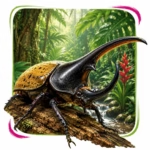
Cockroach Fact Highlight
From the full animal facts page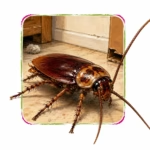
More Animal Comparisons
Pick another animal matchup and keep exploring. Compare appearances, habitats, diets, abilities, and surprising differences.


Make an Animal Story
Turn this beetle vs cockroach comparison into a nighttime insect adventure with our free Animal Story Generator.
Source notes: References used for this comparison. See more See less
Try Another Matchup
Explore this comparison →