
Bharal vs Ibex: Asian Mountain Caprine Comparison
Bharal and ibex share some of Central Asia’s highest rocky landscapes, but the word ibex covers several wild goats. This page uses the Siberian ibex, Capra sibirica, as the fixed comparison. Bharal are medium-sized blue-grey caprines that blend into rock. Siberian ibex are larger, more goat-like animals whose adult males can grow enormous ridged horns longer than a metre.
About Bharal
- Type Living
- Diet Herbivore
- Group Blue sheep species (Pseudois nayaur)
- Known for Slate-blue camouflage, broad chest and sweeping horns
- Special skill Freezes against blue-grey rock, then escapes rapidly toward cliffs
About Siberian Ibex
- Type Living
- Diet Herbivore
- Group Wild goat species (Capra sibirica)
- Known for Huge backward-curving ridged horns, beard and powerful climbing
- Special skill Uses flexible hooves and great body power on steep broken rock
Bharal vs Siberian Ibex: Quick Answer
Bharal, Pseudois nayaur, are blue-grey mountain herbivores weighing about 35-75 kilograms, with sweeping sideways horns and superb rock camouflage. Siberian ibex, Capra sibirica, are larger wild goats; adult males commonly weigh about 80-100 kilograms and can grow metre-long ridged horns. Ibex win size and strength. Bharal win stealth, social gathering and the weirdest false-sheep identity. Speed and swimming are ties.
Bharal vs Siberian Ibex: Quick Comparison
| Feature | Bharal | Siberian Ibex |
|---|---|---|
| Scientific name | Pseudois nayaur | Capra sibirica |
| Common alternate name | Blue sheep | Asiatic ibex |
| Animal group | Caprine in genus Pseudois | True wild goat in genus Capra |
| Adult mass | About 35-75 kg across adult sexes | About 30-100 kg, with adult males commonly 80-100 kg |
| Coat clue | Grey-brown to slate blue with white underparts and a dark side stripe | Highly variable brown coat, often with pale underparts, dark patches and a male beard |
| Male horns | Sweep out sideways, curve back and may curl at the tips | Massive bow-shaped horns curve far backward and carry bold front ridges |
| Female horns | Shorter and slimmer than male horns | Much shorter and thinner than male horns |
| Habitat | Open high plateau, alpine grassland and cliffs, usually avoiding forest | Rocky mountains, steep dry slopes, high valleys and alpine meadows |
| Social life | Changing herds may range from five to hundreds | Female-young and male groups change with season |
| Predator clue | An important prey species for snow leopards | Also preyed on by snow leopards and wolves in parts of its range |
How Are Bharal and Ibex Alike?
- Both are Asian caprines related to goats and sheep.
- Both males and females grow permanent horns.
- Both eat grasses, herbs, leaves and other mountain plants.
- Both form changing herds and move between elevations with season or weather.
- Both use steep cliffs and strong hooves as escape terrain from predators.
How Are Bharal and Ibex Different?
- Bharal belong to genus Pseudois; Siberian ibex are true wild goats in genus Capra.
- Adult male Siberian ibex are generally larger and heavier than male bharal.
- Bharal horns sweep sideways before curving back; ibex horns rise and arc far backward.
- A bharal’s blue-grey coat closely matches bare rock; ibex coats vary more with sex, season and region.
- Bharal may gather in very large herds, while Siberian ibex groups are usually separated more strongly by sex and season.
Bharal vs Ibex Adaptation Showdown
- Size – Siberian Ibex: Adult males commonly reach about 80-100 kilograms, above the bharal’s broad 35-75-kilogram range.
- Speed – Tie: Both are agile mountain runners, but there is no fair same-course test across rock type, slope, age and sex.
- Strength – Siberian Ibex: Its larger adult males, thick neck and huge horn bases give it the whole-body power advantage, not a fight prediction.
- Stealth – Bharal: Slate-blue and grey-brown hair can make a still bharal almost disappear against blue-grey cliffs.
- Social – Bharal: Its flexible gatherings can expand into herds of hundreds when season, food and habitat allow.
- Swimming – Tie: Neither species has a well-supported comparative swimming specialisation.
- Weirdest – Bharal: It is called blue sheep and its genus name means false sheep, yet it sits on the caprine branch alongside goat and sheep relatives with its own unusual mix of features.
Fun Bharal vs Ibex Facts
Bharal Can Vanish in Plain Sight
The coat is not bright blue. It is slate-grey or blue-grey, closely matching high mountain rock, so a bharal that freezes can be extremely difficult to see.
Ibex Horns Can Pass One Metre
Adult male Siberian ibex may grow bow-shaped horns about 100-148 centimetres long. The bold ridges on the front become one of the easiest field clues.
Both Females Grow Horns Too
Female bharal and Siberian ibex have horns, but theirs are much shorter and slimmer than the enormous horns of mature males.
Bharal Feed the Snow-Leopard Food Web
In several high Asian landscapes, bharal are a major wild prey species for snow leopards. Protecting healthy bharal herds helps support the whole mountain ecosystem.
Their Horn Shapes Solve Different Displays
A male bharal’s horns spread outward and curl back beside the head. A male Siberian ibex carries a taller, deeper backward bow with heavy cross-ridges.
Bharal vs Ibex Quiz
Which animal is also called blue sheep? A) Bharal B) Siberian ibex C) Musk ox Answer: A) Bharal
Which animal has the larger adult males? A) Bharal B) Siberian ibex C) They are always identical Answer: B) Siberian ibex
Which animal wins camouflage against blue-grey rock? A) Bharal B) Siberian ibex C) Neither has fur Answer: A) Bharal
How long can male Siberian ibex horns grow? A) More than one metre B) Two centimetres C) They have no horns Answer: A) More than one metre
Which predator often depends on bharal? A) Snow leopard B) Polar bear C) Crocodile Answer: A) Snow leopard
Bharal vs Ibex FAQ
Is a bharal really blue?
Its coat is slate-grey or blue-grey rather than bright blue, helping it blend into mountain rock.
Is a bharal a sheep or a goat?
It is a distinct caprine species in genus Pseudois. The name blue sheep describes its look, not a domestic-sheep identity.
Which ibex is used on this page?
The fixed representative is the Siberian or Asiatic ibex, Capra sibirica, because ibex is a broad name for several species.
Which is bigger, a bharal or a Siberian ibex?
Adult male Siberian ibex are generally larger and heavier, although female and younger size ranges overlap.
Do bharal and Siberian ibex share habitat?
Their ranges can meet in parts of Central and South Asia, and both use steep dry mountains, but local distribution varies.
Animal Words to Know
- Camouflage: Colours or patterns that help an animal blend into its surroundings.
- Caprine: A member of the goat-and-sheep branch of the bovid family.
- Genus: A scientific group containing one or more closely related species.
- Ibex: A common name for several wild goat species with strongly curved horns.
- Plateau: A broad area of high, fairly level land.
Bharal and Ibex Horn-Shape Activity
Bharal and Ibex Horn-Shape Activity
Draw a blue-grey bharal against a cliff and a larger Siberian ibex on a nearby ridge. Give the bharal horns that sweep sideways and curve back. Give the ibex tall bow-shaped horns with bold front ridges and a beard. Add five labels: rock camouflage, false sheep, true wild goat, sideways sweep and backward bow.
Meet Each Animal
Want the full fact file? Here are quick highlights from each animal’s own facts page.
Bharal Fact Highlight
From the full animal facts page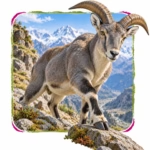
Siberian Ibex Fact Highlight
From the full animal facts page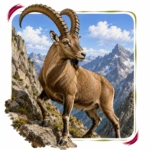
More Animal Comparisons
Pick another animal matchup and keep exploring. Compare appearances, habitats, diets, abilities, and surprising differences.

Make an Animal Story
Create a high-mountain story with a hidden bharal herd and a giant-horned ibex!
Source notes: References used for this comparison. See more See less
Try Another Matchup
Explore this comparison →