
Dingo vs Wolf: Living Wild Canid Lineage Comparison
Dingoes and gray wolves are intelligent wild members of the dog family Canidae. Both have strong senses, padded paws, non-retractable claws, bushy tails, carnivorous diets, pups, territories, and a rich language of scent, posture, sound, and facial signals. A dingo is a smaller ancient dog lineage shaped by thousands of years in Australia. A gray wolf is a much larger Canis lupus predator of the Northern Hemisphere whose closely cooperating family packs can travel and hunt across enormous ranges.
About Dingo
- Type Mammal
- Diet Opportunistic carnivore and scavenger; small and medium mammals, kangaroos and wallabies, rabbits, rodents, birds, reptiles, insects, fish, eggs, carrion, and occasional fruit depending on place and season
- Group Dingo (Canis familiaris; ancient dog lineage; Family Canidae)
- Known for Lean medium-sized wild canid with wedge-shaped head, long narrow muzzle, upright pointed ears, amber or brown eyes, deep chest, slim waist, straight strong legs, white-tipped bushy tail, and coats that may be ginger, sandy, black and tan, black, or white
- Special skill Thriving across extremely different Australian climates while using keen senses, efficient travel, flexible hunting, territorial howls, and an adaptable menu
About Wolf
- Type Mammal
- Diet Carnivore; deer, elk, moose, caribou, wild sheep and goats, bison calves, beavers, hares, rodents, fish, birds, carrion, and other available food varying by region and pack
- Group Gray Wolf (Canis lupus; Family Canidae)
- Known for Large long-legged wild canid with broad head, powerful jaws, rounded triangular ears, deep narrow chest, large paws, long muzzle, dense double coat, sloping back line, and long bushy tail normally carried below the back
- Special skill Traveling long distances with an energy-saving trot and combining family cooperation, scent, hearing, howls, endurance, and large paws to locate and pursue widely scattered prey
Dingo vs Wolf: Quick Answer
A dingo is Australia’s wild canid and is currently classified by major Australian authorities as an ancient form of Canis familiaris, the domestic-dog lineage. A gray wolf is Canis lupus, a separate and usually much larger species native to the Northern Hemisphere. Dingoes often hunt alone or in small flexible groups; wolves more consistently live in family packs. Both howl, defend territories, care for pups, and must never be approached, fed, or treated like pets.
Where Do They Fit?
Follow the branches to see how Dingo and Wolf are classified and related.
Dingo vs Wolf: Quick Comparison
| Feature | Dingo | Gray Wolf |
|---|---|---|
| Current scientific name used here | Canis familiaris | Canis lupus |
| Typical adult mass | About 12–24 kg in Australian Museum guidance | Often about 30–60 kg, varying greatly by sex and region |
| Body build | Lean, light, narrow-waisted, and agile | Larger, broader-headed, heavier-boned, and powerful |
| Native landscape | Australian deserts, grasslands, woodlands, forests, and coasts | Northern tundra, taiga, forests, grasslands, mountains, and semi-deserts |
| Social pattern | Alone, paired, or in flexible family packs | Usually a closely cooperating family pack |
| Main prey pattern | Many small-to-medium animals plus larger prey when cooperating | Often large hoofed mammals plus smaller prey and carrion |
| Voice | Howls and other calls; barking is relatively uncommon | Howls, barks, growls, whines, and other calls |
| Coat colors | Ginger is familiar, but black, tan, white, and mixed coats occur | Gray, brown, black, white, cream, and mixed coats occur |
| Young | Pups raised in a den with help possible from pack members | Pups raised in a den and cared for by the family pack |
| Human relationship | Ecologically and culturally important but managed differently across Australia | Protected, restored, hunted, or managed differently across its international range |
How Are Dingoes and Wolves Alike?
- Both are mammals in Canidae and share the long-legged, muzzle-and-tail body plan of the genus Canis.
- Both are intelligent territorial carnivores with excellent hearing, smell, stamina, and low-light vision.
- Both communicate through howls, scent marks, posture, facial expression, touch, and many quieter sounds.
- Both give birth to pups in sheltered dens and may have relatives help guard or feed the young.
- Both can hunt alone or cooperatively, eat carrion when useful, and strongly influence other animals in an ecosystem.
How Are Dingoes and Wolves Different?
- A gray wolf is normally much taller and two or more times heavier than a dingo.
- The wolf is Canis lupus; the dingo is currently listed by leading Australian taxonomic authorities within Canis familiaris, although older names remain widespread.
- Dingoes evolved as a wild Australian lineage after ancient dogs arrived thousands of years ago; wolves evolved across the Northern Hemisphere.
- Wolf packs are usually stable extended families, while dingoes more often switch between solitary, paired, and pack living.
- Wolves commonly cooperate to take large hoofed prey; dingoes rely more heavily on small-to-medium animals but can cooperate on larger prey.
- A dingo has a lighter wedge-shaped build and upright ears; a wolf has a broader head, bigger feet, denser cold-weather coat, and heavier frame.
Dingo vs Wolf Adaptation Showdown
Wild-canid adaptation showdown: Gray wolf wins size, whole-body strength, and social coordination because it is much heavier and its stable family pack shares travel, pup care, defense, and hunting. Speed is a tie because both are fast runners and published maximums vary too much for a fair invented race. Dingo wins stealth through its lean build, flexible group size, and quiet movement in Australian cover. Swimming is a tie because both can cross water without being aquatic specialists. Dingo wins weirdest fact for its debated names and unusual history as an ancient dog lineage turned Australian apex predator. These categories compare survival adaptations, not combat.
Fun Dingo vs Wolf Facts
The Dingo’s Scientific Name Has Changed
Dingoes have been called Canis dingo, Canis lupus dingo, Canis familiaris dingo, and other combinations. In 2024, the Australian Mammal Taxonomy Consortium and Australian Museum adopted Canis familiaris, treating the dingo as an ancient dog lineage rather than a wolf subspecies or separate species. Scientific names can change as experts review genetics, fossils, anatomy, history, and naming rules.
A Wolf Pack Is Usually a Family
The old idea of a pack ruled by constantly fighting alpha wolves came largely from unrelated captive animals. A wild pack is normally a breeding pair living with pups and older offspring. Parents guide much of the activity because they are the adults raising the family, while siblings cooperate, play, learn, and sometimes leave to find mates and territory.
Dingoes Are Not Always Ginger
Sandy-red dingoes with white feet and tail tips are familiar, but natural coats also include black and tan, sable, cream, solid black, and white. Color frequencies differ among regions and populations. Coat color by itself cannot reliably prove whether a free-ranging animal has dingo or recent domestic-dog ancestry; genetic evidence is more informative.
Howls Carry Information Across Country
Dingoes and wolves howl to locate separated relatives, gather a group, advertise a territory, or respond to other canids. Pitch, timing, repetition, and chorus patterns vary. A wolf or dingo is not necessarily sad or preparing to attack when it howls; the sound is long-distance social communication.
Dingoes Have Lived in Australia for Millennia
Archaeological and genetic evidence shows that the ancestors of dingoes reached Australia with people from Asia thousands of years before European colonization. They became embedded in ecosystems and hold deep cultural significance for many First Nations communities. Exact arrival estimates differ by method and evidence, so one single year should not be presented as certain.
Dingo vs Wolf Quiz
- Which animal is usually much larger? Answer: The gray wolf.
- What scientific name does the Australian Museum currently use for the dingo? Answer: Canis familiaris.
- What is a wolf pack usually made of? Answer: A breeding pair and their offspring, forming a family.
- Are all dingoes ginger? Answer: No; several natural coat colors occur.
- Why do dingoes and wolves howl? Answer: To communicate across distance, find companions, gather, or advertise territory.
Dingo vs Wolf FAQ
Is a dingo a wolf?
No. The gray wolf is Canis lupus. Current Australian Museum taxonomy places the dingo within Canis familiaris as an ancient dog lineage, although older wolf-based names remain in many books and websites.
Which is bigger, a dingo or wolf?
The gray wolf is normally much bigger. Australian Museum guidance gives dingoes a mass of about 12–24 kilograms, while adult wolves often weigh roughly 30–60 kilograms and vary by region.
Do dingoes live in packs?
They can, especially when defending territory, raising pups, or pursuing larger prey, but they also travel and hunt alone or in pairs.
Can dingoes and wolves bark?
Both can make bark-like sounds, but dingoes bark relatively rarely and are especially known for varied howls.
Are wild dingoes safe to feed?
No. Feeding can make a dingo approach people and associate them with food. Follow local wildlife rules, secure food and rubbish, supervise children closely, and keep a respectful distance.
Animal Words to Know
- Canid: A member of the dog family Canidae, including wolves, coyotes, jackals, foxes, dingoes, and domestic dogs.
- Pack: A social group of canids, often a family in wolves and dingoes.
- Territory: An area an animal or group uses and defends against rivals.
- Lineage: A line of descent through evolutionary history.
- Apex predator: A predator near the top of a food web with few or no regular natural predators as an adult.
Dingo and Wolf Canid Activity
Dingo and Wolf Canid Activity
Draw a dingo and gray wolf on the same ground line. Make the wolf much larger, with a broad head, long legs, large paws, and a thick coat. Give the dingo a lean body, pointed ears, and a bushy tail. Add a small map showing Australia for the dingo and the Northern Hemisphere for the wolf. Label canid, pup, pack, howl, territory, and habitat.
Meet Each Animal
Want the full fact file? Here are quick highlights from each animal’s own facts page.
Dingo Fact Highlight
From the full animal facts page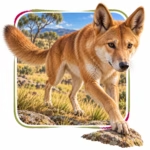
Wolf Fact Highlight
From the full animal facts page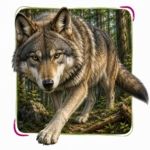
More Animal Comparisons
Pick another animal matchup and keep exploring. Compare appearances, habitats, diets, abilities, and surprising differences.




Make an Animal Story
Turn this dingo vs wolf comparison into a two-hemisphere wild-canid journey with our free Animal Story Generator.
Source notes: References used for this comparison. See more See less
Try Another Matchup
Explore this comparison →