
Dire Wolf vs Gray Wolf: Extinct vs Living Canid Comparison
Dire wolves and gray wolves were both large dog-family predators with similar long-legged, deep-chested outlines, but they were not simply ancient and modern versions of one species. Ancient DNA indicates that the dire-wolf lineage split from the ancestors of living wolf-like canids about 5.7 million years ago. Dire wolves evolved a heavier head, larger teeth, and a more robust body in the Americas, while gray wolves evolved in Eurasia and later spread widely across the Northern Hemisphere.
About Dire Wolf
- Type Extinct Mammal
- Diet Carnivore; horses were important prey in several studies, along with bison, camels, ground sloths, young proboscideans, other large mammals, and scavenged carcasses depending on place
- Group Dire Wolf (Aenocyon dirus; also classified as Canis dirus or Canis (Aenocyon) dirus; Family Canidae)
- Known for A large head, broad muzzle, robust skull and teeth, strong jaws, heavy muscular body, sturdy limbs, bone-crunching dental wear, wolf-like proportions produced by convergent evolution, and an uncertain coat color
- Special skill Combining a robust skull, large teeth, powerful bite, and heavy build for tackling or processing large Ice Age prey
About Gray Wolf
- Type Mammal
- Diet Carnivore and opportunistic feeder; deer, elk, moose, caribou, bison, wild boar, beavers, hares, rodents, fish, carrion, and occasional plant foods depending on region
- Group Gray Wolf (Canis lupus; Family Canidae)
- Known for Long legs, narrow chest, deep rib cage, large paws, long bushy tail, 42 teeth, powerful jaws, thick weather-resistant coat ranging from white to black, keen senses, endurance travel, speed, howling, and cooperative family packs
- Special skill Traveling long distances efficiently while coordinating with pack members through howls, scent, posture, and cooperative movement
Dire Wolf vs Gray Wolf: Quick Answer
A dire wolf was an extinct American canid that was generally heavier-built than an average gray wolf, with a larger head and more robust teeth. A gray wolf is a living Canis species with a lighter endurance-running build, highly studied family packs, and an enormous Northern Hemisphere range. Despite their similar shapes, ancient DNA shows that their lineages had been separate for millions of years.
Where Do They Fit?
Follow the branches to see how Dire Wolf and Gray Wolf are classified and related.
Dire Wolf vs Gray Wolf: Quick Comparison
| Feature | Dire Wolf | Gray Wolf |
|---|---|---|
| Scientific name | Aenocyon dirus; Canis dirus remains an alternative usage | Canis lupus |
| Status | Extinct about 10,000–13,000 years ago depending on the youngest accepted fossils and dating method | Living across parts of North America, Europe, and Asia |
| Relationship | Last known member of a deeply divergent New World canid lineage | Closer to coyotes and dogs than to dire wolves |
| Lineage split | Ancient-DNA study estimated separation from living wolf-like canids about 5.7 million years ago | Belongs to the younger Canis wolf lineage that evolved in Eurasia |
| Typical mass | Often reconstructed around 60–70 kg, though estimates and individuals vary | About 23–80 kg across sexes and populations; northern males are usually largest |
| Build | Heavier, more muscular, with a broad head and robust teeth | Generally lighter and longer-legged for efficient distance travel |
| Range | Mainly the Americas, from northern North America into parts of South America | Broad but fragmented Northern Hemisphere distribution |
| Food | Large Ice Age herbivores and carcasses, reconstructed from fossils and chemistry | Living ungulates, smaller animals, fish, carrion, and occasional plants depending on region |
| Pack evidence | Probable but inferred from fossils; exact group structure is unknown | Directly observed family packs that hunt, travel, defend territories, and raise pups together |
| Main evidence | Fossils, ancient proteins, ancient DNA, isotopes, wear, and biomechanical models | Living observation, tracking, genetics, anatomy, camera traps, and long-term field research |
How Were Dire Wolves and Gray Wolves Alike?
- Both belonged to Canidae, the dog family, and had long muzzles, upright ears, non-retractable claws, padded paws, bushy tails, and carnassial teeth.
- Both were large meat-eating predators capable of hunting hoofed mammals and scavenging carcasses.
- Both had strong jaws and teeth adapted to slice meat, grip food, and process some bone.
- Both lived in North America together during part of the late Pleistocene.
- Both probably benefited from social cooperation, although dire-wolf pack structure is an inference and gray-wolf family life is directly observed.
How Were Dire Wolves and Gray Wolves Different?
- Dire wolves belonged to a deeply separate lineage often called Aenocyon, while gray wolves belong to Canis.
- Dire wolves were typically heavier and more robust, with larger heads and teeth; gray wolves generally have a lighter endurance-travel build.
- Dire wolves evolved in the Americas, while gray-wolf ancestors evolved in Eurasia before gray wolves entered North America.
- Dire-wolf speed, coat, voice, swimming, and exact pack behavior must be inferred; those traits can be measured in living gray wolves.
- Dire wolves disappeared near the end of the Ice Age, while gray wolves survive across three continents and remain ecologically important today.
Dire Wolf vs Gray Wolf Showdown
Wolf showdown: The dire wolf wins typical size and robust strength because its skeleton, skull, and teeth were generally heavier than those of an average gray wolf, although the largest gray wolves overlapped its size. The gray wolf wins speed, stealth, social evidence, and swimming because these abilities are observed in living animals, while the corresponding dire-wolf traits remain fossil inferences. The dire wolf wins the weirdest-fact prize because DNA revealed that its wolf-like shape evolved on a lineage separated from gray wolves for roughly 5.7 million years. These categories compare adaptations and evidence, not an imaginary fight.
Fun Dire Wolf vs Gray Wolf Facts
Dire Wolves Were Not Oversized Gray Wolves
For decades, similar skulls and skeletons encouraged scientists to place dire wolves close to gray wolves in Canis. Ancient genomes changed that picture: the dire-wolf lineage separated from living wolf-like canids millions of years earlier and showed no detected gene flow with gray wolves or coyotes in the sampled fossils.
Their Size Difference Is Often Exaggerated
Dire wolves were heavier and more robust on average, but they were not horse-sized fantasy monsters. Many estimates place them around 60–70 kilograms, comparable to a large northern gray wolf. Their broader head, thick teeth, and muscular skeleton made the contrast more about build than towering height.
La Brea Preserved Thousands of Dire Wolves
More than 4,000 dire-wolf individuals are represented at La Brea Tar Pits. Carnivores may have approached trapped herbivores or carcasses and then become trapped themselves. Their abundance, repeated injuries, and prey ecology help scientists test possible social behavior, but they do not prove that every dire wolf lived in a modern-style pack.
A Gray-Wolf Pack Is Usually a Family
A typical gray-wolf pack is not a random army led by a permanently battling alpha. It is usually a breeding mother and father with their pups and older offspring. The adults guide travel and hunting, while family members communicate, guard territory, deliver food, and help care for young.
Dire Wolves Are Still Extinct
Animals announced in 2025 as revived dire wolves were genetically engineered gray wolves carrying selected edited traits. They were not clones of fossil dire wolves and did not contain a complete reconstructed dire-wolf genome. Natural History Museums of Los Angeles County experts therefore describe dire wolves as still extinct.
Dire Wolf vs Gray Wolf Quiz
- Were dire wolves simply ancient gray wolves? Answer: No; ancient DNA places them on a deeply separate canid lineage.
- Which animal was usually more robust? Answer: The dire wolf.
- Which wolf’s family packs can scientists observe today? Answer: The gray wolf’s.
- Where did dire wolves mainly evolve and live? Answer: In the Americas.
- Did genetically edited gray wolves bring the dire wolf back from extinction? Answer: No; dire wolves remain extinct.
Dire Wolf vs Gray Wolf FAQ
What was the main difference between a dire wolf and a gray wolf?
A dire wolf generally had a heavier body, larger head, and more robust teeth. More importantly, ancient DNA shows it belonged to a lineage that had been separate from gray-wolf ancestors for millions of years.
Was a dire wolf much bigger than a gray wolf?
It was usually heavier than an average gray wolf, but not dramatically taller. Large northern gray wolves overlapped the estimated mass and shoulder height of dire wolves.
Did dire wolves hunt in packs?
They probably used some form of social cooperation, based on fossil abundance, injuries, and prey ecology. However, fossils cannot prove that their groups worked exactly like observed gray-wolf families.
Why did dire wolves become extinct?
Their disappearance coincided with rapid environmental change and the loss of many large prey species near the Ice Age’s end. Human impacts and competition may also have contributed, but no single cause has been proved.
Have scientists brought dire wolves back?
No. The animals publicized in 2025 were gray wolves with selected genetic edits. They were not cloned dire wolves and did not recreate the extinct species’ complete genome.
Animal Words to Know
- Canid: Any member of the dog family, Canidae, including wolves, dogs, coyotes, jackals, and foxes.
- Aenocyon: The genus name now often used for the deeply divergent dire-wolf lineage.
- Convergent evolution: When separate lineages independently evolve similar traits because they face similar challenges.
- Ancient DNA: Genetic material recovered from preserved remains and used to study extinct or past populations.
- Isotope: A form of an element whose chemical pattern in fossils can help reconstruct diet or environment.
Dire Wolf and Gray Wolf Evidence Activity
Dire Wolf and Gray Wolf Evidence Activity
Draw skeletal side views of a dire wolf and gray wolf on the same ground line. Make their sizes overlap, but give the dire wolf a heavier head and teeth and the gray wolf a slightly slimmer build. Use a dotted outer coat on the dire wolf because its fur color is unknown. Add a fossil skull and ancient-DNA card for the dire wolf and tracks, photographs, and a radio collar for the gray wolf. Show them on separate family branches. Label extinct, living, fossil, ancient DNA, skull, and observation.
Meet Each Animal
Want the full fact file? Here are quick highlights from each animal’s own facts page.
Dire Wolf Fact Highlight
From the full animal facts page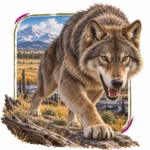
Gray Wolf Fact Highlight
From the full animal facts page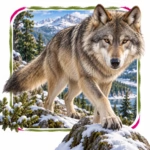
More Animal Comparisons
Pick another animal matchup and keep exploring. Compare appearances, habitats, diets, abilities, and surprising differences.





Make an Animal Story
Turn this dire wolf vs gray wolf comparison into an evidence-filled Ice Age pack adventure with our free Animal Story Generator.
Source notes: References used for this comparison. See more See less
Try Another Matchup
Explore this comparison →