
Dromedary vs Bactrian Camel: Hot-Desert One-Hump-to-Cold-Desert Two-Hump Camel Comparison
Dromedaries and domestic Bactrian camels are two closely related Camelus species shaped by people and different deserts. The one-humped dromedary is generally taller, longer-legged, and short-coated for hot deserts across Africa and southwestern Asia. The two-humped Bactrian is stockier and grows a shaggy winter coat for Central Asian deserts where summer heat flips into bitter winter cold. Both humps store fat, not tanks of liquid water, and both share remarkable feet, eyes, noses, lips, and water-saving physiology.
About Dromedary
- Type Mammal
- Diet A browsing herbivore eating thorny shrubs, acacia leaves, dry grasses, saltbush, forbs, and other sparse desert vegetation; mobile herds spread out and take a few mouthfuls from many plants, while tough split lips and a leathery mouth handle prickly food
- Group Dromedary, Camelus dromedarius, the one-humped domestic camel also called the Arabian camel; its original wild ancestor is extinct, nearly all dromedaries live under human care or herding, and Australia’s huge free-ranging population is feral rather than a surviving native wild lineage
- Known for A tall, relatively light-built camel with adult males often around 1.8–2.4 meters at the shoulder and roughly 400–690 kilograms, while females are commonly about 1.7–1.9 meters and 300–540 kilograms; breeds selected for riding, milk, meat, or load carrying vary substantially
- Special skill One fat-storing hump, long legs that lift the body above hot ground, a relatively short coat, broad two-toed pads, closable nostrils, double lashes, hairy ears, a split grasping lip, chest and knee calluses, concentrated waste, moisture-recovering nasal passages, heat-tolerant body-temperature change, and rapid rehydration support travel in hot dry country
About Bactrian Camel
- Type Mammal
- Diet A grazing and browsing herbivore able to chew dry grass, thorny twigs, reeds, bitter shrubs, and salty plants that many livestock avoid; it travels widely between thin forage patches, ruminates, and draws energy from stored hump fat when food becomes scarce
- Group Domestic Bactrian camel, Camelus bactrianus, the two-humped camel shaped by Central Asian herding; it is a different species from both the one-humped dromedary and the genuinely wild camel Camelus ferus, which is not the direct surviving ancestor of today’s domestic Bactrian camel
- Known for A shorter-looking, stockier camel commonly about 1.8–2.3 meters at the shoulder, 2.25–3.45 meters from head to rump, and roughly 300–690 kilograms in one broad reference range, with large breed and sex differences; its two humps and winter hair increase apparent height and bulk
- Special skill Two fat-storing humps, a heavy shaggy winter coat that sheds dramatically for summer, a compact stocky body, short ears lined with hair, closable nostrils, long lashes, broad tough foot pads that spread on sand or snow, callused resting pads, salt-tolerant browsing, water-saving physiology, and large seasonal body-temperature tolerance fit severe continental climates
Dromedary vs Bactrian Camel: Quick Answer
A dromedary has one hump, longer legs, and a shorter coat and is associated with hot deserts from Africa through Arabia and South Asia. A domestic Bactrian camel has two humps, a stockier body, and a thick winter coat and comes from the cold deserts and steppes of Central Asia. Dromedaries are usually taller; Bactrians look heavier and woollier. Their humps store fat, not water.
Where Do They Fit?
Follow the branches to see how Dromedary and Bactrian Camel are classified and related.
Dromedary vs Bactrian Camel: Quick Comparison
| Feature | Dromedary | Domestic Bactrian Camel |
|---|---|---|
| Scientific name | Camelus dromedarius | Camelus bactrianus |
| Humps | One | Two |
| Body shape | Taller, longer-legged, narrower, and generally lighter-looking | Stockier, shorter-looking, broader, and generally heavier-looking |
| Broad adult mass | Males often about 400–690 kg; females about 300–540 kg | About 300–690 kg in one broad reference range, varying by sex and breed |
| Coat | Relatively short and smooth, with longer hair on some body regions | Long, shaggy winter coat that is shed heavily before summer |
| Core climate | Hot arid and semiarid desert | Cold continental desert and steppe with hot summers and freezing winters |
| Main domestic region | Africa, Arabia, Middle East, and parts of South and Southwest Asia | Mongolia, northern China, Kazakhstan, and Central and Inner Asia |
| Wild status | No original wild population; large feral population in Australia | Domestic species; the wild camel Camelus ferus is a separate species |
| Travel clue | Long-legged riding and hot-desert transport breeds are common | Stocky cold-route pack, fiber, milk, and transport breeds are common |
| Memory trick | Turn D sideways to picture one rounded hump | Turn B sideways to picture two rounded humps |
How Are Dromedaries and Bactrian Camels Alike?
- Both are large even-toed herbivorous mammals in family Camelidae and genus Camelus, with long necks, split upper lips, three-chambered foreguts, and calves that nurse from their mothers.
- Both store energy-rich fat in humps rather than storing liquid water, and a hump shrinks or leans as the animal uses that reserve.
- Both conserve water through heat-tolerant physiology, concentrated urine, dry dung, moisture recovery in the nose, limited sweating, and the ability to rehydrate rapidly when water returns.
- Both protect themselves from dust with closable slit-like nostrils, long double eyelashes, hairy ears, and a transparent third eyelid, while tough lips handle thorny and salty vegetation.
- Both have two spreading toes resting on a broad leathery pad, a pacing gait that moves the legs on one side together, strong social and maternal bonds, and thousands of years of partnership with people.
How Are Dromedaries and Bactrian Camels Different?
- A dromedary has one hump; a domestic Bactrian camel has two, but all three humps are fat stores rather than water tanks.
- Dromedaries are usually taller, longer-legged, narrower, and shorter-haired; Bactrians are stockier, shorter-looking, and much more heavily coated in winter.
- Dromedaries are specialized for predominantly hot deserts and semiarid rangelands; Bactrians tolerate severe continental swings from hot summer to freezing, windy winter.
- Dromedary husbandry centers on Africa, Arabia, and southwestern and southern Asia; domestic Bactrian herding centers on Mongolia, northern China, Kazakhstan, and Central Asia.
- No original wild dromedary population survives, although Australia has feral animals; the domestic Bactrian is not the same species as the endangered genuinely wild camel Camelus ferus.
- Dromedaries often include long-legged riding and racing breeds; Bactrians are traditionally valued for cold-route packing, woolly fiber, milk, meat, and transport, although uses overlap and breed matters.
Dromedary vs Bactrian Camel Adaptation Showdown
Hot-desert runner versus cold-desert carrier showdown: Size is a tie because dromedaries are normally taller and longer-legged while Bactrians are stockier and may look heavier, and broad body-mass ranges overlap. Dromedary receives a cautious speed win for the lighter, longer-limbed build and specialized riding and racing breeds; no standardized all-breed species race exists. Bactrian wins strength narrowly for its compact build and long history as a heavy pack animal on cold Central Asian routes, but work capacity depends strongly on breed, training, load, weather, and welfare. Stealth is a tie because both sandy-to-brown coats suit open dry country and neither is an ambush animal. Social behavior is a tie because both are domestic herd species with comparable breeding groups and strong mother–calf bonds. Swimming is a tie: both can swim, some coastal dromedary breeds do so regularly, but neither species as a whole is aquatic. Bactrian wins strangest adaptation for combining two fat humps with a thick winter fleece that can peel away in great shaggy sheets before summer. These fields compare adaptations, not combat or forced performance.
Fun Dromedary vs Bactrian Camel Facts
Humps Store Fat, Not a Hidden Tank of Water
A camel concentrates fat in one or two humps instead of spreading as much insulation over the entire body. When food is scarce, metabolism releases energy from that fat and also produces some metabolic water, but the hump contains no sloshing reservoir. A well-fed hump stands plump; a depleted hump becomes smaller and may lean until nutrition restores it.
The Letters D and B Make a Useful Hump Trick
Turn a capital D onto its flat side and its single curve can remind you of the dromedary’s one hump. Turn a capital B onto its straight side and its two curves suggest a Bactrian camel’s two humps. The trick identifies the domestic species, but a two-humped animal could also be a rare wild camel or a hybrid, so context still matters.
The Wild Camel Is Not a Feral Domestic Bactrian
Camelus ferus is a genuinely wild, genetically distinct species surviving in only parts of Mongolia and northwestern China. It is not simply an escaped domestic Bactrian and is not the direct surviving ancestor of Camelus bactrianus. Dromedaries also lack an original wild population; Australia’s free-ranging herds descend from domestic animals and are therefore feral.
Bactrian Camels Drop a Winter Coat in Shaggy Sheets
A Central Asian winter demands long dense hair around the head, neck, legs, humps, and body. As warm weather arrives, the coat loosens in large uneven patches, making a healthy molting camel look temporarily ragged. Dromedaries grow protective hair too, but their core hot-desert design carries a much shorter overall coat.
The Two Domestic Camel Species Can Produce Hybrids
People along Central Asian trade routes have crossed dromedaries and Bactrian camels for centuries. A first-generation hybrid commonly has one long or partly divided hump and may combine large size with heat and cold tolerance. Many hybrids are fertile, but that does not erase the two parent species or turn the separate wild camel into their ancestor.
Dromedary vs Bactrian Camel Quiz
- How many humps does a dromedary have? Answer: One.
- What do camel humps store? Answer: Fat, not liquid water.
- Which camel grows the thicker shaggy winter coat? Answer: The domestic Bactrian camel.
- Where is the dromedary’s large feral population? Answer: Australia.
- Is the wild camel Camelus ferus simply a wild domestic Bactrian? Answer: No. It is a distinct genuinely wild species.
Dromedary vs Bactrian Camel FAQ
Which camel has one hump and which has two?
The dromedary, Camelus dromedarius, has one hump. The domestic Bactrian camel, Camelus bactrianus, has two. The genuinely wild camel, Camelus ferus, also has two humps but is a separate species from the domestic Bactrian.
Which camel is bigger?
There is no clean overall winner. Dromedaries are generally taller and longer-legged. Bactrians are stockier and look bulkier, especially in winter. Adult mass varies with sex, breed, nutrition, work, and measurement, and the species’ broad ranges overlap.
Do camels store water in their humps?
No. Humps store fat. Camels conserve water throughout the body by tolerating temperature change, reducing unnecessary sweating, producing concentrated urine and dry dung, recovering moisture from exhaled air, and safely rehydrating when water becomes available.
Can dromedaries and Bactrian camels live in the same place?
People keep both and breed hybrids in parts of Central and Southwest Asia. Each pure species is best matched to different climate patterns, and husbandry must provide suitable food, water, shelter, foot care, load limits, social contact, and veterinary care.
Are there wild dromedaries or Bactrian camels?
The original wild dromedary is extinct, and Australia’s free-ranging dromedaries are feral descendants of domestic animals. Domestic Bactrian camels are also livestock. A separate species called the wild camel, Camelus ferus, survives in Mongolia and China and should not be confused with either feral animals or domestic Bactrians.
Animal Words to Know
- Dromedary: The one-humped domestic camel, Camelus dromedarius.
- Bactrian: In this comparison, the two-humped domestic camel Camelus bactrianus.
- Feral: Descended from domesticated animals but now living and reproducing without routine human control.
- Hump fat: Concentrated energy tissue that shrinks as a camel uses it; it is not stored drinking water.
- Continental climate: A climate with large seasonal temperature swings, including the hot summers and freezing winters of Central Asian deserts.
Dromedary and Bactrian Camel Habitat Activity
Dromedary and Bactrian Camel Habitat Activity
Draw a dromedary and domestic Bactrian camel on the same ground line. Give the dromedary one hump, long legs, and a short coat in a hot desert. Give the Bactrian camel two humps, a stockier body, and shaggy winter hair in a cold Central Asian desert. Show the broad two-toed foot pads and long eyelashes shared by both. Add a note that the wild Bactrian camel is a separate species. Label hump, coat, foot pad, hot desert, cold desert, and calf.
Meet Each Animal
Want the full fact file? Here are quick highlights from each animal’s own facts page.
Dromedary Fact Highlight
From the full animal facts page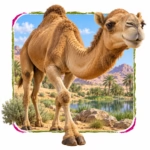
Bactrian Camel Fact Highlight
From the full animal facts page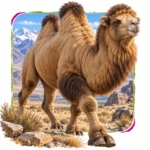
More Animal Comparisons
Pick another animal matchup and keep exploring. Compare appearances, habitats, diets, abilities, and surprising differences.





Make an Animal Story
Turn this dromedary vs Bactrian camel comparison into a one-hump hot-desert and two-hump snowy-steppe journey with our free Animal Story Generator.
Source notes: References used for this comparison. See more See less
Try Another Matchup
Explore this comparison →