
Elk vs Caribou: Mountain-Meadow-Elk-to-Tundra-Caribou Cervid Comparison
Elk and caribou are large northern members of the deer family, but they are different genera shaped for different landscapes. An elk is usually the larger, taller, darker-necked Cervus deer of forests, meadows, and mountain valleys. A caribou is the more compact Rangifer deer of tundra, taiga, peatland, and northern mountains. Bull elk and both male and many female caribou grow antlers. Elk are famous for pale rump patches and high bugles; caribou for wide snowshoe-like hooves, dense buoyant coats, female antlers, and—in some populations—enormous migrations. Caribou and reindeer are the same widely recognized species, not two animals to add as a third contestant.
About Elk
- Type Mammal
- Diet Mixed-feeding herbivore grazing grasses, sedges, and forbs and browsing leaves, shrubs, twigs, bark, conifer needles, and aquatic plants; diet changes with green-up, drought, snow, fire history, habitat, and local plant availability
- Group North American elk or wapiti, usually classified as Cervus canadensis in family Cervidae; some taxonomic treatments place wapiti with the Eurasian red deer as Cervus elaphus, so scientific labels may differ among otherwise reliable references
- Known for The second-largest living deer after the moose, with adult bulls commonly around 1.4–1.5 meters at the shoulder and roughly 320–500 kilograms while cows are smaller; both sexes have a tan-to-brown body, dark shaggy neck, slender dark legs, and large cream rump patch, but only bulls normally grow long swept-back branching antlers
- Special skill Long efficient legs, broad cloven hooves, a four-chambered ruminant stomach, insulating seasonal coat, conspicuous rump signal, annually renewed bull antlers, and coordinated herd vigilance support life from plains to mountains. A bull’s far-carrying whistle-like bugle advertises condition and warns rivals during the rut
About Caribou
- Type Mammal
- Diet Herbivore eating lichens and dried sedges heavily in many winter ranges, plus willow and birch leaves, grasses, sedges, forbs, mushrooms, and shrubs in warmer seasons; diet varies among tundra, mountain, island, and forest populations and no herd lives on “reindeer moss” alone
- Group Caribou, the North American common name for Rangifer tarandus in family Cervidae; reindeer is the Eurasian name for the same widely recognized species and is also used for domesticated or semi-domesticated Rangifer, although proposed taxonomic revisions divide some populations differently
- Known for A medium-to-large cold-adapted deer with short ears and tail, deep chest, dense two-layer coat, pale neck and rump, large spreading hooves, and irregular branching antlers; Alaska adult bulls average about 159–182 kilograms with exceptional individuals around 318 kilograms, while females are smaller, and both sexes commonly grow antlers
- Special skill Broad concave hooves spread across snow and soft tundra, dig craters for winter food, grip ice, and help paddle in water. Hollow guard hairs and dense underfur trap insulating air and add buoyancy. Many females retain antlers through winter after mature bulls have shed theirs, and a vascular nasal system warms cold inhaled air
Elk vs Caribou: Quick Answer
An elk is generally larger and taller, with a tan body, dark shaggy neck, pale rump patch, and antlers normally limited to males. A caribou is smaller and more compact, with a thick pale-necked coat, broad spreading hooves, and antlers in males and many females. Elk favor forests, meadows, and mountain valleys; caribou favor tundra, taiga, peatlands, and northern mountains. Caribou are the North American form of the same widely recognized species called reindeer in Eurasia.
Where Do They Fit?
Follow the branches to see how Elk and Caribou are classified and related.
Elk vs Caribou: Quick Comparison
| Feature | Elk | Caribou |
|---|---|---|
| Scientific name | Cervus canadensis in the treatment used here; some references use Cervus elaphus | Rangifer tarandus in the widely used treatment; taxonomy is under revision |
| Other name | Wapiti; “elk” means moose in much of Europe | Reindeer in Eurasia and for domesticated or semi-domesticated Rangifer |
| Typical build | Larger, taller, long-legged, with a dark mane-like neck | More compact and cold-adapted, with short ears and a deep insulating coat |
| Adult mass example | Yellowstone bulls about 318 kg and cows about 227 kg; regional bulls can be much heavier | Alaska bulls average about 159–182 kg and cows about 80–120 kg, with regional variation |
| Antlers | Normally grown by bulls; long main beams sweep back with upward tines | Grown by bulls and many cows; complex beams often include forward brow shovels |
| Core habitat | Forest edge, meadow, grassland, shrubland, and mountain valley | Tundra, taiga, peatland, coastal plain, and northern mountain |
| Winter food | Dry grass, shrubs, bark, twigs, and other reachable browse | Lichens, dried sedges, shrubs, and other foods uncovered from snow |
| Hooves | Strong travel hooves suited to slopes, meadow, forest, snow, and varied ground | Very broad spreading hooves used as snowshoes, digging scoops, traction edges, and paddles |
| Social spectacle | Rut herds organized around bugling bulls; seasonal cow-calf and bachelor groups | Some populations form enormous migration and post-calving aggregations |
| Most recognizable sound | Bull’s rising whistle-like bugle during rut | Cow-calf contact calls, grunts and huffs; walking can include tendon clicks |
How Are Elk and Caribou Alike?
- Both are even-toed hoofed ruminant mammals in family Cervidae, with four-chambered stomachs, cloven hooves, long legs, rotating ears, excellent senses, and one calf in a typical birth.
- Both grow antlers made of living velvet-covered bone and shed and regrow them on a seasonal cycle, although which sex grows them and when they drop differ.
- Both eat changing mixtures of grasses, sedges, forbs, leaves, shrubs, fungi, bark, and other plant material rather than following one identical menu all year.
- Both may form sex-separated groups outside the rut, gather for autumn breeding, migrate between seasonal ranges in some populations, and depend on connected habitat and safe movement corridors.
- Both are strong runners and capable swimmers, carry thick seasonal coats, communicate with scent and sound, and require a long respectful viewing distance because adults are powerful wild animals.
How Are Elk and Caribou Different?
- Elk belong to genus Cervus and caribou to genus Rangifer. They share the deer family but are not the same species, and neither is a moose.
- Elk are generally larger, taller, longer-legged, and darker through the neck; caribou are usually smaller, more compact, shorter-eared, and more heavily insulated for Arctic and subarctic cold.
- Only bull elk normally carry antlers, while both male and many female caribou grow them. Pregnant caribou cows may retain antlers until calving after mature bulls shed theirs in autumn.
- Elk hooves travel efficiently across forest, meadow, slope, and snow. Caribou hooves are unusually broad and concave, spreading over soft tundra, digging through snow, gripping seasonal surfaces, and paddling during swims.
- Elk diets emphasize grass, forbs, shrubs, bark, and other meadow or woodland plants. Caribou can digest large amounts of lichen in winter, then switch strongly toward green leaves, sedges, forbs, and mushrooms in summer.
- Many elk migrate between mountain summer and valley winter ranges, but some caribou populations make far longer tundra journeys and gather in much larger herds; other woodland, mountain, or island caribou are less migratory.
Elk vs Caribou Adaptation Showdown
Mountain-meadow deer versus tundra-travel deer showdown: Elk wins typical size because representative mature bulls and cows are generally much heavier and taller than comparable caribou, though sex and population create overlap. Speed is a tie because both can sprint and travel swiftly but popular maximum figures are not standardized direct trials. Elk wins absolute whole-body strength from its greater typical mass; the result is not a fight prediction. Stealth is a tie because elk blend into broken forest and meadow while caribou coats match tundra, snow, rock, and lichen country seasonally. Caribou wins social behavior for the enormous migratory and post-calving aggregations of some herds, while acknowledging that not every population migrates or gathers at that scale. Caribou wins swimming for broad paddle-like hooves, buoyant air-trapping fur, and routine river crossings during migration, although elk also swim capably. Caribou wins strangest adaptation for combining female antlers, seasonally useful snowshoe hooves, heat-saving nasal anatomy, and hollow guard hairs. These fields compare survival adaptations, not combat.
Fun Elk vs Caribou Facts
Caribou and Reindeer Are the Same Widely Recognized Species
Rangifer tarandus is generally called caribou in North America and reindeer in Eurasia. In Alaska and Canada, “reindeer” often especially means domesticated or semi-domesticated descendants of Eurasian stock, while caribou means wild native herds. Appearance can differ through geography, environment, and selective breeding, and newer taxonomic proposals split some Rangifer lineages, so names should always carry place and context.
Female Caribou Commonly Grow Antlers but Female Elk Usually Do Not
A caribou cow can grow a slender irregular rack, keep it through winter, and often retain it until around calving; large bulls commonly drop theirs after the autumn rut. Elk reverse the familiar picture: bulls grow sweeping antlers, while cows are normally antlerless. Antler timing changes access to food and status, and exceptional antlered female elk do not erase the broad difference.
Caribou Hooves Change Jobs With the Ground
A caribou’s large concave toes spread to support its weight on snow, mud, and soft tundra. The hard rim can bite into ice, and the hoof can scrape a crater through snow to reach lichens and sedges. In water, the broad feet help paddle. Elk hooves are excellent mountain-and-meadow travel tools, but they are not as wide or multipurpose as the caribou’s Arctic design.
Some Caribou Complete Enormous Seasonal Journeys
National Park Service tracking shows that some Arctic caribou populations travel more than 1,500 kilometers between calving and winter grounds and back, while individual annual GPS tracks can total far more through everyday movement. Other caribou populations move modestly or remain comparatively settled. Elk also migrate with snow and plant green-up, but the largest caribou routes and aggregations are on another scale.
An Elk Bull Makes a High Whistle From a Huge Body
During the autumn rut, a bull elk’s bugle begins as a deep or breathy note, rises into a piercing whistle, and may finish with grunts. The call announces the bull’s presence and condition across forest and meadow. Caribou communicate too, especially cows and calves, but the elk’s surprisingly high sound is one of North America’s clearest seasonal wildlife signals.
Elk vs Caribou Quiz
- Which animal is generally larger? Answer: The elk.
- Which sex grows antlers in caribou? Answer: Males and many females.
- What is a caribou called in Eurasia? Answer: A reindeer.
- Name two jobs of a caribou hoof. Answer: Any two of supporting on snow, digging for food, gripping ice, crossing soft tundra, or paddling while swimming.
- What famous call does a bull elk make in autumn? Answer: A bugle.
Elk vs Caribou FAQ
Is a caribou a type of elk?
No. Both are members of deer family Cervidae, but elk are Cervus canadensis in the treatment used here and caribou are Rangifer tarandus. They differ in body size, antler patterns, coat, hooves, habitat, diet, and migration.
Which is bigger, an elk or caribou?
Elk are generally bigger. Yellowstone bulls are roughly 318 kilograms and cows about 227 kilograms, while Alaska caribou bulls average around 159–182 kilograms and cows around 80–120 kilograms. Region, sex, season, nutrition, and taxonomic population matter, and exceptional individuals overlap.
Are caribou and reindeer the same animal?
Yes under the widely used classification: both are Rangifer tarandus. Caribou is the North American name for wild native animals; reindeer is the Eurasian name and often refers to domesticated or semi-domesticated stock in North America. Proposed taxonomic revisions may split lineages, so scientific treatments can differ.
Do female elk and female caribou have antlers?
Female elk normally do not grow antlers, though rare hormone-related exceptions occur. Many female caribou do grow antlers and pregnant cows commonly retain them through winter until near calving, after mature bulls have dropped theirs.
Do all elk and caribou migrate?
No. Many mountain elk move between high summer and low winter ranges, and several barren-ground caribou herds make enormous seasonal journeys. Other elk remain in smaller year-round ranges, while some woodland, mountain, island, or far-northern caribou move much shorter distances. Population and landscape matter.
Animal Words to Know
- Cervid: A member of deer family Cervidae, including elk, caribou, moose, and many animals called deer.
- Antler: A branching bone structure grown and usually shed annually; it differs from a permanent keratin-covered horn.
- Rut: The seasonal breeding period when mature males display, call, scent-mark, and compete for mating opportunities.
- Lichen: A partnership mainly between a fungus and a photosynthetic organism; several ground lichens are important winter caribou food.
- Migration: Regular seasonal movement between ranges, such as a calving area, summer feeding area, and winter range.
Elk and Caribou Habitat Activity
Elk and Caribou Habitat Activity
Draw an elk and caribou on the same ground line. Make the elk larger and taller, with a dark neck, pale rump patch, and swept-back branching antlers beside a mountain meadow. Give the caribou a compact body, pale neck, broad hooves, and a tundra herd; include an antlered female. Label antlers, hooves, bugle, migration, meadow, and tundra.
Meet Each Animal
Want the full fact file? Here are quick highlights from each animal’s own facts page.
Elk Fact Highlight
From the full animal facts page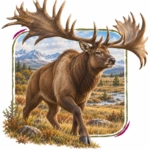
Caribou Fact Highlight
From the full animal facts page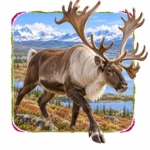
More Animal Comparisons
Pick another animal matchup and keep exploring. Compare appearances, habitats, diets, abilities, and surprising differences.






Make an Animal Story
Turn this elk vs caribou comparison into a mountain-meadow and tundra-migration journey with our free Animal Story Generator.
Source notes: References used for this comparison. See more See less
Try Another Matchup
Explore this comparison →