
Fly vs Gnat: Fly Group Comparison
A gnat is a fly, not a separate kind of insect. Fly is the scientific umbrella for the entire order Diptera, which includes house flies, hoverflies, fruit flies, crane flies, mosquitoes, midges, and many other forms. Gnat is an informal name usually given to certain tiny, delicate flies. Because different regions apply the word to different insects, no single scientific family contains every gnat.
About Fly
- Type Insect
- Diet Varies: nectar, sap, fungi, decaying matter, plants, prey, dung, carrion, or blood depending on species and life stage
- Group True Fly (Order Diptera)
- Known for One functional wing pair, balancing halteres, liquid-feeding mouthparts, complete metamorphosis, immense diversity, and vital roles in pollination and decomposition
- Special skill Using halteres for agile flight and filling an extraordinary range of ecological jobs
About Gnat
- Type Insect
- Diet Varies: fungi, decaying material, plant tissue, nectar, microorganisms, or blood depending on the fly
- Group Small True Fly (Informal Name)
- Known for Tiny delicate bodies, long legs or antennae in many forms, moist breeding sites, dancing swarms, and widely varied larval diets
- Special skill Using tiny damp habitats in soil, fungi, plants, streams, ponds, or decaying material for larval development
Fly vs Gnat: Quick Answer
Every gnat is a true fly, but most flies are not gnats. Fly means any insect in the order Diptera, whose adults use one functional pair of wings and two balancing halteres. Gnat is a flexible common name for several especially small flies, often with slender bodies, long legs or antennae, moist larval habitats, and swarming adults.
Where Do They Fit?
Follow the branches to see how Fly and Gnat are classified and related.
Fly vs Gnat: Quick Comparison
| Feature | Fly | Gnat |
|---|---|---|
| Animal type | Insect | Insect |
| Animal group | The entire order Diptera | An informal category inside Diptera |
| Examples | House flies, hoverflies, fruit flies, crane flies, mosquitoes, midges, and many others | Fungus gnats, gall gnats, biting midges, eye gnats, black flies, or other tiny flies depending on usage |
| Typical size | Ranges from almost microscopic to several centimeters long | Usually tiny and delicate |
| Body shape | Short, stout, hairy, flat, long-legged, mosquito-like, or many other forms | Often slender with long legs or multi-segmented antennae |
| Wings | One functional pair plus two halteres | One functional pair plus two halteres |
| Young stage | Larva, often called a maggot | Larva, with form depending on the fly family |
| Larval habitat | Soil, water, plants, fungi, wood, nests, carrion, dung, or other sites | Often moist soil, fungi, decaying matter, plants, streams, or ponds |
| Diet | Almost every kind of liquid or soft organic food | Fungi, decay, plants, nectar, microorganisms, or blood depending on group |
| Biting | Most do not bite people, but some families have biting adults | Many do not bite, although some insects called biting gnats do |
How Are Flies and Gnats Alike?
- Gnats are flies, so both belong to the insect order Diptera.
- Both adults normally fly with one functional wing pair and balance with halteres.
- Both have six legs, two antennae, compound eyes, and liquid-feeding adult mouthparts.
- Both undergo complete metamorphosis through egg, larva, pupa, and adult stages.
- Both include species that pollinate plants, recycle nutrients, feed other wildlife, or affect plants and animals.
How Are Flies and Gnats Different?
- Fly is the name for an entire scientific order, while gnat is an informal label within that order.
- Flies collectively range from tiny specks to very large crane flies and robber flies, while gnats are usually defined partly by their small size.
- Fly body shapes, antennae, mouthparts, diets, and habitats are extraordinarily varied, while familiar gnats often look slender and delicate.
- Fly larvae occupy nearly every kind of wet or organic habitat, while many gnat larvae are especially associated with moisture, fungi, decay, plants, streams, or ponds.
- Some familiar flies are strong long-distance or acrobatic fliers, while many fungus gnats are weak fliers that remain near their damp breeding material.
Fly vs Gnat Showdown
True-fly showdown: The broader fly order wins size, speed, strength, and swimming because it contains large robber flies, agile house flies, powerful predators, and many aquatic specialists. The gnat takes stealth through its extremely small body. Social life is a tie because most flies are solitary even when adults gather in swarms. The fly order wins our weirdest-fact prize for turning its ancestral hindwings into vibrating halteres that act like airborne motion sensors—a feature every gnat shares.
Fun Fly vs Gnat Facts
Every Gnat Is a Fly
Gnat is a common label nested inside the true-fly order Diptera. Comparing a gnat with a fly is like comparing a sparrow with a bird, except gnat is less exact because people apply the name to several unrelated small-fly families.
Two Wings Give Diptera Its Name
Diptera means two wings. Most adult true flies use only the front pair for flight, while the reduced hindwings form halteres that vibrate and detect body rotation during turns. Gnats carry the same equipment.
Gnat Is a Size-and-Shape Nickname
People commonly call a fly a gnat when it is very small, delicate, mosquito-like, or seen swarming. Fungus gnats, gall gnats, non-biting midges, biting midges, black flies, and eye gnats belong to several different families.
Fly Larvae Run Hidden Recycling Crews
Many fly larvae live out of sight in water, soil, fungi, leaf litter, dung, carrion, fruit, wood, or plant tissue. They break down material, hunt smaller organisms, filter water, or become food for fish and other animals.
Tiny Gnats Can Be Pollinators
Adult gnats may visit flowers for nectar and can transfer pollen, while fungus-feeding and decaying-matter-feeding larvae recycle nutrients. Some tiny midges are essential pollinators of plants with very small flowers, including cacao and certain orchids.
Fly vs Gnat Quiz
- Is a gnat a fly? Answer: Yes.
- What insect order contains all true flies? Answer: Diptera.
- How many functional wings does a typical adult true fly use? Answer: Two, or one pair.
- What are a fly’s balancing organs called? Answer: Halteres.
- Does the word gnat identify one exact scientific family? Answer: No.
Fly vs Gnat FAQ
What is the main difference between a fly and a gnat?
Fly is the broad scientific name for all insects in Diptera. Gnat is an informal name for several especially tiny kinds of flies.
Are gnats baby flies?
No. Adult gnats are fully grown flies. A young fly is a larva, often called a maggot, and later becomes a pupa before emerging as an adult.
Do all gnats bite?
No. Fungus gnats and non-biting midges do not bite people. Some small flies called biting gnats, no-see-ums, or black flies have biting females.
Why do gnats fly in clouds?
Many clouds are mating swarms made mostly of males, while others appear because many adults emerged from the same damp larval habitat at nearly the same time.
Does every fly look like a house fly?
No. The fly order includes delicate gnats, mosquitoes, long-legged crane flies, colorful hoverflies, fuzzy bee flies, strong robber flies, wingless parasites, and many other body forms.
Animal Words to Know
- Diptera: The insect order containing all true flies.
- Gnat: An informal and regionally variable name for several kinds of tiny fly.
- Halter: One club-shaped balancing organ formed from a true fly’s reduced hindwing.
- Maggot: A common name for the legless larva of many kinds of fly.
- Swarm: A gathering of flying insects, often formed for mating or after mass emergence.
Fly and Gnat Naming Activity
Fly and Gnat Naming Activity
Draw a house fly beside a much smaller fungus gnat, using a magnified circle for the gnat. Give both one working pair of wings and two tiny balancing organs behind them. Add an umbrella labeled “flies” over both animals and explain that gnat is an informal name for several small, delicate flies. Label fly, gnat, wing, balancing organ, antennae, and larva.
Meet Each Animal
Want the full fact file? Here are quick highlights from each animal’s own facts page.
Fly Fact Highlight
From the full animal facts page
Gnat Fact Highlight
From the full animal facts page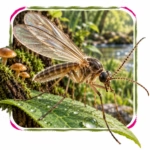
More Animal Comparisons
Pick another animal matchup and keep exploring. Compare appearances, habitats, diets, abilities, and surprising differences.






Make an Animal Story
Turn this fly vs gnat comparison into a miniature garden adventure with our free Animal Story Generator.
Source notes: References used for this comparison. See more See less
Try Another Matchup
Explore this comparison →