
Gila Monster vs Rattlesnake for Kids
Gila Monsters and Western Diamondback Rattlesnakes share dry parts of the southwestern United States and northern Mexico, but one is a stocky lizard and the other is a pit viper. Both are venomous, both prefer to avoid people, and both help control animal populations. Their scales, movement, senses, and venom systems reveal two very different reptile designs.
About Gila Monster
- Type Reptile
- Diet Carnivore; eggs, nestlings, small mammals, lizards, frogs, insects, and carrion
- Group Lizard; family Helodermatidae
- Known for Beadlike scales, a thick tail, and venom delivered through grooved lower teeth
- Special skill A firm chewing bite moves venom from lower-jaw glands along grooves in its teeth
About Western Diamondback Rattlesnake
- Type Reptile
- Diet Carnivore; mostly small mammals plus birds, lizards, and other prey
- Group Pit viper; family Viperidae
- Known for Dark back diamonds, black-and-white tail bands, heat-sensing pits, and a rattle
- Special skill Paired facial pits detect heat, while hinged hollow fangs inject venom
Quick Answer
Quick answer: The Western Diamondback is the longer and heavier animal in the published ranges used here. It senses warm prey with facial pits and injects venom through long hollow fangs. The Gila Monster has four legs, beadlike armored scales, and a thick tail that stores fat. Its venom flows from glands in the lower jaw along grooved teeth as the lizard holds and chews.
Gila Monster vs Western Diamondback Rattlesnake: Quick Comparison
| Feature | Gila Monster | Western Diamondback Rattlesnake |
|---|---|---|
| Scientific identity | Heloderma suspectum | Crotalus atrox |
| Reptile body | Heavy lizard with four short legs | Heavy-bodied snake with no legs |
| Published adult size | Up to about 56 cm and roughly 0.7-1.4 kg | Often around 1.5 m; published mass can reach about 6.7 kg |
| Range | Southwestern United States and northwestern Mexico | Southwestern United States and northern to central Mexico |
| Outer pattern | Black with pink, orange, or yellow beadlike scales | Brown or gray with dark diamonds and black-and-white tail rings |
| Venom delivery | Lower-jaw glands and grooved teeth; holds and chews | Upper-jaw glands and long hinged hollow fangs; strikes and releases |
| Special sense | Strong smell and tongue-based chemical sensing | Smell plus paired heat-sensitive facial pits |
| Food | Eggs, nestlings, small mammals, lizards, frogs, insects, and carrion | Small mammals, birds, lizards, and other prey swallowed whole |
| Young | Lays eggs; young hatch from underground nests | Gives birth to live young equipped with fangs and venom |
| Warning clue | Bold colors, hissing, and a strong gripping bite if threatened | A raised coil and rapidly vibrating rattle may warn danger away |
How Are Gila Monsters and Rattlesnakes Alike?
- Both are venomous reptiles native to dry parts of North America.
- Both are carnivores that eat small animals and can follow chemical scent clues with the tongue.
- Both often use burrows, rock shelters, or crevices to escape extreme heat and cold.
- Both are generally solitary and avoid wasting energy in harsh desert conditions.
- Both should be watched only from a safe distance and left undisturbed in the wild.
How Are Gila Monsters and Rattlesnakes Different?
- The Gila Monster is a four-legged lizard; the Western Diamondback is a limbless snake.
- The rattlesnake is much longer and can be several times heavier than the Gila Monster.
- Gila Monsters move venom along grooved lower teeth while chewing; rattlesnakes inject venom through hinged hollow fangs.
- The rattlesnake has paired heat-sensing facial pits and a tail rattle; the Gila Monster has neither.
- Gila Monsters lay eggs, while Western Diamondbacks give birth to live young.
Gila Monster vs Rattlesnake Showdown
Adaptation showdown: Western Diamondback Rattlesnake wins size because its published length and mass are much greater. Speed is a Tie because the sources do not give a fair matched travel test. Strength is a Tie because a tenacious lizard bite and a fast snake strike are different tools without a matched measure. Western Diamondback Rattlesnake wins stealth because camouflage and heat pits support hidden ambush hunting in dim conditions. Social behavior is a Tie because both are usually solitary, although rattlesnakes may share winter dens. Swimming is a Tie because neither is treated here as a water specialist. Western Diamondback Rattlesnake wins weirdest for a keratin rattle with interlocking segments and paired pits that sense tiny heat differences.
Fun Gila Monster vs Western Diamondback Rattlesnake Facts
Venom Takes Two Routes
A Gila Monster’s venom glands sit in the lower jaw, and the liquid travels along grooves in the teeth while the animal holds and chews. A rattlesnake stores venom near the upper jaw and injects it through long hollow fangs.
A Tail That Stores Energy
A well-fed Gila Monster stores fat in its thick tail and body. That reserve helps the slow-moving lizard live through long stretches when it remains in a burrow or food is scarce.
The Rattle Is Empty
A rattlesnake’s hollow-looking rattle has no tiny beads inside. Its loose keratin segments knock against one another as the tail vibrates rapidly, creating the famous buzzing sound.
Heat Clues in Darkness
Each pit between a rattlesnake’s eye and nostril detects infrared heat. The brain combines those signals with vision, helping the snake locate warm prey even when light is poor.
Counting Rings Does Not Give Age
A rattle segment is added after a shed, but snakes may shed several times in a year and older segments break off. That means the number of rattle pieces does not reveal an exact age.
Gila Monster vs Rattlesnake Quiz
- Which animal is a lizard with four legs? Answer: The Gila Monster.
- Which animal has heat-sensing facial pits? Answer: The Western Diamondback Rattlesnake.
- How does a Gila Monster deliver venom? Answer: It holds and chews so venom moves along grooves in its lower teeth.
- What makes a rattlesnake’s rattle buzz? Answer: Loose keratin segments strike one another.
- Which reptile lays eggs? Answer: The Gila Monster.
Gila Monster vs Western Diamondback Rattlesnake FAQ
Is a Gila Monster a snake?
No. It is a venomous lizard with four short legs.
Which is bigger, a Gila Monster or Western Diamondback?
The Western Diamondback is much longer and reaches a much greater published mass.
Can a rattlesnake’s age be counted from its rattle?
No. Segments may break off, and more than one can be added in a year.
Do Gila Monsters spit or jump at people?
No. They do not spit venom or leap at people, and they normally avoid contact.
What should you do if you see either reptile?
Stay well back, do not touch or corner it, and let a knowledgeable adult or wildlife professional handle any safety concern.
Animal Words to Know
- Venom: A toxin delivered by a bite, sting, spine, or similar body structure.
- Pit viper: A viper with heat-sensitive pits on the face.
- Keratin: The tough protein that makes structures such as claws, fingernails, scales, and rattle segments.
- Osteoderm: A small plate of bone in the skin that adds armor.
- Infrared: Energy associated with heat that people cannot see but some animals can detect.
Build a Desert Reptile Clue Board
Build a Desert Reptile Clue Board
Draw exactly one adult Gila Monster and exactly one adult Western Diamondback Rattlesnake in neighboring desert habitats at honest relative scale, with the snake much longer. Add labeled cards for four legs, no legs, grooved teeth, hollow fangs, beadlike scales, heat pits, fat-storing tail, and rattle. Sort each card and explain the clues. Observe wild reptiles from a distance without people handling animals.
Meet Each Animal
Want the full fact file? Here are quick highlights from each animal’s own facts page.
Gila Monster Fact Highlight
From the full animal facts page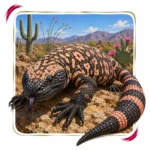
Western Diamondback Rattlesnake Fact Highlight
From the full animal facts pageMore Animal Comparisons
Pick another animal matchup and keep exploring. Compare appearances, habitats, diets, abilities, and surprising differences.



Make an Animal Story
Send a careful Gila Monster and a heat-sensing Western Diamondback into a desert mystery with our free Animal Story Generator.