
Grasshopper vs Locust: Grasshopper-to-Locust Phase Comparison
Every locust is a kind of short-horned grasshopper, but most grasshoppers can never become locusts. This row compares a differential grasshopper with a desert locust so measurements stay concrete. Both are six-legged Acrididae insects with short antennae, enlarged jumping legs, chewing mouthparts, egg-nymph-adult life cycles, and plant diets. The special locust difference is phase polyphenism: crowding can change behavior, color, body proportions, physiology, and attraction to neighbors, producing marching hopper bands and migrating adult swarms.
About Grasshopper
- Type Insect
- Diet A broad plant eater that consumes both forbs and grasses, including ragweed, sunflower, prickly lettuce, soybean, wheat, corn, cotton, vegetables, and other available plants; favored foods change with place and plant condition
- Group Differential grasshopper (Melanoplus differentialis), used as one measurable non-locust example; thousands of other animals called grasshoppers differ in size, colors, food, habitat, wings, songs, and behavior
- Known for A robust short-horned grasshopper usually about 3–5 centimeters long depending on sex and population, with yellow, greenish, tan, or sometimes black coloring, distinctive black chevrons on the enlarged hind femora, short antennae, two large compound eyes, chewing mouthparts, two pairs of wings as an adult, and six legs including extremely powerful jumping hind legs
- Special skill Huge femora storing energy for sudden jumps, spiny hind tibiae, wings for escape and dispersal, short antennae, side-positioned compound eyes, a tympanal hearing membrane on the abdomen, sound made by rubbing body parts, strong chewing mandibles, camouflage, egg pods protected in soil, winter egg diapause, and multiple nymphal molts before adulthood
About Locust
- Type Insect
- Diet Leaves, shoots, flowers, seeds, grasses, shrubs, and crops; an adult may eat roughly its own body mass, about two grams, in fresh vegetation per day, so the effect becomes enormous only when millions feed together
- Group Desert locust (Schistocerca gregaria), used as the best-studied locust example; only a small minority of short-horned grasshopper species can make a true crowd-triggered locust phase
- Known for A large short-horned grasshopper with adults commonly about 4.5–6 centimeters in the gregarious phase, females generally larger than males, long clear wings extending beyond the abdomen, strong jumping legs, chewing mouthparts, and color that changes with phase and age: solitary forms are camouflaged, crowded immature adults often pink, and mature gregarious males bright yellow
- Special skill Density-sensitive phase polyphenism affecting attraction, activity, color, shape, metabolism, and reproduction; long wings and wind-assisted endurance flight; visual and odor cues for coordinated movement; large food intake; tough egg pods laid in moist sandy soil; repeated generations after rain; powerful jumps; broad plant diet; and flexible timing that lets populations exploit short-lived desert greenery
Grasshopper vs Locust: Quick Answer
A locust is not a separate insect order—it is one of the few grasshopper species able to switch between a mostly solitary phase and a crowded gregarious phase. Most grasshoppers, including the differential grasshopper used here, may gather or have outbreaks but do not make that full reversible change. Desert-locust nymphs can form marching hopper bands, and the winged adults can form vast migrating swarms.
Where Do They Fit?
Follow the branches to see how Grasshopper and Locust are classified and related.
Grasshopper vs Locust: Quick Comparison
| Feature | Grasshopper (Differential Grasshopper) | Locust (Desert Locust) |
|---|---|---|
| Scientific name | Melanoplus differentialis | Schistocerca gregaria |
| Family | Acrididae, the short-horned grasshoppers | Acrididae, so it is also a short-horned grasshopper |
| Selected adult size | Roughly 3–5 cm, with females generally larger | Gregarious adults commonly about 4.5–6 cm, with females generally larger |
| Low-density behavior | Usually independent; no true alternative locust phase | Solitarious individuals avoid one another and behave much like ordinary grasshoppers |
| Crowding response | Can aggregate or break out without the complete locust transformation | Can change behavior, attraction, color, shape, and physiology toward a gregarious phase |
| Young stage | Wingless nymph that molts several times | Wingless nymph called a hopper; gregarious hoppers form marching bands |
| Adult movement | Jumps and makes short or sometimes longer dispersal flights | Gregarious adults make sustained wind-assisted swarm flights |
| Main example range | North America, especially the central United States | Africa, the Near East, and southwest Asia, expanding widely during plagues |
| Color clue | Often yellow-green or tan with black chevrons on the hind femur | Changes with phase and maturity; crowded young adults may be pink and mature males yellow |
| Group word | Aggregation or outbreak; not every moving mass is a true locust swarm | Hopper band for crowded nymphs and swarm for gregarious winged adults |
How Are Grasshoppers and Locusts Alike?
- Both selected insects belong to order Orthoptera, suborder Caelifera, and family Acrididae; biologically, the locust is a specialized grasshopper.
- Both have an exoskeleton, six legs, short antennae, compound eyes, chewing mouthparts, enlarged jumping hind legs, and two pairs of wings as healthy adults.
- Both pass through incomplete metamorphosis—egg, several wingless nymphal instars, and adult—with no caterpillar or pupal stage.
- Both eat vegetation, lay groups of eggs in soil, shed their outer skeleton to grow, and rely on warmth to power much of their activity.
- Both can become agricultural pests at high density, and non-locust grasshoppers can also gather, march, migrate, and damage crops during outbreaks.
How Are Grasshoppers and Locusts Different?
- Most grasshopper species have one broad behavioral form; locust species can reversibly shift between solitarious and gregarious phases as population density and environmental conditions change.
- A differential grasshopper may form outbreak bands without becoming a different phase; a crowded desert locust changes attraction, activity, color, physiology, and sometimes body proportions over time.
- Gregarious desert-locust hoppers align into dense marching bands, and adults form coordinated, long-traveling swarms; ordinary grasshopper outbreaks are generally less cohesive and less persistently migratory.
- The selected differential grasshopper lives in North American meadows, field edges, and cropland; the desert locust is adapted to irregular rainfall and temporary greenery across African and Asian drylands.
- Differential-grasshopper coloring stays centered on green, yellow, tan, or black variation with hind-leg chevrons; a desert locust’s appearance changes conspicuously with phase, age, sex, and reproductive maturity.
- “Grasshopper” is a broad common name covering thousands of species, whereas “locust” is an ecological label reserved for a small set of grasshoppers with the swarming phase syndrome.
Grasshopper vs Locust Adaptation Showdown
Jumping-insect adaptation showdown: Locust wins typical size only for the chosen desert-locust and differential-grasshopper examples; grasshopper species range from tiny to larger than either. Locust wins speed for sustained wind-assisted travel, not necessarily a single jump or still-air sprint. Strength is a tie because both have powerful size-adjusted jumping legs and no fair universal test. Grasshopper wins stealth because the selected solitary insect relies more consistently on camouflage and spacing, though solitarious locusts also hide well. Locust wins teamwork for aligned hopper bands and adult swarms, and weirdest adaptation for density-triggered phase polyphenism. Swimming is a tie because neither is aquatic. These categories compare adaptations, not a fight.
Fun Grasshopper vs Locust Facts
Every Locust Is a Grasshopper, but the Reverse Fails
“Locust” does not name a separate order or family. It describes a small set of short-horned grasshopper species that can express a powerful gregarious phase. A differential grasshopper and a desert locust both belong to Acrididae, yet only the desert locust carries the inherited phase-switching system needed to make classic hopper bands and migratory swarms.
Crowding Can Rewrite a Locust’s Social Rules
A solitarious desert locust tends to avoid neighbors. After rain grows abundant food, repeated breeding can raise density; as vegetation later shrinks, bodies meet more often. Touch, sight, and odor help trigger nervous-system changes that make locusts more active and attracted to one another. Full changes in color, form, metabolism, and reproduction develop across hours, molts, or generations rather than in one magical instant.
Hoppers March Before Adults Fly
A young locust is called a hopper because it has not yet grown working wings. Gregarious hoppers gather into bands that walk and hop in the same general direction. After the final molt, adults can join flying swarms. Calling a wingless band a swarm misses an important life-stage clue, while calling every grasshopper gathering a locust band misses the phase clue.
A Swarm Travels with Moving Air
FAO reports that desert-locust swarms commonly move with the wind at roughly 16–19 kilometers per hour and may cover about 5–130 kilometers or more in a day. A square kilometer can contain roughly 40–80 million adults. The insects do not flap as one perfect machine; each responds to neighbors, light, temperature, food, and air while the whole crowd moves across the landscape.
An Outbreak Does Not Automatically Make a Locust
Differential grasshoppers can reach damaging densities, move as nymph bands, and fly from dry vegetation into crops. Some outbreak adults even develop longer wings and slimmer bodies. Those changes are real, but researchers do not classify this species as a true locust because it lacks the complete density-driven solitarious-to-gregarious syndrome and the characteristic long-range swarm cycle.
Grasshopper vs Locust Quiz
- Is every locust a grasshopper? Answer: Yes. Locusts are specialized short-horned grasshoppers.
- Can every grasshopper turn into a locust? Answer: No. Only a small number of species have the inherited phase-switching ability.
- What is a wingless young locust called? Answer: A nymph or hopper.
- What group do gregarious hoppers form before they have adult wings? Answer: A hopper band.
- What does phase polyphenism mean here? Answer: The same locust species can develop contrasting solitary and gregarious forms in response to population density and conditions.
Grasshopper vs Locust FAQ
Are locusts and grasshoppers the same animal?
A locust is a grasshopper, but “grasshopper” covers thousands of species. Only a small minority can make the dramatic crowd-triggered phase change associated with locust bands and swarms. They share the same basic insect body plan and are not separate orders.
Can an ordinary grasshopper become a locust?
No. Crowding cannot give a species a biological system it never evolved. Some non-locust grasshoppers form outbreaks, aggregations, or moving bands, but that does not turn them into desert locusts or create the full locust phase syndrome.
Do locusts always live in swarms?
No. During quiet periods, desert locusts occur at low density in a solitarious phase and generally avoid one another. Favorable rain, breeding, concentration, and crowding can push populations toward the gregarious phase. Swarms are temporary outcomes, not the insect’s permanent lifestyle.
Why do desert locust swarms form after rain?
Rain moistens sandy soil for eggs and grows temporary vegetation that feeds parents and young. Several successful generations can multiply the population. When vegetation becomes patchy or dries, locusts crowd into smaller green areas, and repeated contact plus visual and odor cues promote gregarization.
Do locusts bite or sting people?
They have chewing mouthparts but do not hunt people, have no stinger, and are mainly a crop and food-security threat. A handled insect might nip defensively. Never collect or eat locusts from an outbreak because control operations may have exposed them to pesticides.
Animal Words to Know
- Acrididae: The family of short-horned grasshoppers that includes all true locust species.
- Phase polyphenism: The ability of one species to develop contrasting forms in response to conditions such as crowding.
- Gregarious: Attracted to others and behaving as part of a group rather than avoiding neighbors.
- Hopper: A wingless locust nymph that moves mainly by walking and jumping between molts.
- Swarm: A large, mobile aggregation of winged gregarious adult locusts.
Grasshopper and Locust Phase Activity
Grasshopper and Locust Phase Activity
Draw an ordinary grasshopper beside three stages of a desert locust: a solitary locust, a crowded hopper band, and an adult swarm. Add arrows showing how rain, new plant growth, and crowding can help trigger the change to the gregarious phase. Write one clear note: a locust is a kind of grasshopper that can change phase, but most grasshoppers do not. Label grasshopper, locust, solitary, gregarious, hopper, and swarm.
Meet Each Animal
Want the full fact file? Here are quick highlights from each animal’s own facts page.
Grasshopper Fact Highlight
From the full animal facts page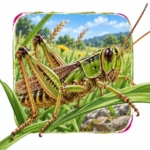
Locust Fact Highlight
From the full animal facts page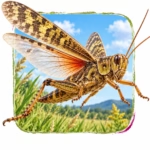
More Animal Comparisons
Pick another animal matchup and keep exploring. Compare appearances, habitats, diets, abilities, and surprising differences.



Make an Animal Story
Turn this grasshopper vs locust comparison into a rain, crowding, and moving-swarm mystery with our free Animal Story Generator.
Source notes: References used for this comparison. See more See less
Try Another Matchup
Explore this comparison →