
Horse vs Donkey: Living Domestic Equid Species Comparison
Horses and donkeys are close relatives in the same genus, and both are intelligent social hoofed mammals with one toe per foot, mobile ears, high-crowned teeth, hindgut fermentation, long pregnancies, and foals that can stand soon after birth. They are not simply large and small versions of one animal. Domestic horses usually have longer legs, shorter ears, flowing manes and tails, faster flight responses, and 64 chromosomes. Donkeys usually have longer ears, an upright mane, a tufted switch tail, smaller boxier hooves, a more deliberate threat response, and 62 chromosomes. Breed, training, health, and living conditions create wide overlap.
About Horse
- Type Mammal
- Diet Grazing herbivore needing frequent forage such as grass and suitable hay, clean water, minerals, and carefully balanced supplementary feed when required; rich grain or pasture can be harmful when energy intake exceeds the individual’s needs
- Group Domestic horse (Equus caballus, also classified as Equus ferus caballus)
- Known for An extremely variable domestic equid shaped into hundreds of breeds, from miniature horses around 0.9 meter at the shoulder to large riding and draft breeds around 1.7 meters or more, commonly about 227–900 kilograms, with a deep muscular torso, relatively long legs, shorter ears, a long mane, and a tail covered with long hair from near its base
- Special skill One weight-bearing toe enclosed by an oval hoof, long elastic legs and energy-storing tendons for efficient running, large side-set eyes, highly mobile ears, high-crowned grinding teeth, a fermentation chamber in the hindgut, and a long-haired tail that swishes insects
About Donkey
- Type Mammal
- Diet Efficient browsing and grazing herbivore able to use coarse, fibrous, relatively low-energy forage; needs species-appropriate straw or hay, controlled access to rich grass, clean water, minerals, and expert feeding because a horse-style energy-rich ration can cause obesity and laminitis
- Group Domestic donkey (Equus asinus or Equus africanus asinus)
- Known for A highly variable domestic equid descended from African wild asses, ranging from miniature breeds below 0.9 meter to mammoth donkeys around 1.4 meters or more at the shoulder, generally stockier and smaller than full-size horses, with very long ears, a short upright mane, narrow boxier hooves, low withers, and a tail ending in a long-haired switch
- Special skill Very large mobile ears for communication, distant hearing, and some heat exchange; small upright hard-walled hooves suited to rocky ground, efficient digestion of fibrous forage, greater tolerance of dehydration than a horse, subtle pain behavior, and a sparse-haired tail with a fly-swatting terminal tuft
Horse vs Donkey: Quick Answer
A horse is usually taller, longer-legged, faster, and more herd-oriented, with shorter ears, a flowing mane and tail, a whinny, and 64 chromosomes. A donkey is usually smaller and stockier, with very long ears, an upright mane, a tail tuft, a bray, small boxier hooves, dry-country adaptations, and 62 chromosomes. Both are domestic equids, herbivores, social animals, and parents of foals.
Where Do They Fit?
Follow the branches to see how Horse and Donkey are classified and related.
Horse vs Donkey: Quick Comparison
| Feature | Horse | Donkey |
|---|---|---|
| Scientific identity | Equus caballus or Equus ferus caballus | Equus asinus or Equus africanus asinus |
| Chromosomes | 64 | 62 |
| Typical build | Usually taller, longer-legged, deeper-bodied, and built for sustained efficient travel and speed | Usually smaller, stockier, narrower-footed, and built for careful travel over sparse rocky country |
| Ears | Long and mobile but relatively short for an equid | Much longer and broad, useful for communication, hearing, and heat exchange |
| Mane and tail | Longer mane; long tail hair grows from near the base | Short upright mane; shorter tail hair ends in a long-haired switch |
| Voice | Neigh, whinny, nicker, squeal, snort, and blow | Loud inhaled-and-exhaled bray plus snorts, squeals, and other calls |
| Hooves | Generally broader and more oval, with a lower hoof angle | Generally smaller, boxier, more upright, and thick-walled |
| Threat response | Often reacts quickly by moving with the herd or fleeing | Often stops to assess, freezes, moves away, or defends itself depending on the situation |
| Food management | Forage-based diet, with energy adjusted to breed, age, work, and health | Usually needs lower-energy fibrous forage and careful weight control |
| Young | Foal; usually one after about 11 months | Foal; usually one after roughly 12 months |
How Are Horses and Donkeys Alike?
- Both are mammals in genus Equus and family Equidae, closely related to zebras and wild asses.
- Both walk on one enlarged toe per foot inside a hoof and possess long limbs suited to covering open ground.
- Both are herbivorous hindgut fermenters that need near-continuous access to suitable fibrous forage rather than large infrequent meals.
- Both communicate through ears, eyes, muzzle, tail, posture, touch, scent, and several vocal sounds, and both need compatible social contact.
- Both usually give birth to one alert foal that stands and nurses soon after birth, although their average gestation lengths differ.
How Are Horses and Donkeys Different?
- A domestic horse has 64 chromosomes; a domestic donkey has 62, showing that they are different species despite their close relationship.
- Most horses are taller and faster than most donkeys, but miniature horses and mammoth donkeys create substantial size overlap.
- Horse ears are shorter, the mane usually lies along the neck, and long hair covers most of the tail; donkey ears are much longer, the mane stands more upright, and long tail hair is concentrated in a terminal switch.
- Horse hooves are generally broader and more oval; donkey hooves are often smaller, boxier, more upright, and adapted to firm rocky ground.
- Horses often show a rapid herd-flight response, whereas donkeys more often stop and assess or freeze before deciding whether to leave or defend themselves.
- Donkeys use low-energy fibrous food very efficiently and can become obese on rich horse-style rations, so their diet and healthcare must be managed as donkey-specific.
Horse vs Donkey Adaptation Showdown
Equine adaptation showdown: Horse wins group-level size and speed because full-size riding and racing breeds are generally taller, longer-legged, and faster, though miniature horses and mammoth donkeys overlap. Strength is a tie: large horses provide greater absolute pulling power, while donkeys can carry and pull useful loads relative to their smaller build when fit and responsibly managed. Camouflage, social skill, and swimming are ties because coat, temperament, training, and individual experience vary. Donkey wins weirdest adaptation for enormous ears, a two-part bray, and a dry-country body that handles coarse forage and dehydration unusually well. These categories compare adaptations, not combat.
Fun Horse vs Donkey Facts
They Share a Genus but Not a Chromosome Count
Horse and donkey DNA is similar enough for the animals to produce hybrids, yet the parents remain distinct species. A typical domestic horse has 64 chromosomes arranged in 32 pairs, while a domestic donkey has 62 arranged in 31 pairs. Their best-known offspring, the mule, receives 32 from its horse mother and 31 from its donkey father.
A Donkey Bray Works Across Open Country
A horse neigh is made mainly while breathing outward. A donkey’s famous hee-haw contains an inward part followed by an outward part, producing a penetrating two-stage call. The far-carrying bray helps widely separated donkeys locate or advertise themselves across open dry landscapes.
Their Tails Reveal Different Ancestries
A domestic horse usually grows long tail hair from near the tail base, creating a full flowing curtain. A donkey’s upper tail remains covered in shorter body-like hair and ends in a brush or switch. Both tails swat flies, but the silhouettes make a quick identification clue.
Stopping Is Not the Same as Being Stubborn
Grassland horses often survived by moving rapidly with companions when danger appeared. Donkey ancestors lived in rough arid country where blind flight could lead over a cliff or away from scarce resources. A donkey that freezes or investigates may be assessing risk, pain, footing, or confusing instructions, so patient humane handling matters.
A Horse Menu Can Be Too Rich for a Donkey
Both animals need fibrous forage, water, salt, movement, hoof care, dental care, and veterinary support. Donkeys evolved to extract energy from sparse coarse plants and may become overweight or develop laminitis on unrestricted lush grass or energy-rich horse rations. Feeding must match the individual rather than the label on the stable door.
Horse vs Donkey Quiz
- Which animal usually has the longer ears? Answer: The donkey.
- How many chromosomes does a typical domestic horse have? Answer: 64.
- What is the long-haired end of a donkey’s tail called? Answer: A switch or tuft.
- Why might a donkey stop when frightened? Answer: It may be assessing the threat, footing, pain, or instructions before acting.
- What are the young of both horses and donkeys called? Answer: Foals.
Horse vs Donkey FAQ
Is a donkey a small horse?
No. Horses and donkeys belong to the same genus, Equus, but are different species with different chromosome numbers, anatomy, behavior, metabolism, and care needs.
Which is bigger, a horse or donkey?
A typical full-size horse is taller and heavier, but both groups vary enormously. A mammoth donkey can stand taller than a miniature horse or small pony, so breed and individual measurements matter.
Why are donkey ears so long?
They improve communication and hearing across open country and provide extra skin surface through which circulating blood can release some heat. Ears also reveal attention and mood.
Are donkeys stubborn?
That label is misleading. Donkeys often pause to assess danger, discomfort, unclear signals, or unsafe footing. Calm reward-based training and species-appropriate care work better than force.
Can a horse and donkey have a baby?
Yes. A male donkey and female horse produce a mule; the reverse cross produces a hinny. These hybrids usually have 63 chromosomes and are normally infertile.
Animal Words to Know
- Equid: A member of the horse family Equidae, including horses, donkeys, zebras, and their hybrids.
- Withers: The ridge above the shoulders used to measure an equine’s height.
- Hindgut fermenter: A plant eater whose microbes break down fiber mainly in the cecum and colon.
- Bray: The donkey’s loud two-part call, produced across inhalation and exhalation.
- Laminitis: Painful inflammation and damage inside the hoof that requires urgent veterinary care.
Horse and Donkey Detective Activity
Horse and Donkey Detective Activity
Draw a horse and donkey at the same scale. Give the horse shorter ears, a mane that falls to one side, and a long flowing tail. Give the donkey much longer ears, a short upright mane, and a tail ending in a tuft. Add a neigh bubble for the horse and a bray bubble for the donkey. Label ears, mane, tail, hoof, foal, neigh, and bray.
Meet Each Animal
Want the full fact file? Here are quick highlights from each animal’s own facts page.
Horse Fact Highlight
From the full animal facts page
Donkey Fact Highlight
From the full animal facts page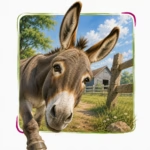
More Animal Comparisons
Pick another animal matchup and keep exploring. Compare appearances, habitats, diets, abilities, and surprising differences.






Make an Animal Story
Turn this horse vs donkey comparison into a grassland-and-rocky-trail equine adventure with our free Animal Story Generator.
Source notes: References used for this comparison. See more See less
Try Another Matchup
Explore this comparison →