
Horse vs Mule: Living Domestic Equid Hybrid Comparison
A horse and mule may stand in the same pasture, wear similar equipment, eat forage, travel in social groups, and share a horse-like body, full tail, one-toed hooves, and many behaviors. The family connection is unusually direct: every mule has a mare horse mother and jack donkey father. The horse is a fertile domestic species with 64 chromosomes and predictable breeding lines. The mule is a first-generation hybrid with 63 chromosomes, longer ears, narrower harder hooves, no consistent breed standard, and normal infertility with rare documented female exceptions. A mule may excel at careful mountain pack work, while a horse usually wins group-level speed and has much wider specialized breed diversity.
About Horse
- Type Mammal
- Diet Grazing herbivore needing frequent suitable grass or hay, clean water, minerals, and carefully balanced supplementary feed only when required by age, health, reproduction, or work
- Group Domestic horse (Equus caballus, also classified as Equus ferus caballus)
- Known for A fertile domestic equid species represented by hundreds of breeds, from miniature animals to powerful draft horses, commonly about 0.9–1.7 meters at the shoulder and 227–900 kilograms, with shorter ears than a mule, a long mane and forelock, full flowing tail, broader oval hooves, and a body that can be bred for racing, riding, driving, sport, or draft work
- Special skill 64 chromosomes arranged in 32 pairs, one-toed oval hooves, long elastic legs and energy-storing tendons, broad breed diversity, large side-set eyes, mobile ears, high-crowned grinding teeth, hindgut fermentation, and a full tail that helps swat insects
About Mule
- Type Mammal
- Diet Herbivorous hindgut fermenter needing individual, forage-first feeding; many mules use feed efficiently and may need fewer calories than a similarly sized working horse, but requirements vary and neither parent-based guesswork nor deliberate underfeeding is safe
- Group Domestic hybrid: male donkey Equus asinus × female horse Equus caballus
- Known for An extremely variable first-generation equine hybrid whose size and body type depend strongly on the jack donkey and especially the mare’s breed, from miniature crosses to large draft mules; many working mules fall around 360–450 kilograms and combine a horse-like body and full tail with longer donkey-like ears, a shorter sparse mane, narrower boxier hooves, and a somewhat larger head
- Special skill 63 chromosomes, typically producing infertility because chromosome partners do not divide evenly during egg or sperm formation; long mobile donkey-like ears, horse-like full tail, small hard boxy hooves, strong careful footing, efficient forage use, heat and work endurance, and hybrid combinations that vary with both parents
Horse vs Mule: Quick Answer
A horse is a domestic species with 64 chromosomes and can normally reproduce with other horses. A mule is the hybrid offspring of a male donkey and female horse, usually has 63 chromosomes, and is normally infertile. Mules commonly have longer ears, a shorter mane, narrower harder hooves, a horse-like full tail, and strong sure-footed pack endurance; horses usually have shorter ears, a fuller mane and forelock, broader hooves, greater top speed, and far more breed-defined body types.
Where Do They Fit?
Follow the branches to see how Horse and Mule are classified and related.
Horse vs Mule: Quick Comparison
| Feature | Horse | Mule |
|---|---|---|
| Biological identity | Domestic equid species | First-generation horse-donkey hybrid, not a naturally breeding species |
| Parents | Mare horse and stallion horse | Mare horse and jack donkey |
| Chromosomes | 64, normally forming 32 matching pairs | Usually 63, an uneven set inherited from the two species |
| Fertility | Normally fertile when healthy and mature | Males are infertile and females are almost always infertile, with rare documented exceptions |
| Ears and mane | Shorter ears, usually full forelock and longer mane | Longer donkey-like ears, often sparse forelock and shorter mane |
| Tail | Full long hair from near the base | Usually a full horse-like tail rather than a donkey switch |
| Hooves | Generally broader and more oval | Generally narrower, boxier, more upright, and hard-walled |
| Size | Ranges from miniature to giant draft breeds | Ranges from miniature to draft size according to both parents, especially the mare |
| Common strengths | Speed, specialized gaits, sport, riding, driving, and absolute draft power in large breeds | Sure-footedness, pack endurance, careful movement, efficient feed use, and heat tolerance |
| Conservation status | Domestic form has no normal IUCN category | Domestic hybrid has no wild population or IUCN species category |
How Are Horses and Mules Alike?
- Both are domestic equids with one hoofed toe per foot, large mobile ears, side-set eyes, grinding teeth, and hindgut fermentation.
- Both are herbivores that need safe forage, water, movement, social contact, hoof and dental care, shelter, and veterinary attention.
- Both can learn subtle signals, form social bonds, play, explore, remember routines, and become fearful or defensive under rough handling.
- Both occur in miniature, riding, pack, and draft-sized forms, so a photograph without a scale may not reveal which is larger.
- Both have full-haired tails and may share almost any horse coat color because every mule inherits half of its genome from a horse mare.
How Are Horses and Mules Different?
- A horse is a species and normally has two horse parents; a mule is specifically the offspring of a male donkey and female horse.
- A horse usually has 64 chromosomes and can reproduce; a mule usually has 63 and is infertile because its chromosomes cannot pair evenly during meiosis.
- Mules generally have longer ears, a shorter or thinner mane, a larger heavier-looking head, and narrower boxier hooves than horses of comparable size.
- Horse size and performance are organized into established breeds; mule appearance is less predictable because each cross recombines traits from a particular jack and mare.
- Horses usually reach higher group-level speeds, while mules are especially valued for secure footing, endurance, and pack work on rough mountain terrain.
- A mule is not a baby donkey, a donkey breed, or a hinny; a hinny is the reciprocal and less common cross of a stallion horse and jenny donkey.
Horse vs Mule Adaptation Showdown
Equine hybrid adaptation showdown: Horse wins group-level size and speed because specialized draft and racing breeds reach greater extremes, although mule size can overlap almost the whole horse range. Mule wins practical pack strength for its combination of endurance, hard hooves, secure footing, and efficient work on rough ground; a large draft horse still has greater absolute pulling power. Camouflage, social skill, and swimming are ties because coat, experience, handling, and individual ability vary. Mule wins weirdest adaptation for carrying 63 chromosomes—halfway between its 64-chromosome horse mother and 62-chromosome donkey father—which explains its normal infertility. These categories compare adaptations, not combat.
Fun Horse vs Mule Facts
Every Mule Has a Horse Mother
A mule is not any horse-donkey mixture. Its father is a male donkey called a jack and its mother is a female horse called a mare. Reversing the parents—a stallion horse and jenny donkey—produces a related hybrid called a hinny. The two crosses share parent species but develop in different maternal bodies.
The Number 63 Makes Reproduction Difficult
A horse egg contributes 32 chromosomes and donkey sperm contributes 31, so a typical mule receives 63. When an adult makes eggs or sperm, chromosomes should match into pairs before dividing. The mule’s mixed odd set usually cannot complete that pairing evenly, making male mules infertile and female fertility extraordinarily rare.
The Mare Helps Set the Mule’s Size
A mule can be tiny, saddle-sized, or a heavy draft animal because horse mares and donkey jacks come in many sizes. The mare’s uterine environment and the genes from both parents influence growth, while conformation remains individual. Calling every mule medium-sized hides one of the hybrid’s most obvious surprises.
A Mule Mixes Visible Clues from Both Parents
Many mules have a horse-like torso and full tail but donkey-like long ears, short mane, narrow hard hooves, and a somewhat larger head. Their voice may also begin like a whinny and end with bray-like notes. No feature is copied with exactly the same strength in every individual.
Mountain Skill Still Requires Humane Care
Mules have long been valued for pack work because their careful movement, strong hooves, endurance, and efficient feeding can suit rough trails. None of those traits makes a mule an unbreakable machine. Loads must fit the individual’s condition, age, terrain, weather, tack, training, rest, and veterinary advice.
Horse vs Mule Quiz
- Which animal is a hybrid? Answer: The mule.
- Who are a mule’s parents? Answer: A jack donkey father and mare horse mother.
- How many chromosomes does a typical mule have? Answer: 63.
- Why are mules normally infertile? Answer: Their mixed odd chromosome set cannot pair and divide evenly during egg or sperm formation.
- Which equine is especially valued for sure-footed pack work on rough trails? Answer: The mule, when healthy, trained, properly equipped, and responsibly loaded.
Horse vs Mule FAQ
Is a mule half horse and half donkey?
Yes in parentage: it receives one chromosome set from a mare horse and one from a jack donkey. That does not mean every visible trait appears in an exact 50–50 blend.
Can a mule have a baby?
Male mules are considered infertile, and female mules are almost always infertile. A small number of scientifically documented female mules have reproduced, so “normally infertile” is more accurate than “never.”
Is a mule stronger than a horse?
It depends on the job and animals. Large draft horses have greater absolute pulling power, while mules are often outstanding pack workers relative to their size because of endurance, hard hooves, secure footing, and efficient metabolism.
How can children tell a horse from a mule?
Look at several clues together. Mules usually have longer ears, a shorter mane and forelock, a heavier-looking head, and narrower boxier hooves, while keeping a full horse-like tail.
Is a mule the same as a hinny?
No. A mule has a donkey father and horse mother. A hinny has a horse father and donkey mother. They can look similar, but the parent direction and prenatal environment differ.
Animal Words to Know
- Hybrid: Offspring produced by parents from two different species or genetically distinct groups.
- Jack: An adult male donkey.
- Mare: An adult female horse; in formal equine use, the term may also describe an adult female mule.
- Meiosis: The special cell division that makes eggs or sperm with half the usual chromosome set.
- Sure-footed: Able to place the feet securely and maintain balance on difficult ground.
Horse and Mule Inheritance Activity
Horse and Mule Inheritance Activity
Draw a mare horse, a jack donkey, and their mule offspring. Make chromosome cards with 64 pieces for the horse, 62 for the donkey, and 63 for the mule. Try pairing the mule’s pieces to see why most mules cannot produce young. Give the mule long ears and a horse-like tail. Label mare, jack, mule, hybrid, chromosome, and inheritance.
Meet Each Animal
Want the full fact file? Here are quick highlights from each animal’s own facts page.
Horse Fact Highlight
From the full animal facts page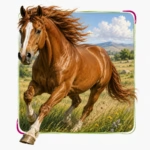
Mule Fact Highlight
From the full animal facts page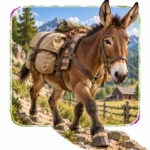
More Animal Comparisons
Pick another animal matchup and keep exploring. Compare appearances, habitats, diets, abilities, and surprising differences.






Make an Animal Story
Turn this horse vs mule comparison into a chromosome-and-mountain-trail adventure with our free Animal Story Generator.
Source notes: References used for this comparison. See more See less
Try Another Matchup
Explore this comparison →