
Lion vs Hyena: Overlapping African-Carnivore Comparison
Lions and spotted hyenas are large African carnivores that overlap in habitat, eat many of the same prey, live in complex social groups, and sometimes compete over food. A lion is a true cat with retractable claws, a level back, a tail tuft, and—in most adult males—a mane. A spotted hyena belongs to its own family, has a sloping back, bone-crushing teeth, rounded ears, spots, and a female-dominated clan. Both hunt and scavenge, so the popular picture of lions as hunters and hyenas as mere scavengers is wrong.
About Lion
- Type Mammal
- Diet Obligate carnivore that hunts medium-sized and large mammals, scavenges when opportunities arise, steals kills from other predators, and sometimes takes smaller prey
- Group Lion (Panthera leo), focusing mainly on African populations so its habitat and behavior can be compared directly with the spotted hyena
- Known for A large muscular cat with a tawny coat, rounded head, powerful forelegs, retractable claws, long tail ending in a dark tuft, and strong sexual dimorphism; adult males are usually larger and often grow a mane, while females normally lack one
- Special skill Powerful forelimbs, retractable claws, binocular vision, sensitive hearing, rough tongue, cooperative hunting, territorial scent marking, night vision, a resonant roar, and a mane that provides a visual social signal
About Hyena
- Type Mammal
- Diet A highly capable hunter and opportunistic scavenger that eats antelope and other mammals, birds, reptiles, fish, insects, eggs, and carcass remains, including skin and bones that many predators leave behind
- Group Hyena, represented here by the spotted hyena (Crocuta crocuta); the four living hyena species differ in size, diet, markings, social structure, and vocal behavior
- Known for A strongly built carnivoran with rounded ears, a sloping back caused partly by longer forelimbs, a broad head, powerful neck and jaws, coarse sandy or gray-brown fur with dark spots, a short mane, and adult females that are commonly larger and socially dominant over males
- Special skill Exceptional bone-crushing premolars, powerful jaws and neck, efficient digestion, long-distance endurance, scent marking, varied calls, communal dens, coalition building, individual recognition, and complex female-led social relationships
Lion vs Hyena: Quick Answer
A lion is a large social cat living in a pride, while a spotted hyena belongs to the hyena family and lives in a female-led clan. Lions are generally heavier and stronger in a short individual effort. Spotted hyenas have greater endurance, exceptional bone-crushing jaws, and remarkably complex societies. Both are skilled hunters, both scavenge, and both may steal food from the other.
Where Do They Fit?
Follow the branches to see how Lion and Hyena are classified and related.
Lion vs Hyena: Quick Comparison
| Feature | Lion | Hyena (Spotted Hyena Representative) |
|---|---|---|
| Scientific name | Panthera leo | Crocuta crocuta |
| Animal family | Felidae, the cat family | Hyaenidae, the hyena family |
| Typical adult build | Heavier cat with a level back and powerful forequarters | Smaller but robust carnivoran with a sloping back and massive neck |
| Coat clue | Mostly plain tawny coat; adult males commonly have a mane | Dark spots, rounded ears, short mane, and no lion-like tail tuft |
| Social group | Pride with related females, cubs, and resident male or male coalition | Female-dominated clan with flexible subgroups |
| Hunting style | Stalking, ambush, short acceleration, and sometimes group hunting | Long pursuit, endurance, group hunting, and adaptable solo hunting |
| Scavenging | Readily eats carcasses and steals kills when possible | Readily scavenges but also kills much of its own food |
| Special feeding tool | Retractable claws, strong forelimbs, large canines, and slicing teeth | Bone-crushing premolars, powerful jaws, and highly acidic digestion |
| Famous sound | Deep roar carrying across several kilometers in good conditions | Long-distance whoop plus giggles, growls, grunts, and other calls |
| Young and nursery | Cubs may be raised together within a pride nursery | Cubs use a communal den but are nursed mainly by their own mother |
How Are Lions and Hyenas Alike?
- Both are warm-blooded African carnivoran mammals that overlap across many savannas, grasslands, and open woodlands.
- Both are skilled predators that hunt live prey, scavenge carcasses, and sometimes take food captured by the other species.
- Both live in territorial social groups, cooperate with familiar group members, and communicate using sounds, scent, and body posture.
- Both rest during much of the hot day and are often most active from evening through the cooler night and early morning.
- Both raise cubs that depend on milk, protection, learning, and access to a safe nursery area.
How Are Lions and Hyenas Different?
- A lion belongs to the cat family Felidae, while a spotted hyena belongs to the separate family Hyaenidae.
- Lions have retractable claws, a more level back, and a tufted tail; spotted hyenas have nonretractable claws, rounded ears, spots, and a visibly sloping back.
- Adult male lions are usually substantially heavier than spotted hyenas, although lionesses and the largest female hyenas are closer in size.
- Lions rely heavily on stalking and short bursts of acceleration, while spotted hyenas are superb endurance travelers and pursuit hunters.
- A lion pride centers on related adult females but resident males usually outrank females; a spotted-hyena clan is strongly female-dominated, with adult females normally ranking above immigrant males.
- Spotted hyenas can crack and digest large bones far more completely, while lions often leave bones and tougher remains for other scavengers.
Lion vs Hyena Adaptation Showdown
Savanna-specialist showdown: Lion wins typical size because adult males and many females outweigh spotted hyenas. Lion also wins short-burst speed, individual forelimb strength, and stalking stealth, although results vary with sex, age, terrain, and distance. Spotted hyena wins teamwork for its large, flexible, female-led clan network and wins weirdest adaptation for crushing and digesting bones that many predators cannot use. Swimming is a tie because both can swim but neither is aquatic. A hyena may outperform a lion over a long pursuit, while a lion is built for explosive acceleration. These categories compare ecological adaptations, not a fight.
Fun Lion vs Hyena Facts
Hyenas Are Closer to Cats Than to Dogs
A spotted hyena’s sloping back, dog-like muzzle, and ground-eating behavior can make it look canine, but hyenas belong to the cat-like branch of Carnivora called Feliformia. They are not cats either: the family Hyaenidae follows its own evolutionary path alongside mongooses and other feliform carnivorans.
Both Hunters Also Work as Food Thieves
Spotted hyenas are not merely scavengers. They frequently hunt their own prey, sometimes alone and sometimes in groups. Lions also scavenge and may drive hyenas, cheetahs, leopards, or wild dogs from kills. Which species gains food during an encounter depends on numbers, age, sex, hunger, and circumstances.
A Clan Is a Female-Led Social Network
Spotted-hyena clans may contain dozens of recognizable individuals. Females usually remain in their birth clan, inherit social advantages through their mothers, and rank above immigrant adult males. Members repeatedly split into small parties and reunite, producing a flexible system that researchers call fission-fusion society.
A Roar and a Whoop Carry Different Messages
A lion’s roar advertises presence and territory and helps separated pride members locate one another. A spotted hyena’s rising-and-falling whoop also travels long distances and can identify the caller. The famous hyena “laugh” is a shorter giggle often linked to excitement, frustration, submission, or feeding competition—not proof that the animal finds something funny.
Bone-Crushing Teeth Unlock a Hidden Meal
Spotted hyenas use enlarged premolars, strong jaw muscles, and a powerful neck to crack bones. Highly acidic digestion extracts nutrients from skin, ligaments, and bone, while indigestible hair and hoof fragments may be regurgitated. Lions have formidable teeth but are less specialized for processing an entire large skeleton.
Lion vs Hyena Quiz
- Is a spotted hyena a type of wild dog? Answer: No. It belongs to the cat-like branch of Carnivora and to its own family, Hyaenidae.
- What is a lion’s social group called? Answer: A pride.
- What is a spotted hyena’s social group called? Answer: A clan.
- Do spotted hyenas hunt live prey? Answer: Yes. They are highly successful hunters as well as scavengers.
- Which animal is especially adapted to cracking and digesting bones? Answer: The spotted hyena.
Lion vs Hyena FAQ
Who is bigger, a lion or a spotted hyena?
Lions are generally bigger. Adult male lions are much heavier than spotted hyenas, while lionesses are also usually heavier, although their range overlaps more closely with that of large female hyenas.
Are hyenas dogs or cats?
Neither. Hyenas form their own family, Hyaenidae. They belong to Feliformia, the cat-like branch of the order Carnivora, so they are evolutionarily closer to cats and mongooses than to dogs.
Do lions and hyenas both hunt?
Yes. Both kill live prey and both scavenge. Spotted hyenas obtain much of their food by hunting in many ecosystems, while lions readily take over carcasses or kills when an opportunity appears.
Why do lions and hyenas compete?
They overlap in habitat and often pursue the same prey. They may compete over carcasses, hunting areas, water, and safe spaces for cubs. Most of their daily lives are spent apart rather than in constant conflict.
Does a hyena laugh because it is happy?
Not in the human sense. The rapid giggle can communicate excitement, frustration, submission, or social tension. Hyenas also whoop, growl, grunt, yell, and use scent and posture to exchange information.
Animal Words to Know
- Feliformia: The cat-like evolutionary branch of Carnivora containing cats, hyenas, mongooses, and related mammals.
- Pride: A lion social group typically containing related females, their young, and one or more resident males.
- Clan: The territorial, female-dominated social community of spotted hyenas.
- Fission-fusion society: A social system in which members repeatedly separate into smaller parties and later reunite.
- Kleptoparasitism: Gaining food by taking prey or a carcass obtained by another animal.
Lion and Hyena Savanna Activity
Lion and Hyena Savanna Activity
Draw a lion and a spotted hyena at a realistic scale on the same savanna. Give the lion a tawny coat, level back, tufted tail, and a pride in the background. Give the hyena rounded ears, dark spots, powerful shoulders, a sloping back, and a clan near a den. Show both animals as capable hunters rather than making one only a scavenger. Label cat family, hyena family, pride, clan, roar, and whoop.
Meet Each Animal
Want the full fact file? Here are quick highlights from each animal’s own facts page.
Lion Fact Highlight
From the full animal facts page
Hyena Fact Highlight
From the full animal facts page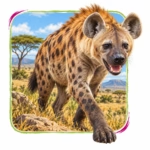
More Animal Comparisons
Pick another animal matchup and keep exploring. Compare appearances, habitats, diets, abilities, and surprising differences.






Make an Animal Story
Turn this lion vs hyena comparison into a pride-and-clan savanna mystery with our free Animal Story Generator.
Source notes: References used for this comparison. See more See less
Try Another Matchup
Explore this comparison →