
Macaque vs Langur: Asian Monkey Comparison
Macaque and langur are broad names for many monkey species. This page compares two familiar South Asian examples: the Rhesus Macaque and the Bengal Sacred Langur. Both live in troops and can thrive near people, but their shapes and menus differ. The macaque is compact, short-tailed and adventurous about food. The langur is long-limbed, long-tailed and mainly plant-eating.
About Rhesus Macaque
- Type Living
- Diet Omnivore
- Group Old World monkey species (Macaca mulatta)
- Known for Pink face, cheek pouches, flexible diet, busy troops and comfort around water
- Special skill Adapts to many habitats, stores food in cheek pouches and swims confidently
About Bengal Sacred Langur
- Type Living
- Diet Herbivore, mainly leaves, shoots and fruit
- Group Old World monkey species (Semnopithecus entellus)
- Known for Black face, pale gray coat, very long tail and leaf-rich diet
- Special skill Leaps between trees and uses an exceptionally long tail for balance on branches and ground
Rhesus Macaque vs Bengal Sacred Langur: Quick Answer
A Rhesus Macaque is a sturdy brown monkey with a pink face, a medium-length tail and cheek pouches. It eats plants and small animals, lives in large complex troops and swims well. A Bengal Sacred Langur is a lankier gray monkey with a black face and a tail longer than its body. It mainly eats leaves, shoots and fruit. Both are Old World monkeys, not apes.
Where Do They Fit?
Follow the branches to see how Rhesus Macaque and Bengal Sacred Langur are classified and related.
Rhesus Macaque vs Bengal Sacred Langur: Quick Comparison
| Feature | Rhesus Macaque | Bengal Sacred Langur |
|---|---|---|
| Scientific name | Macaca mulatta | Semnopithecus entellus |
| Primate group | Old World monkey in family Cercopithecidae | Old World monkey in family Cercopithecidae |
| Core native range | Southern and eastern Asia | Much of India under the current species split |
| Adult mass | About 4-12 kg | About 9.9-13 kg in the older species account |
| Body length | About 45-64 cm, not counting tail | About 58.5-64 cm, not counting tail |
| Tail | About 19-32 cm; shorter than the body | About 86-91 cm; much longer than the body |
| Face and coat | Grizzled brown coat with a mostly bare pink or red face | Pale gray or brownish coat with black face, hands and feet |
| Food | Omnivorous: fruit, seeds, leaves, insects and many other foods | Mostly leaves, shoots, flowers and fruit |
| Social life | Large multi-male, multi-female troops with clear ranks | Flexible one-male or multi-male troops with females and young |
| Standout skill | Highly adaptable and a capable swimmer | Long-limbed leaping with an extra-long balancing tail |
How Are Rhesus Macaques and Bengal Sacred Langurs Alike?
- Both are Asian Old World monkeys in the family Cercopithecidae.
- Both have tails, forward-facing eyes and grasping hands and feet.
- Both live in social troops with rank, calls and close family bonds.
- Both can climb trees and travel on the ground.
- Both can adjust to farms, villages and other human-shaped habitats.
How Are Rhesus Macaques and Bengal Sacred Langurs Different?
- Rhesus macaques are compact and brown with pink faces; Bengal sacred langurs are lanky and pale with black faces.
- A macaque’s tail is shorter than its body; a langur’s tail is much longer than its body.
- Rhesus macaques are omnivores; Bengal sacred langurs rely much more on leaves and other plant foods.
- Macaques have cheek pouches for holding food; langurs do not use macaque-like cheek pouches.
- Rhesus macaques are well documented swimmers; Bengal sacred langurs are better known for long leaps and balance.
Rhesus Macaque vs Bengal Sacred Langur Adaptation Showdown
- Size – Bengal Sacred Langur: It is usually longer-bodied and a little heavier, though adult mass ranges overlap.
- Speed – Tie: The macaque scrambles quickly and the langur makes long leaps, but no fair same-course race is available.
- Strength – Tie: The macaque is compact and muscular, while the langur is longer and can be heavier; the sources do not support a simple winner.
- Stealth – Bengal Sacred Langur: Its gray coat blends with pale trunks, rocks and dry woodland, while its long limbs can carry it high into trees.
- Social – Tie: Both form complex ranked troops with calls, alliances and strong relationships between mothers and young.
- Swimming – Rhesus Macaque: Species accounts directly describe rhesus macaques as good swimmers that enjoy water.
- Weirdest – Bengal Sacred Langur: Its tail can be roughly a third longer than its head-and-body length, forming a remarkable balancing pole.
Fun Macaque vs Langur Facts
A Pocket Inside Each Cheek
A rhesus macaque can tuck food into cheek pouches and chew it later in a safer place.
The Tail Is Longer Than the Monkey
A Bengal sacred langur’s tail may reach about 86-91 centimetres, while its head and body measure about 58.5-64 centimetres.
Macaques Take to Water
Rhesus macaques are strong swimmers and may splash, dive or cross water as part of normal life.
A Baby Changes Color
A newborn Bengal sacred langur has dark fur. As it grows, most of the coat becomes pale gray while the face stays black.
Gray Langur Names Were Split
Scientists once grouped many gray langurs under one species name. Modern lists recognize several species, so this page uses the Bengal Sacred Langur only.
Macaque vs Langur Quiz
Which monkey has a pink face? A) Rhesus Macaque B) Bengal Sacred Langur C) Both Answer: A) Rhesus Macaque
Which has a tail longer than its body? A) Rhesus Macaque B) Bengal Sacred Langur C) Neither Answer: B) Bengal Sacred Langur
Which is an omnivore? A) Rhesus Macaque B) Bengal Sacred Langur C) Neither Answer: A) Rhesus Macaque
What do both animals live in? A) Troops B) Hives C) Herds of cattle Answer: A) Troops
Which is directly known as a good swimmer? A) Rhesus Macaque B) Bengal Sacred Langur C) Neither Answer: A) Rhesus Macaque
Macaque vs Langur FAQ
Are macaques and langurs the same?
No. They are different groups of Old World monkeys. This page compares one species from each group.
Which is bigger, a rhesus macaque or a Bengal sacred langur?
The langur is usually longer and slightly heavier, but adult mass ranges overlap.
Why does the macaque have cheek pouches?
They let it collect food quickly and carry it away before chewing.
What does a Bengal sacred langur eat?
It mainly eats plant foods such as leaves, shoots, flowers and fruit.
Can rhesus macaques swim?
Yes. They are capable swimmers and often seem comfortable around water.
Animal Words to Know
- Cheek pouch: A stretchy pocket inside the mouth used to hold food temporarily.
- Omnivore: An animal that eats both plant and animal foods.
- Primate: A mammal group containing monkeys, apes, lemurs and humans.
- Rank: An animal’s social position inside a group.
- Troop: A social group of monkeys.
Compare Monkey Shapes
Compare Monkey Shapes
Draw both monkeys at the same body length. Give the rhesus macaque a compact body, pink face and tail about half as long as its body. Give the Bengal sacred langur long limbs, a black face and a tail longer than its body. Label cheek pouch, balancing tail, omnivore and leaf eater.
Meet Each Animal
Want the full fact file? Here are quick highlights from each animal’s own facts page.
Rhesus Macaque Fact Highlight
From the full animal facts page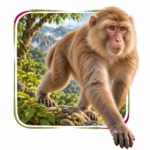
Bengal Sacred Langur Fact Highlight
From the full animal facts page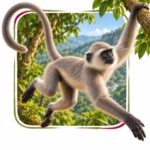
More Animal Comparisons
Pick another animal matchup and keep exploring. Compare appearances, habitats, diets, abilities, and surprising differences.


Make an Animal Story
Create a monkey story with a clever swimmer and a long-tailed leaf eater!
Source notes: References used for this comparison. See more See less
Try Another Matchup
Explore this comparison →