
Spotted-tailed Quoll vs Australian Dingo: Australian Predator Comparison
The Spotted-tailed Quoll and Australian Dingo are Australian predators, but the resemblance stops at sharp teeth and a taste for meat. The quoll is a spotted marsupial with a pouch, gripping feet, and strong climbing skills. The dingo is a much larger placental canid with long running legs and flexible pack behavior.
About Spotted-tailed Quoll
- Type Carnivorous marsupial
- Diet Carnivore
- Group Marsupial carnivore family, Dasyuridae
- Known for White spots that continue onto the tail and agile forest climbing
- Special skill Climbs trees and uses a strong bite to hunt prey in forest and on the ground
About Australian Dingo
- Type Wild canid
- Diet Mostly carnivore and opportunistic omnivore
- Group Dog family, Canidae
- Known for Howling, cooperative hunting, and life across nearly every mainland habitat
- Special skill Cooperates in packs to hunt prey larger than one dingo could tackle
Spotted-tailed Quoll vs Australian Dingo: Quick Answer
A Spotted-tailed Quoll is a cat-sized carnivorous marsupial of eastern forests, with white spots extending along its tail and strong climbing feet. An Australian Dingo is a larger mainland wild canid that may hunt cooperatively in packs. The quoll raises tiny joeys on pouch teats, while the dingo raises several pups in a den.
Where Do They Fit?
Follow the branches to see how Spotted-tailed Quoll and Australian Dingo are classified and related.
Spotted-tailed Quoll vs Australian Dingo: Quick Comparison
| Feature | Spotted-tailed Quoll | Australian Dingo |
|---|---|---|
| Scientific name | Dasyurus maculatus | Canis familiaris, with Canis lupus dingo also widely used |
| Mammal branch | Marsupial in family Dasyuridae | Placental canid in family Canidae |
| Body size | Females average about 1.8 kg and males about 3.5 kg | Usually about 12 to 24 kg |
| Appearance | Reddish-brown or dark fur with white spots continuing onto the tail | Usually ginger with white points, erect ears, and a bushy unspotted tail |
| Native home | Eastern mainland Australia and Tasmania | Most of mainland Australia |
| Main habitat | Forest, rainforest, woodland, heath, rocky gullies, and nearby open ground | Desert, grassland, woodland, forest, tropical country, and mountains |
| Movement | Runs, pounces, climbs trees, and explores logs and rocky dens | Runs long distances and hunts alone, in pairs, or in packs |
| Main food | Birds, mammals, reptiles, invertebrates, eggs, and carrion | Kangaroos, wallabies, rabbits, rodents, birds, reptiles, carrion, and some fruit |
| Social life | Mostly solitary, with overlapping home ranges | Flexible pack social system with a breeding pair and helpers |
| Young | Tiny joeys attach to six teats in a pouch and later use a den | Usually four to six pups are born and raised in a den |
How Quolls and Dingoes Are Alike
- Both are Australian mammal predators with pointed muzzles, sharp canine teeth, and keen smell.
- Both eat a varied meat-based diet and may hunt live prey or scavenge carrion.
- Both use sheltered dens such as caves, rock crevices, logs, or ground holes.
- Both are active mainly from dusk through night, although timing changes with habitat and weather.
- Both help shape food webs by affecting prey and competing predators.
How Quolls and Dingoes Are Different
- The quoll is a pouch-bearing marsupial, while the dingo is a placental member of the dog family.
- The dingo is several times heavier and has much longer legs than the Spotted-tailed Quoll.
- The quoll is an agile climber with gripping feet, while the dingo is a ground-running endurance hunter.
- Quolls are mostly solitary, while dingoes can form cooperative packs.
- A female quoll carries tiny joeys on six teats, while a dingo gives birth to larger pups in a den.
Quoll vs Dingo Adaptation Showdown
Adaptation showdown: Australian Dingo wins size because adults commonly weigh about 12 to 24 kg, several times the mass of even a male Spotted-tailed Quoll. Australian Dingo wins speed because long legs and an efficient canid stride suit extended chases. Australian Dingo wins strength because its much larger body can subdue prey beyond a quoll’s usual size. Spotted-tailed Quoll wins stealth because its spotted coat, nocturnal habits, climbing, and use of dense forest cover help it approach unseen. Australian Dingo wins social behavior because packs hunt, defend territories, and help raise pups, while quolls are mainly solitary. Swimming is a Tie because neither species is aquatic, though both can cross water when needed. Spotted-tailed Quoll wins weirdest because white spots continue onto its tail, tiny joeys compete for six teats, and its feet help it hunt both on the ground and in trees.
Fun Spotted-tailed Quoll vs Australian Dingo Facts
The Only Australian Quoll With a Spotted Tail
All Australian quolls have white body spots, but only the Spotted-tailed Quoll carries the pattern down its long furry tail.
Second in the Marsupial Predator League
The Spotted-tailed Quoll is Australia’s second-largest surviving carnivorous marsupial after the Tasmanian Devil. Adult males average about 3.5 kg.
More Newborns Than Teats
A female Spotted-tailed Quoll may give birth to many extremely tiny young, but only six can attach to her six teats and continue developing.
A Predator That Climbs
Broad foot pads and ridged surfaces improve the quoll’s grip. It can chase animals into trees, raid nests, and use logs or rocky crevices as dens.
A Pack Changes the Hunt
Dingoes may hunt small prey alone, but a pack can cooperate when pursuing larger prey such as kangaroos or wallabies. Pack members also help raise pups.
Quoll vs Dingo Quiz
- Which animal has white spots continuing onto its tail? Answer: The Spotted-tailed Quoll.
- Which animal may hunt in a cooperative pack? Answer: The Australian Dingo.
- What mammal branch does a quoll belong to? Answer: It is a marsupial.
- Why are a quoll’s feet useful in trees? Answer: Broad pads and ridges improve grip while climbing.
- Which animal is much heavier? Answer: The Australian Dingo.
Spotted-tailed Quoll vs Australian Dingo FAQ
Is a quoll a spotted cat?
No. It is a carnivorous marsupial, not a member of the cat family.
Would a quoll and dingo meet?
Their mainland ranges can overlap, but the smaller nocturnal quoll usually avoids the much larger dingo.
Can a dingo climb trees like a quoll?
No. Dingoes are ground-running canids and lack the quoll’s gripping climbing feet.
Do quolls have pouches?
Yes. The Spotted-tailed Quoll has a pouch that protects tiny joeys attached to six teats.
Which animal lives in Tasmania?
Spotted-tailed Quolls live in Tasmania and eastern mainland Australia. Wild dingoes live on the mainland, not Tasmania.
Animal Words to Know
- Dasyurid: A member of the marsupial carnivore family that includes quolls and Tasmanian Devils.
- Home range: The area an animal regularly travels while finding food, shelter, and mates.
- Carrion: The body of a dead animal used as food.
- Arboreal: Adapted for living or moving in trees.
- Placental mammal: A mammal whose developing young receives nourishment through a placenta before birth.
Compare a Climber and a Runner
Compare a Climber and a Runner
Draw exactly one adult Spotted-tailed Quoll and exactly one adult Australian Dingo at honest relative scale, making the dingo dramatically larger. Build a forest route with a log, tree, rocky den, and narrow branches for the quoll, then an open-ground tracking route and den for the dingo. Label spots, tail, feet, pouch, ears, legs, pack, and pups. Never approach, feed, or handle wild predators.
Meet Each Animal
Want the full fact file? Here are quick highlights from each animal’s own facts page.
Spotted-tailed Quoll Fact Highlight
From the full animal facts page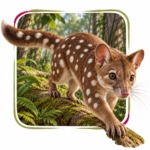
Australian Dingo Fact Highlight
From the full animal facts page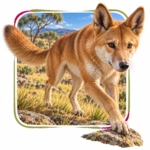
More Animal Comparisons
Pick another animal matchup and keep exploring. Compare appearances, habitats, diets, abilities, and surprising differences.
Make an Animal Story
Send a spotted climbing Quoll and a howling Dingo through an Australian forest mystery with our free Animal Story Generator.
Source notes: References used for this comparison. See more See less
Try Another Matchup
Explore this comparison →