
Red Fox vs Arctic Fox: Temperate Generalist-to-Polar Specialist Fox Comparison
Red and Arctic foxes are close relatives built for very different levels of flexibility. The larger red fox uses long legs, big ears, varied foods, and several coat colors across much of the Northern Hemisphere, including farms and cities. The smaller Arctic fox is the polar specialist, with compact features, furred feet, an extraordinarily warm coat, seasonal camouflage, tundra dens, and long journeys over sea ice. Their ranges meet in northern tundra, where the larger red fox can displace or kill Arctic foxes.
About Red Fox
- Type Mammal
- Diet An opportunistic omnivore eating voles, mice, rabbits, birds, eggs, insects, worms, carrion, fruit, berries, and other available food; it listens for small mammals, springs in a high arc, pins prey with its forefeet, and buries extra food in caches it can relocate later
- Group Red fox, Vulpes vulpes, the largest true fox and an extremely adaptable member of family Canidae; red, cross, silver, and dark individuals are color forms of the same species, and European and North American red foxes remain Vulpes vulpes
- Known for A slender, long-legged fox commonly about 56–82 centimeters from head to rump with a 35–43-centimeter tail and roughly 2.7–6.8 kilograms in Alaska, while some populations elsewhere contain considerably heavier animals; males usually exceed females and red foxes are generally larger than Arctic foxes where the species overlap
- Special skill Longer legs, a relatively lean body, large pointed ears, keen directional hearing, a narrow snow-diving muzzle, sensitive whiskers, padded paws, non-retractable claws, a balancing white-tipped brush, variable red-to-silver camouflage, food caching, and a remarkably broad omnivorous menu let this fox hunt from tundra to city edge
About Arctic Fox
- Type Mammal
- Diet An opportunistic predator and scavenger centered on lemmings, voles, nesting seabirds, eggs, fish, carrion, and seasonal berries; coastal animals use marine food, inland populations track rodent cycles, and surplus summer food is cached around dens or beneath stones for lean months
- Group Arctic fox, Vulpes lagopus, a distinct circumpolar fox species formerly placed in genus Alopex; the name lagopus means “hare-foot” or “rabbit-footed” and refers to the unusually dense fur covering its winter feet
- Known for A compact fox often around 46–68 centimeters from head to rump with a tail around 30 centimeters and adults commonly about 2.5–8 kilograms depending on sex, season, region, and food; its rounded silhouette and luxurious winter fur make it look larger than the body beneath
- Special skill A short muzzle, compact body, small rounded ears, short legs, thick fat, exceptionally dense insulating fur, furred paw pads, and a bushy tail that can cover the face reduce heat loss. White-phase animals change from brown-gray summer camouflage to white winter fur, while blue-phase foxes remain dark; sharp hearing guides headfirst pounces onto rodents beneath snow.
Red Fox vs Arctic Fox: Quick Answer
A red fox is usually larger, longer-legged, and more widely distributed, with large pointed ears, dark lower legs, and a white-tipped tail. An Arctic fox is smaller and rounder, with short ears, furred footpads, and a much denser coat. Most white-phase Arctic foxes turn brown-gray in summer and white in winter, while blue-phase Arctic foxes stay dark. Red foxes can enter tundra, but Arctic foxes are the true high-polar specialists.
Where Do They Fit?
Follow the branches to see how Red Fox and Arctic Fox are classified and related.
Red Fox vs Arctic Fox: Quick Comparison
| Feature | Red Fox | Arctic Fox |
|---|---|---|
| Scientific name | Vulpes vulpes | Vulpes lagopus |
| Typical build | Larger, leaner, longer-legged, with bigger pointed ears | Smaller, compact, short-legged, with small rounded ears |
| Broad mass clue | Often about 2.7–6.8 kg in Alaska, but heavier populations occur elsewhere | Commonly about 2.5–8 kg, varying with sex, region, food, and season |
| Coat clue | Red, cross, silver, or dark; does not normally turn white for winter | White phase usually brown-gray in summer and white in winter; blue phase stays dark |
| Main habitat | Forest, grassland, farmland, mountain, desert edge, suburb, and tundra edge | Treeless Arctic and alpine tundra, coast, island, snowfield, and sea ice |
| Range | Much of North America, Europe, Asia, and part of North Africa; introduced elsewhere | Circumpolar Arctic across North America, Greenland, Iceland, Scandinavia, and Russia |
| Food | Rodents, rabbits, birds, insects, carrion, fruit, berries, and other available foods | Lemmings, voles, seabirds, eggs, fish, carrion, marine food, and some berries |
| Foot clue | Ordinary furred canid paws with pads partly exposed | Winter paw pads densely covered by insulating fur |
| Den clue | Earth den often enlarged from another burrowing animal’s shelter | Large tundra den systems that generations may reuse for centuries |
| Northern overlap | Larger competitor that can take food, dens, or Arctic foxes | Cold specialist vulnerable where red foxes expand onto tundra |
How Are Red Foxes and Arctic Foxes Alike?
- Both are true foxes in genus Vulpes and family Canidae, with long muzzles, upright ears, bushy tails, non-retractable claws, excellent smell, sharp hearing, and a springing rodent-hunting pounce.
- Both are flexible opportunists that eat small mammals, birds, eggs, insects, carrion, and plant foods, then cache surplus meals for later.
- Both usually forage alone but form breeding pairs and family groups, communicate through scent and varied calls, and rely on dens to shelter dependent kits.
- Both remain active through winter, grow a denser cold-season coat, use the tail for balance and warmth, and can hunt rodents moving beneath snow.
- Both may live in northern tundra, influence rodent and ground-nesting-bird populations, and face disease, trapping, habitat change, and altered food webs.
How Are Red Foxes and Arctic Foxes Different?
- The red fox is generally larger, longer-legged, and larger-eared; the Arctic fox is compact, short-legged, and small-eared to reduce exposed surface area and heat loss.
- Red foxes span an enormous variety of temperate, dry, urban, mountain, and northern habitats; Arctic foxes are restricted mainly to circumpolar and alpine tundra, coasts, and sea-ice landscapes.
- A red fox may be red, cross, silver, or dark but keeps the same general color through winter; most white-phase Arctic foxes molt from brown-gray summer fur to white winter camouflage.
- The red fox’s foot pads remain more exposed; an Arctic fox grows dense hair across the soles, inspiring the scientific name lagopus, or “hare-foot.”
- Red foxes use many medium and small prey plus fruit and urban-edge foods; Arctic fox populations often rise and fall with lemming cycles or rely on seabirds and marine carrion.
- Where their ranges overlap, the larger red fox is behaviorally dominant and may seize food or dens and kill Arctic foxes; warming, shrubs, and human food can help red foxes move farther north.
Red Fox vs Arctic Fox Adaptation Showdown
Habitat-generalist versus polar-specialist showdown: Red fox wins typical size and strength because it is generally the larger, longer-limbed fox and dominates Arctic foxes where they overlap; this describes ecology, not a staged fight. Speed is a tie because both sprint and pounce quickly, while published maximum-speed claims are not standardized same-condition trials. Stealth is a tie: red, cross, and silver coats vanish into varied vegetation and shadow, while Arctic fox seasonal colors match snow or summer tundra. Arctic fox wins social behavior narrowly for stable breeding pairs, very large family litters, helper females, and documented family travel, although red fox society is also flexible. Swimming is a tie because both can cross water but neither is anatomically specialized like an otter; Arctic fox sea-ice travel happens mainly on top of frozen water. Arctic fox wins strangest adaptation for fur-covered soles, a compact heat-saving body, and a white-phase coat that changes color with the seasons. These fields compare adaptations, not combat.
Fun Red Fox vs Arctic Fox Facts
The Red Fox Can Become the Arctic Fox’s Northern Rival
Red foxes and Arctic foxes naturally overlap around the tundra–boreal boundary. The red fox is larger and can take food, occupy dens, chase Arctic foxes away, or kill them. Warming alone does not explain every local change, but warmer conditions, taller shrubs, roads, settlements, and reliable human food can make northern landscapes easier for red foxes to occupy.
Not Every Arctic Fox Turns White
The common white color phase molts into brown-gray summer fur and then grows a white winter coat. The genetically different blue phase remains charcoal, brown, or bluish gray through the year and is especially common on some maritime islands. Red foxes also have color morphs—red, cross, silver, and dark—but they do not perform the same whole-body white winter change.
Furry Soles Put “Hare-Foot” in the Scientific Name
Vulpes lagopus literally points to hare-like feet. Dense winter fur grows around and across the Arctic fox’s pads, adding insulation and traction on snow and ice. The red fox also grows a warm winter coat and has fur between its toes, but its pads are more exposed and its longer legs and larger ears reflect life across less extreme climates.
Both Foxes Can Dive Headfirst Into Snow
A fox may pause, rotate its ears toward a vole or lemming beneath the snow, leap high, and plunge its narrow muzzle into the surface. Red and Arctic fox skulls are long and pointed compared with many other carnivores, helping the snout enter snow with less impact while the forefeet pin the hidden prey.
An Arctic Fox Den Can Outlast Many Human Buildings
A raised tundra mound may hold a maze of entrances and chambers, and generations can enlarge and reuse the same site for centuries because suitable dry den ground is scarce. In a rich lemming year, Arctic fox parents can raise an unusually large litter. Red foxes also reuse and enlarge dens, but their broader habitat gives them more kinds of shelter.
Red Fox vs Arctic Fox Quiz
- Which fox is generally larger? Answer: The red fox.
- Does every Arctic fox become white in winter? Answer: No. White-phase foxes usually do, while blue-phase foxes remain dark.
- Why are Arctic fox feet compared with hare feet? Answer: Dense fur covers the paw pads in winter, helping insulate and grip.
- What important inland prey makes many Arctic fox populations rise and fall? Answer: Lemmings and other small rodents.
- Can red and Arctic foxes live in the same northern region? Answer: Yes. Their ranges overlap, but the larger red fox often dominates.
Red Fox vs Arctic Fox FAQ
Is an Arctic fox just a white red fox?
No. They are separate species: Vulpes lagopus and Vulpes vulpes. A white-phase Arctic fox changes coat with the season and has a compact body, tiny ears, and furred footpads. A red fox may be silver or dark, but it does not become an Arctic fox or normally turn fully white in winter.
Which is bigger, a red fox or Arctic fox?
The red fox is generally bigger, with longer legs and larger ears. Body masses overlap because sex, region, season, and food matter, and the Arctic fox’s enormous winter coat exaggerates its outline. Species identification should use build, feet, tail, ears, coat phase, habitat, and range together.
Which fox is faster?
This page gives a tie. Both can accelerate, sprint, turn, and pounce, but popular top-speed figures come from mixed observations rather than a controlled comparison. The red fox has longer legs; the Arctic fox has the endurance to make extraordinary polar journeys.
Why can red foxes be a problem for Arctic foxes?
Red foxes are larger competitors. They may take food and dens, displace Arctic foxes, or kill them. Climate warming, expanding shrubs, and human food can help red foxes persist farther north, although local prey, snow, predators, and land use also shape the outcome.
Do Arctic foxes live at the South Pole?
No. Arctic foxes live in the Northern Hemisphere around the Arctic and on some northern mountains and islands. Antarctica has no native foxes. Never feed or approach either fox; habituated or sick wild foxes can bite and may carry rabies.
Animal Words to Know
- Circumpolar: Distributed around the far north of the globe rather than in one Arctic country.
- Color phase: An inherited coat-color form within a species, such as white and blue Arctic foxes or red and silver red foxes.
- Cache: Food hidden for a later meal, often beneath soil, snow, stones, or vegetation.
- Tundra: A cold, mostly treeless biome with low plants and a short growing season.
- Competition: The struggle to use limited resources such as food, dens, or territory; it need not involve a direct fight.
Red Fox and Arctic Fox Seasonal Activity
Red Fox and Arctic Fox Seasonal Activity
Divide the page into summer and winter. Give the red fox a slender body, long legs, large ears, and a reddish coat with a white tail tip beside woodland or farmland. Give the Arctic fox a compact body, short ears, furred feet, and tundra habitat; show a brown-gray summer coat and a white winter coat, while noting that some Arctic foxes stay dark. Label ears, legs, feet, coat, tundra, and den.
Meet Each Animal
Want the full fact file? Here are quick highlights from each animal’s own facts page.
Red Fox Fact Highlight
From the full animal facts page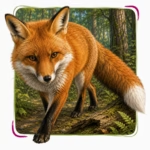
Arctic Fox Fact Highlight
From the full animal facts page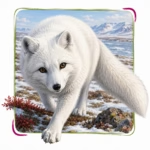
More Animal Comparisons
Pick another animal matchup and keep exploring. Compare appearances, habitats, diets, abilities, and surprising differences.






Make an Animal Story
Turn this red fox vs Arctic fox comparison into a forest-edge and changing-tundra mystery with our free Animal Story Generator.
Source notes: References used for this comparison. See more See less
Try Another Matchup
Explore this comparison →