
Red Panda vs Giant Panda: Living Asian Bamboo-Eating Mammal Comparison
Red pandas and giant pandas share a name, Asian mountain forests, a bamboo-heavy diet, and even a wrist bone that works like a thumb. Those similarities are remarkable, but the animals are not close relatives. A red panda is the cat-sized only living member of Ailuridae, with red fur, ringed tail, and superb tree-climbing ankles. A giant panda is a giant black-and-white bear in Ursidae, many times heavier and built to crush thick bamboo.
About Red Panda
- Type Mammal
- Diet About 95 percent bamboo, especially nutritious leaf tips and tender shoots, with smaller amounts of fruit, roots, grasses, insects, grubs, eggs, and occasional tiny vertebrates
- Group Red Panda (Ailurus fulgens; Family Ailuridae)
- Known for Small tree-climbing carnivoran weighing about 3.6–7.7 kilograms, with rusty-red coat, white face, reddish tear marks, pointed ears, dark belly and legs, furred feet, semi-retractable claws, and a very long bushy tail ringed red and buff
- Special skill Rotating extremely flexible ankles to descend trees headfirst while a long tail balances, fur-covered feet insulate, claws grip bark, and a false thumb holds bamboo
About Giant Panda
- Type Mammal
- Diet Almost entirely bamboo, including leaves, shoots, and woody stems, eaten in very large quantities; occasionally other plants or small animal material
- Group Giant Panda (Ailuropoda melanoleuca; Family Ursidae)
- Known for Large heavy bear about 60–90 centimeters at the shoulder and 1.2–1.8 meters long, with white head and body, black ears, eye patches, shoulders and legs, thick woolly coat, powerful jaws, large crushing molars, short tail, and enlarged wrist bone acting as a false thumb
- Special skill Using a bear’s massive jaw muscles, broad molars, upright feeding posture, and false thumb to grasp, strip, and crush fibrous bamboo for many hours each day
Red Panda vs Giant Panda: Quick Answer
A red panda is a small reddish tree-climber in the family Ailuridae. It weighs about 3.6–7.7 kilograms and balances with a long ringed tail. A giant panda is a black-and-white bear in Ursidae. It can weigh more than 100 kilograms and uses huge jaws to crush bamboo. Both have independently adapted wrist bones called pseudo-thumbs, but they are not close relatives.
Where Do They Fit?
Follow the branches to see how Red Panda and Giant Panda are classified and related.
Red Panda vs Giant Panda: Quick Comparison
| Feature | Red Panda | Giant Panda |
|---|---|---|
| Scientific name | Ailurus fulgens | Ailuropoda melanoleuca |
| Family | Ailuridae | Ursidae, the bears |
| Adult mass | About 3.6–7.7 kg | Females up to about 104 kg; males up to about 113 kg in the wild |
| Colors | Rusty red, white, and dark brown-black | Black and white |
| Tail | Very long, bushy, and ringed | Short and stubby |
| Main food | Bamboo leaf tips and tender shoots | Bamboo leaves, shoots, and woody stems |
| False thumb | Modified wrist bone for holding bamboo | Separately evolved modified wrist bone for holding bamboo |
| Movement | Highly arboreal and can climb headfirst down trunks | Mainly ground-dwelling but can climb and swim |
| Native range | Himalayas and nearby mountains across several Asian countries | Mountain ranges of south-central China |
| Conservation status | Endangered | Vulnerable |
How Are Red Pandas and Giant Pandas Alike?
- Both are mammals in the order Carnivora even though bamboo dominates their diets.
- Both live in cool mountainous Asian forests with bamboo understories and spend much of the day feeding or resting.
- Both grasp bamboo with a pseudo-thumb made from an enlarged wrist bone.
- Both are generally solitary and communicate using scent marks, calls, and signs left along travel routes.
- Both depend on connected forest, reliable bamboo, clean water, protected habitat, and international conservation work.
How Are Red Pandas and Giant Pandas Different?
- Red pandas belong to Ailuridae, while giant pandas are true bears in Ursidae.
- A giant panda may weigh more than fifteen times as much as a red panda.
- Red pandas are rusty red with long ringed tails; giant pandas are black and white with short tails.
- Red pandas specialize in tree climbing and descend headfirst; giant pandas spend most feeding time on the ground.
- Red pandas select tender bamboo leaves and shoots, while giant pandas can crush tough leaves, shoots, and woody stems.
- Red pandas range across several Himalayan and neighboring countries; wild giant pandas survive only in parts of south-central China.
Red Panda vs Giant Panda Adaptation Showdown
Bamboo-forest adaptation showdown: Giant panda wins size, jaw strength, and swimming through its powerful bear body. Red panda wins nimble movement and canopy stealth through its light frame, rotating ankles, claws, rust-colored camouflage, and balancing tail. Social skill is a tie because both are mostly solitary but communicate through scent and calls. Red panda wins weirdest fact for being the only living member of Ailuridae and the only known carnivore with its specialized odor-testing tongue structure. These categories compare adaptations, not combat.
Fun Red Panda vs Giant Panda Facts
The Two Pandas Are Not Close Relatives
The giant panda is a bear in Ursidae. The red panda is the only living member of Ailuridae and belongs within the musteloid branch of Carnivora. Their shared name and bamboo diet do not make one a miniature version of the other.
Both Pandas Built a False Thumb
Each panda grips bamboo using an enlarged wrist bone covered by a fleshy pad. The structures have different evolutionary histories and are a classic example of convergent evolution: similar solutions appearing independently when animals face similar challenges.
Red Pandas Climb Down Headfirst
A red panda can rotate its ankles far enough to point its curved claws into the bark while descending a trunk headfirst. Its long tail balances turns and its fur-covered soles help with cold surfaces. Most similarly sized tree mammals descend less confidently or back down.
Giant Pandas Must Keep Eating
A giant panda has a digestive system more like a carnivore’s than a grazing herbivore’s, so it extracts nutrients from bamboo inefficiently. It compensates by eating large quantities—often tens of pounds—and spending many hours each day feeding, then resting to conserve energy.
Plant Eaters Can Belong to Carnivora
Carnivora is an evolutionary order, not a rule that every member eats only meat. Red pandas and giant pandas inherited carnivoran teeth and digestion from their ancestors but evolved strong bamboo specializations. Their classification comes from ancestry and anatomy, not a menu label.
Red Panda vs Giant Panda Quiz
- Which panda is a true bear? Answer: The giant panda.
- Which panda has a long ringed tail? Answer: The red panda.
- What is a panda’s pseudo-thumb made from? Answer: An enlarged wrist bone with a fleshy pad.
- Which panda can climb down a tree headfirst? Answer: The red panda.
- Are the two pandas close relatives? Answer: No; their shared adaptations evolved independently.
Red Panda vs Giant Panda FAQ
Is a red panda a baby giant panda?
No. They are separate adult species from different families. A baby of either species is called a cub.
Which panda is bigger?
The giant panda is dramatically bigger. Wild males may reach about 113 kilograms, compared with roughly 3.6–7.7 kilograms for an adult red panda.
Why do both pandas eat bamboo?
Each lineage adapted to bamboo-rich mountain forests. Similar diets favored gripping wrist bones, strong teeth, long feeding periods, and energy-saving behavior.
Can both pandas climb?
Yes, but the red panda is the more specialized tree climber and can descend trunks headfirst. Giant pandas mainly feed on the ground, though they can climb.
Can pandas be pets?
No. Both are protected wild animals with specialized needs. Giant pandas are powerful bears, and red pandas are endangered animals threatened in part by illegal trade.
Animal Words to Know
- Pseudo-thumb: An enlarged wrist bone and pad that function like an extra gripping digit.
- Convergent evolution: Independent evolution of similar adaptations in lineages facing similar challenges.
- Arboreal: Adapted for spending much of life in trees.
- Carnivora: The mammal order containing cats, dogs, bears, seals, musteloids, and their relatives.
- Endangered: Facing a very high risk of extinction in the wild.
Red Panda and Giant Panda Activity
Red Panda and Giant Panda Activity
Draw a red panda and giant panda at the same scale. Make the giant panda many times larger, with black-and-white fur and bamboo on the ground. Place the rust-colored red panda on a branch with its long ringed tail. Add a close-up of each paw showing five digits and a wrist-bone pad used like a thumb. Label bear family, red panda family, bamboo, pseudo-thumb, climbing, and tail.
Meet Each Animal
Want the full fact file? Here are quick highlights from each animal’s own facts page.
Red Panda Fact Highlight
From the full animal facts page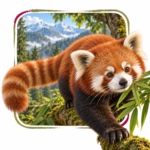
Giant Panda Fact Highlight
From the full animal facts page
More Animal Comparisons
Pick another animal matchup and keep exploring. Compare appearances, habitats, diets, abilities, and surprising differences.
Make an Animal Story
Turn this red panda vs giant panda comparison into a bamboo-forest rescue adventure with our free Animal Story Generator.
Source notes: References used for this comparison. See more See less
Try Another Matchup
Explore this comparison →