
Rook vs Crow: Living European Corvid Species Comparison
Rooks and carrion crows are closely related black birds in the genus Corvus. Both are clever omnivores with strong bills, excellent memories, complex calls, stick nests, family care, and adaptable feeding behavior. An adult rook has a long pointed gray bill surrounded by pale bare skin and usually appears in a sociable flock or rookery. A carrion crow has a fully feathered black face, thicker blunt bill, heavier body, and is more often seen alone or with its mate. Juvenile rooks still have facial feathers, so behavior, body shape, bill shape, and companions must also be checked.
About Rook
- Type Bird
- Diet Opportunistic omnivore; earthworms, beetles and larvae, grain, seeds, nuts, fruit, carrion, scraps, eggs, young birds, and small vertebrates depending on season
- Group Rook (Corvus frugilegus; Family Corvidae)
- Known for Large black corvid with purple-blue gloss, long pointed grayish bill, pale bare facial skin around the bill in adults, peaked crown, slightly wedge-shaped tail, loose shaggy thigh feathers called pantaloons, and a somewhat untidy silhouette
- Special skill Combining group vigilance, strong memory, food caching, flexible problem-solving, and a long probing bill to find hidden food in soil and grass
About Crow
- Type Bird
- Diet Highly opportunistic omnivore; carrion, insects, worms, seeds, grain, nuts, fruit, shellfish, eggs, small animals, food scraps, and almost any safe nutritious item it can obtain
- Group Carrion Crow (Corvus corone; Family Corvidae)
- Known for Large heavy all-black corvid with green-purple gloss, fully feathered black face, thick blunt black bill, rounded crown, broad wings, strong legs, fan-shaped to slightly rounded tail, and a neater more solid silhouette than a rook
- Special skill Learning quickly, remembering places and individuals, manipulating objects, exploiting human-made environments, and using a powerful general-purpose bill on many foods
Rook vs Crow: Quick Answer
Look at the face, bill, feathers, and company. An adult rook has pale bare skin around a long pointed grayish bill, a peaked head, shaggy thigh feathers, and a strong preference for flocks and communal rookeries. A carrion crow has black feathers covering the base of a thicker black bill, a heavier neater body, and is commonly alone or in a pair. A young rook has a feathered face, so no single clue works every time.
Where Do They Fit?
Follow the branches to see how Rook and Crow are classified and related.
Rook vs Crow: Quick Comparison
| Feature | Rook | Carrion Crow |
|---|---|---|
| Scientific name | Corvus frugilegus | Corvus corone |
| Length | About 44–46 cm | About 45–47 cm |
| Typical weight | About 280–340 g | About 370–650 g |
| Adult face | Pale bare skin around bill base | Glossy black feathers cover bill base |
| Juvenile face | Dark and feathered, resembling a crow | Dark and feathered like the adult |
| Bill | Longer, narrower, pointed, and grayish in adults | Thicker, blunter, powerful, and black |
| Feather shape | Peaked crown, loose pantaloons, untidy outline | Rounded crown and neater solid outline |
| Social pattern | Usually in flocks and communal colonies | Often alone or in a territorial pair |
| Nest pattern | Many stick nests together in a rookery | One pair’s more isolated stick nest |
| Call | Hoarser, softer, and often heard in a chorus | Clearer, harder, ringing caw |
How Are Rooks and Crows Alike?
- Both are large corvids in the genus Corvus and have glossy black feathers, strong feet, and sturdy bills.
- Both are intelligent, curious, adaptable omnivores that remember food locations and learn from experience.
- Both eat invertebrates, seeds, fruit, carrion, eggs, scraps, and other foods that change with season and opportunity.
- Both build substantial stick nests, lay eggs, raise chicks cooperatively as a pair, and defend their young.
- Both use varied calls, postures, flight displays, facial attention, and social learning to communicate.
How Are Rooks and Crows Different?
- An adult rook has pale bare facial skin; a carrion crow remains fully black-feathered around the bill.
- The rook has a longer pointed grayish bill, while the crow has a deeper, thicker, black bill.
- A carrion crow is normally heavier despite having a similar body length.
- Rooks have peaked heads, shaggy thigh pantaloons, and a slightly untidy outline; crows look rounder and more solid.
- Rooks usually feed, roost, and nest communally; carrion crows are more often solitary or paired during breeding.
- A rookery holds many neighboring nests in tall trees, while each territorial crow pair normally keeps a more isolated nest.
Rook vs Crow Adaptation Showdown
Corvid adaptation showdown: Carrion crow wins size and strength because it is generally much heavier, and stealth because a lone or paired bird can forage without a noisy colony nearby. Speed is a tie because flight depends on wind, route, and behavior rather than a reliable species race. Rook wins social coordination through year-round flocking and communal nesting, and weirdest fact because adults develop a pale bare face while juveniles begin with black facial feathers. Swimming is a tie because neither is an aquatic specialist. These categories compare survival adaptations, not combat.
Fun Rook vs Crow Facts
A Rookery Is a Treetop Neighborhood
Rooks place many bulky stick nests close together in the upper branches of mature trees. Pairs repair and reuse the colony each breeding season, and some sites remain active for decades. Living near neighbors provides shared information and many watching eyes, although it also creates loud arguments and opportunities for unattended sticks to be borrowed.
Young Rooks Can Look Like Crows
A juvenile rook has dark feathers covering the skin around its bill, so the famous pale adult face is missing. As the bird matures, those facial feathers are lost and pale skin becomes obvious. A careful observer also checks the rook’s pointed bill, peaked head, loose leg feathers, wedge-like tail, calls, and flocking behavior.
The Old Rook-and-Crow Saying Is Unreliable
People sometimes say that one rook is a crow and many crows are rooks. The saying reflects typical behavior but is not an identification rule. Rooks occasionally appear alone, and carrion crows can gather in families, winter flocks, roosts, or rich feeding places. Anatomy plus several behavior clues gives a safer answer.
A Rook Can Hide Food for Later
Rooks cache surplus food in soil, grass, leaf litter, or other hiding places and later return to retrieve it. Successful caching uses memory of locations and awareness of other birds that might steal the prize. Carrion crows also store food, showing that planning and spatial memory are valuable across the crow family.
Carrion Crow Is One Precise Kind of Crow
Crow is a broad everyday name used for many species in Corvus and sometimes for the entire family Corvidae. This comparison uses the carrion crow, Corvus corone, because it is the black crow most often confused with rooks across much of Britain. In Ireland and northwestern Scotland, the gray-and-black hooded crow largely replaces it.
Rook vs Crow Quiz
- What surrounds an adult rook’s bill? Answer: Pale bare facial skin.
- Which bird is normally heavier? Answer: The carrion crow.
- What is a communal rook nesting colony called? Answer: A rookery.
- Why can a juvenile rook be mistaken for a crow? Answer: It still has dark feathers covering its face.
- Is a bird alone automatically a crow? Answer: No; behavior varies, so several identification clues are needed.
Rook vs Crow FAQ
How can you tell a rook from a crow?
An adult rook has pale bare skin around a pointed gray bill, a peaked head, shaggy thigh feathers, and often flock companions. A carrion crow has a fully feathered black face, thicker black bill, heavier body, and is often alone or paired.
Which is bigger, a rook or carrion crow?
They have similar lengths, but the carrion crow is usually considerably heavier and more solidly built.
Do all rooks have white faces?
No. Adults have pale grayish bare skin around the bill rather than white feathers. Juveniles have dark facial feathers and resemble crows.
Do rooks always live in groups?
They are strongly social and usually flock, roost, and nest communally, but an individual rook can occasionally appear alone.
Are rooks and crows the same species?
No. The rook is Corvus frugilegus and the carrion crow is Corvus corone, although both belong to the same genus and family.
Animal Words to Know
- Corvid: A bird in the intelligent crow family Corvidae.
- Rookery: A communal breeding colony containing many rook nests.
- Carrion: The remains of a dead animal, one of many foods used by opportunistic birds.
- Cache: Food hidden for later use.
- Juvenile: A young bird that has left the nest but has not yet developed every adult feature.
Rook and Crow Detective Activity
Rook and Crow Detective Activity
Draw an adult rook, a young rook, and a carrion crow at the same scale. Give the adult rook pale bare skin around the base of its pointed bill; keep the young rook’s face feathered. Give the crow a fully feathered black face and a thicker bill. Add a rookery with many nests and a separate crow pair. Label bare face, feathered face, pointed bill, thick bill, rookery, and caw.
Meet Each Animal
Want the full fact file? Here are quick highlights from each animal’s own facts page.
Rook Fact Highlight
From the full animal facts page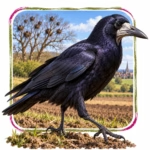
Crow Fact Highlight
From the full animal facts page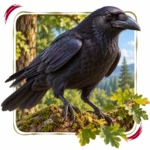
More Animal Comparisons
Pick another animal matchup and keep exploring. Compare appearances, habitats, diets, abilities, and surprising differences.




Make an Animal Story
Turn this rook vs crow comparison into a clever countryside bird mystery with our free Animal Story Generator.
Source notes: References used for this comparison. See more See less
Try Another Matchup
Explore this comparison →