
Tapir vs Anteater: Living South American Long-Snouted Mammal Comparison
A lowland tapir and giant anteater can both look as if someone stretched the front of the face, but their long noses do different jobs and the animals are distant relatives. The tapir is a large odd-toed herbivore related to horses and rhinoceroses. Its nose and upper lip form a flexible mini-trunk for smelling, grasping leaves, and snorkeling. The giant anteater is a toothless insect specialist related to tamanduas, sloths, and armadillos. Its rigid tubular snout hides an extraordinary sticky tongue, while its giant claws open ant and termite nests.
About Tapir
- Type Mammal
- Diet Herbivorous browser and grazer eating leaves, shoots, twigs, bark, aquatic plants, grasses, fallen fruit, and seeds, many of which pass through the gut and are dispersed
- Group Lowland Tapir (Tapirus terrestris; Family Tapiridae; Order Perissodactyla)
- Known for Large heavy odd-toed hoofed mammal about 150–250 kilograms and roughly 2 meters long, with dark brown or reddish barrel body, tapered front, rounded rear, short bristly mane, four splayed toes on each front foot, three on each hind foot, small tail, and flexible prehensile nose-and-upper-lip proboscis
- Special skill Grasping vegetation with a multidirectional mini-trunk, pushing through dense forest with a tapered body, spreading toes on mud, swimming strongly, walking underwater, and using the proboscis as a surface snorkel
About Anteater
- Type Mammal
- Diet Specialized insectivore feeding almost entirely on ants and termites, located by smell, exposed with powerful claws, and gathered rapidly on a saliva-coated tongue
- Group Giant Anteater (Myrmecophaga tridactyla; Family Myrmecophagidae; Order Pilosa)
- Known for Largest living anteater, about 1.8–2.4 meters from long tubular snout to enormous bushy tail and commonly 27–45 kilograms, with narrow toothless mouth, tongue up to about 60 centimeters, powerful shoulders, huge curved front claws folded into the palms during knuckle-walking, gray-brown coat, white-bordered black shoulder stripe, and shaggy tail
- Special skill Identifying insect species by smell, opening hard nests with enormous claws, flicking a two-foot sticky tongue up to 150 times per minute, feeding briefly at each colony, and carrying one striped pup on the mother’s back
Tapir vs Anteater: Quick Answer
A lowland tapir is a 150–250-kilogram hoofed plant eater with a short flexible trunk, teeth, four front toes, three rear toes, and excellent swimming ability. A giant anteater is a 27–45-kilogram clawed insect eater with a long rigid snout, no teeth, a tongue around 60 centimeters long, and knuckle-walking forefeet. Both live in parts of South America, but they belong to completely different mammal orders.
Where Do They Fit?
Follow the branches to see how Tapir and Anteater are classified and related.
Tapir vs Anteater: Quick Comparison
| Feature | Lowland Tapir | Giant Anteater |
|---|---|---|
| Scientific name | Tapirus terrestris | Myrmecophaga tridactyla |
| Order and family | Perissodactyla; Tapiridae | Pilosa; Myrmecophagidae |
| Adult mass | About 150–250 kg | Commonly about 27–45 kg |
| Long-face tool | Flexible prehensile nose-and-upper-lip mini-trunk | Rigid tubular snout containing a very long tongue |
| Teeth | Has incisors, canines, premolars, and molars | No teeth |
| Feet | Four splayed front toes and three rear toes with hooves | Huge curved front claws protected by knuckle-walking |
| Diet | Leaves, shoots, fruit, grass, bark, and aquatic plants | Mostly ants and termites |
| Swimming | Excellent swimmer that may walk underwater and snorkel | Can swim but is less specialized for aquatic life |
| Young | Striped-and-spotted calf walking beside its mother | Single striped pup riding on its mother’s back |
| Global conservation status | Vulnerable | Vulnerable |
How Are Tapirs and Anteaters Alike?
- Both are warm-blooded, furred, mostly solitary placental mammals found in South America.
- Both use a strong sense of smell and elongated snout while searching for food.
- Both can inhabit forest, savanna, wetland, and grassland mosaics and can swim when needed.
- Both usually produce one well-cared-for young and communicate quietly through scent, posture, touch, and occasional calls.
- Both are globally Vulnerable and threatened by habitat loss, fire, roads, hunting, dogs, and fragmented landscapes.
How Are Tapirs and Anteaters Different?
- Tapirs are odd-toed hoofed relatives of horses and rhinos; anteaters are pilosans related to sloths and more distantly armadillos.
- A tapir’s short proboscis bends and grasps vegetation; an anteater’s long snout is mostly rigid and channels a tongue into insect tunnels.
- Tapirs have a full set of chewing teeth, whereas giant anteaters have no teeth at all.
- Tapirs walk on splayed hoofed toes; giant anteaters protect their long front claws by walking on their knuckles.
- A tapir eats plants and disperses seeds; an anteater opens insect nests and removes small portions of ants or termites.
- A tapir calf follows its mother on the ground; a giant-anteater pup rides on its mother’s back with their dark stripes aligned.
Tapir vs Anteater Adaptation Showdown
Long-snout adaptation showdown: Tapir wins size, whole-body strength, dense-forest stealth, and swimming through its heavy tapered body, muddy-ground toes, dark camouflage, and snorkel-like proboscis. Giant anteater wins short-burst running speed and weirdest feeding tool with a toothless mouth, two-foot sticky tongue, 150 flicks per minute, and claw-protecting knuckle walk. Social skill is a tie because both are mostly solitary but invest strongly in one young. These categories compare adaptations, not combat.
Fun Tapir vs Anteater Facts
Their Long Noses Are Different Machines
A tapir’s proboscis is formed from its nose and upper lip and can curl around leaves, investigate the ground, and rise above water like a snorkel. A giant anteater’s narrow snout barely bends; it acts as a protected tube through which the sticky tongue reaches insect tunnels.
Anteaters Have No Teeth
A lowland tapir has incisors, canines, premolars, and ridged molars for cutting and grinding plants. A giant anteater is completely toothless. It swallows insects rapidly, and a muscular stomach plus swallowed grit helps process the tiny food instead of chewing it.
They Sit on Distant Mammal Branches
Tapirs belong to Perissodactyla with rhinoceroses and horses. Giant anteaters belong to Pilosa with tamanduas and sloths; Pilosa joins armadillos in the larger xenarthran lineage. Similar snouts evolved independently because the animals use them for different ecological tasks.
Their Babies Wear Camouflage Differently
A lowland tapir calf is brown with cream-white spots and horizontal stripes that break up its outline in forest light. A giant-anteater pup rides on its mother’s back, and its dark shoulder stripe lines up with hers, making the pair look more like one large animal.
They Help the Habitat in Opposite Ways
Tapirs swallow fruit and deposit viable seeds in new places, earning the nickname gardeners of the forest. Giant anteaters open ant and termite nests but feed briefly and move on, leaving colonies and nest structures with time to recover.
Tapir vs Anteater Quiz
- Which animal has a flexible mini-trunk? Answer: The tapir.
- Which animal has no teeth? Answer: The giant anteater.
- What does a giant anteater use to open insect nests? Answer: Its powerful curved front claws.
- Which animal disperses many seeds? Answer: The tapir.
- How does a young giant anteater travel? Answer: It rides on its mother’s back.
Tapir vs Anteater FAQ
Is a tapir a type of anteater?
No. A tapir is an odd-toed hoofed mammal related to horses and rhinos. An anteater is a pilosan related to tamanduas and sloths.
Which is bigger, a tapir or giant anteater?
The lowland tapir is much heavier at about 150–250 kilograms, compared with roughly 27–45 kilograms for a giant anteater.
Do tapirs eat ants?
Tapirs are herbivores that eat leaves, fruit, shoots, grass, and other plants. Their long nose is for smelling and grasping, not insect feeding.
Can both animals swim?
Yes, but tapirs are the aquatic specialists. They readily enter rivers, may walk along the bottom, and can hold the proboscis above water like a snorkel.
Are tapirs and giant anteaters dangerous to approach?
Yes. Both avoid people but are powerful wild animals. A tapir can bite, and a giant anteater has formidable claws. Observe from a safe distance and never corner or touch one.
Animal Words to Know
- Proboscis: An elongated flexible nose or nose-and-lip structure.
- Prehensile: Able to grasp or hold an object.
- Perissodactyl: An odd-toed hoofed mammal such as a tapir, horse, or rhinoceros.
- Pilosan: A member of the mammal order containing anteaters and sloths.
- Insectivore: An animal whose diet consists mainly or entirely of insects.
Tapir and Anteater Feeding Activity
Tapir and Anteater Feeding Activity
Draw a lowland tapir and giant anteater at the same scale. Make the tapir much heavier, with a short flexible nose reaching for leaves and fruit. Give the anteater a long narrow snout, an extended sticky tongue, large folded front claws, and an ant mound. Label flexible nose, tongue, teeth, claws, herbivore, insect eater, and seed dispersal.
Meet Each Animal
Want the full fact file? Here are quick highlights from each animal’s own facts page.
Tapir Fact Highlight
From the full animal facts page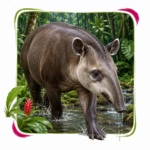
Anteater Fact Highlight
From the full animal facts page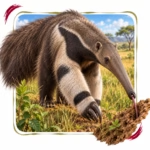
More Animal Comparisons
Pick another animal matchup and keep exploring. Compare appearances, habitats, diets, abilities, and surprising differences.


Make an Animal Story
Turn this tapir vs anteater comparison into a long-snout rainforest mystery with our free Animal Story Generator.
Source notes: References used for this comparison. See more See less
Try Another Matchup
Explore this comparison →