
Henodus Facts for Kids
Henodus was a small, heavily armoured placodont that lived in Late Triassic Germany. It was not a turtle, although its broad flat shell and short boxy head made it look remarkably turtle-like. Henodus had only four functional crushing teeth, beak-like jaw edges, and an unusual feeding system that may have handled tiny crustaceans, snails, algae, and other soft or small foods.
Quick Henodus Facts
- Animal Type: Prehistoric aquatic reptile
- Group: Henodontid placodont
- Known For: Wide flat shell, turtle-like appearance, boxy head, only four functional crushing teeth, and unusual mixed feeding adaptations
- Lived During: Late Triassic, around 235 million years ago
- Diet: Probably small crustaceans, tiny snails, algae, and other plant or animal food
What You’ll Learn
Explore 10 turtle-like henodus facts for kids about its flat armored body, broad mouth, shellfish-like feeding, and Triassic waters, plus a quiz, glossary, and activity
These easy facts are made for kids, parents, teachers, and curious young learners.
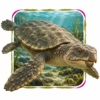
10 Fun Henodus Facts for Kids
1. Henodus Was a Placodont
Henodus belonged to Placodontia, a group of Triassic aquatic reptiles related more closely to plesiosaurs than to turtles.
Kid Decode: It looked turtle-ish while carrying completely different family paperwork.
2. It Was About One Metre Long
Most reconstructions show Henodus as a compact animal around 1 metre long, although estimates vary among specimens and reconstructions.
Kid Decode: It packed a broad shell into a body shorter than many children are tall.
3. It Had a Wide Flat Shell
Its back was protected by a broad carapace made from many small bony plates arranged in a mosaic.
Kid Decode: The armour looked like a fossil floor tiled by a very determined reptile.
4. Its Head Was Boxy
Henodus had a broad, flattened skull with a squared front, closely placed eyes, and beak-like jaw margins.
Kid Decode: Its face looked as though someone had gently pressed a reptile into rectangle mode.
5. It Had Only Four Functional Teeth
Henodus carried one crushing tooth on each side of the palate and one matching tooth on each side of the lower jaw.
Kid Decode: Four working teeth handled the job that other placodonts gave to a whole dental toolbox.
6. Its Teeth Grew From Below
CT scans show that replacement teeth developed beneath the working teeth and moved upward in a vertical replacement system.
Kid Decode: Even its tiny tooth team kept replacements waiting downstairs.
7. Its Feeding Style Is Still Debated
Jaw grooves, denticles, a broad snout, and throat anatomy have led scientists to suggest suction feeding, filtering, scraping, or a mixture of methods.
Kid Decode: The mouth left scientists several clues but no instruction manual.
8. It May Have Eaten Plants and Small Animals
Microscopic wear on its teeth suggests that Henodus may have eaten both small hard-shelled animals and plant material such as algae.
Kid Decode: Its menu may have mixed crunchy mini-snacks with green lagoon food.
9. It Lived in Brackish or Lake-Like Water
Henodus fossils from Germany came from deposits formed in a restricted lagoon or shallow lake with fresh to brackish water.
Kid Decode: Among placodonts, it chose the unusual neighbourhood away from a normal open sea.
10. Its Name Means Single Tooth
Henodus means single tooth, while the species name chelyops refers to its turtle-like face.
Kid Decode: Its name squeezed its tiny tooth count and turtle disguise into two words.
The Weirdest Henodus Fact
Henodus looked like a turtle but was a placodont with only four functional crushing teeth and a diet that may have included both tiny animals and algae.
Try This Henodus Activity
Henodus Drawing Activity
Draw Henodus moving across the bottom of a Late Triassic lagoon. Add a wide flat mosaic shell, boxy head, beak-like jaws, four tiny crushing teeth shown in a cutaway bubble, short limbs, algae, small crustaceans, tiny snails, muddy water, and a “not a turtle” label.
Quick Henodus Quiz
- Was Henodus a turtle? Answer: No, it was a placodont.
- During which period did it live? Answer: The Late Triassic.
- How many functional crushing teeth did it have? Answer: Four.
- What protected its back? Answer: A broad shell made from many bony plates.
- What may Henodus have eaten? Answer: Small crustaceans, tiny snails, algae, and other small foods.
Mini Glossary
- Placodont: A Triassic aquatic reptile, many of which had crushing teeth and body armour.
- Carapace: A hard protective covering over the back.
- Brackish: Slightly salty water formed by mixing fresh water and seawater.
- Microwear: Tiny scratches and pits on teeth left by food.
- Tooth Replacement: The process of growing a new tooth to replace an old one.
 Japanese Spider Crab Facts for Kids
 Bengal Tiger Facts for Kids
 Ferret Facts for Kids
 Lake Mackay Hare-Wallaby Facts for Kids
More Animal Facts for Kids
Visit the full animal facts library or explore a focused animal group.
More Extinct Animal Facts for Kids
Discover dinosaurs, Ice Age giants, prehistoric sea creatures, recently extinct species, and other animals from the past.
Fact check note: Fact checked with Pommery and colleagues’ 2021 CT study of Henodus teeth, Gere and colleagues’ 2024 placodont dental-microwear analysis, Rieppel’s feeding-mechanism research, and studies of the Late Triassic Tübingen deposits.

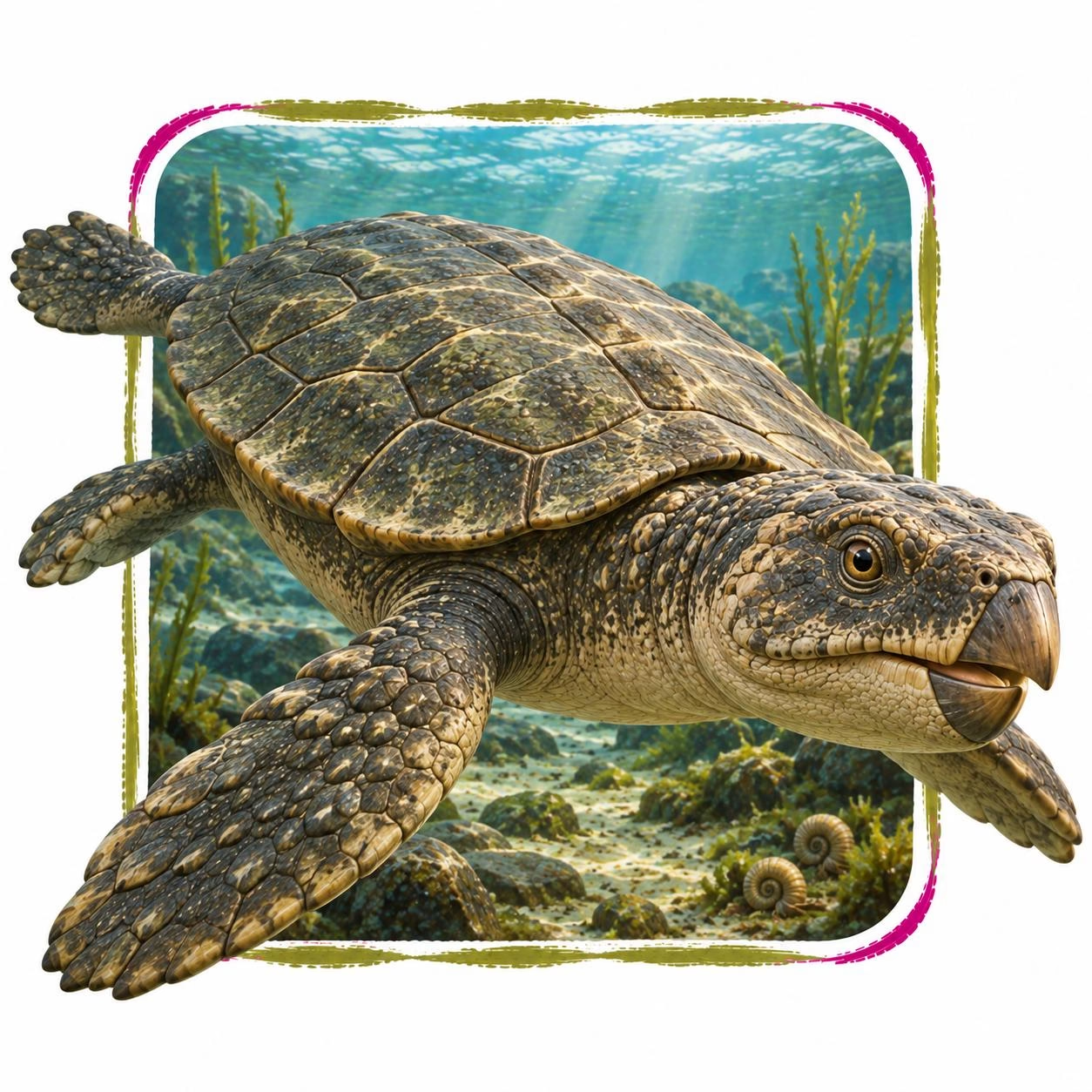
Henodus in its natural Late Triassic brackish lagoons, shallow lakes, quiet coastal basins, muddy bottoms, algae-rich shallows, and restricted waterways of ancient Germany habitat