
Arctotherium Facts for Kids
Arctotherium was a genus of short-faced bears that lived in South America during the Pleistocene. These bears descended from North American ancestors that crossed the newly formed land connection between the continents. The earliest species, Arctotherium angustidens, included an enormous individual weighing well over a tonne, but evidence from teeth, skulls, and isotopes shows that even this giant probably ate a flexible mixture of meat and plants.
Quick Arctotherium Facts
- Animal Type: Extinct bear
- Group: Tremarctine short-faced bear
- Known For: Giant size in A. angustidens, powerful jaws, mixed diet, South American range, and spectacular healed injuries
- Lived During: Pleistocene, roughly 2 million to 11,000 years ago
- Diet: Omnivorous; meat, carrion, bones, and plant food in varying amounts
What You’ll Learn
Explore 10 enormous arctotherium facts for kids about giant size, strong jaws, powerful limbs, diet, and Ice Age South America, plus a quiz, glossary, and activity
Clear explanations make them fun for children, families, teachers, and young animal explorers.
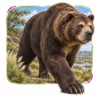
10 Fun Arctotherium Facts for Kids
1. Arctotherium Was a True Bear
Arctotherium belonged to the bear family Ursidae and to the tremarctine branch, whose only living member is the spectacled bear.
Kid Decode: Its closest living cousin is a much smaller bear wearing pale rings around its eyes.
2. Its Ancestors Entered South America
Short-faced bears crossed from North America after the Panamanian land bridge connected the continents during the Great American Biotic Interchange.
Kid Decode: A new bridge between continents delivered one very large furry newcomer.
3. Five Species Are Recognised
Scientists generally recognise five species of Arctotherium, ranging from the gigantic A. angustidens to smaller later forms.
Kid Decode: The genus began with heavyweight giants and later explored more modest bear sizes.
4. One Individual Was Enormous
An old male A. angustidens from Argentina produced body-mass estimates from about 983 to 2,042 kilograms, with roughly 1.6 tonnes often used as a cautious central estimate.
Kid Decode: The fossil measuring tape briefly wandered into small-car territory.
5. It Was Not a Pure Meat Eater
Multiple lines of evidence indicate that A. angustidens ate substantial animal matter but also consumed plant food.
Kid Decode: This giant bear kept both steak and salad on the Pleistocene menu.
6. It Probably Scavenged Often
Its great size and strength would have allowed it to drive other predators away from carcasses as well as hunt prey itself.
Kid Decode: Sometimes the easiest hunting method may have been arriving late and looking enormous.
7. Its Teeth Show Hard Use
Broken teeth, cavities, and heavy wear suggest that large Arctotherium sometimes chewed hard foods such as bones.
Kid Decode: Its dinner occasionally left the dental record looking like a repair shop.
8. One Giant Bear Survived Serious Injuries
The largest known specimen was an elderly male with fused and damaged bones, showing that it lived for years after major injuries.
Kid Decode: The skeleton records a heavyweight life filled with bruises, healing, and remarkable survival.
9. Some Arctotherium Used Dens
Fossils from Argentina include a probable den associated with A. angustidens, providing rare clues about shelter use.
Kid Decode: Even a giant bear occasionally needed a quiet room away from the Pleistocene crowd.
10. Later Species Became Smaller
Across the genus, later species generally became smaller and may have relied more heavily on plant foods as South America’s predator community changed.
Kid Decode: The family story gradually turned down both the body-size dial and the meat setting.
The Weirdest Arctotherium Fact
The biggest known Arctotherium was an elderly male that may have weighed around 1.6 tonnes and carried several serious injuries that had healed during life.
Try This Arctotherium Activity
Arctotherium Drawing Activity
Draw Arctotherium angustidens walking across an Early Pleistocene Argentine grassland. Add a massive bear body, broad head, powerful jaws, large paws, broken-tooth and healed-bone clue panels, a carcass guarded from another predator, berries and roots, a den entrance, and a map showing the journey from North America into South America.
Quick Arctotherium Quiz
- Was Arctotherium a true bear? Answer: Yes, it belonged to the bear family.
- Where did it live? Answer: South America.
- Which species included the largest known individual? Answer: Arctotherium angustidens.
- Was it strictly carnivorous? Answer: No, it was an omnivore that ate both animal and plant food.
- What living bear is its closest relative? Answer: The spectacled bear.
Mini Glossary
- Tremarctine: A bear from the branch containing spectacled and short-faced bears.
- Omnivore: An animal that eats both plant and animal food.
- Scavenger: An animal that feeds on animals it did not necessarily kill.
- Allometry: The study of how body proportions change with size, often used to estimate fossil mass.
- Great American Biotic Interchange: The movement of animals between North and South America after the continents became connected.
 Snail Facts for Kids
 Mouse Facts for Kids
 Kangaroo Facts for Kids
 Cearadactylus Facts for Kids
More Animal Facts for Kids
Visit the full animal facts library or explore a focused animal group.
More Extinct Animal Facts for Kids
Discover dinosaurs, Ice Age giants, prehistoric sea creatures, recently extinct species, and other animals from the past.
Fact check note: Fact checked with Soibelzon and Schubert’s 2011 giant-specimen study, Soibelzon and colleagues’ 2014 multiproxy diet analysis, Soibelzon and colleagues’ den report, and South American tremarctine evolutionary research.

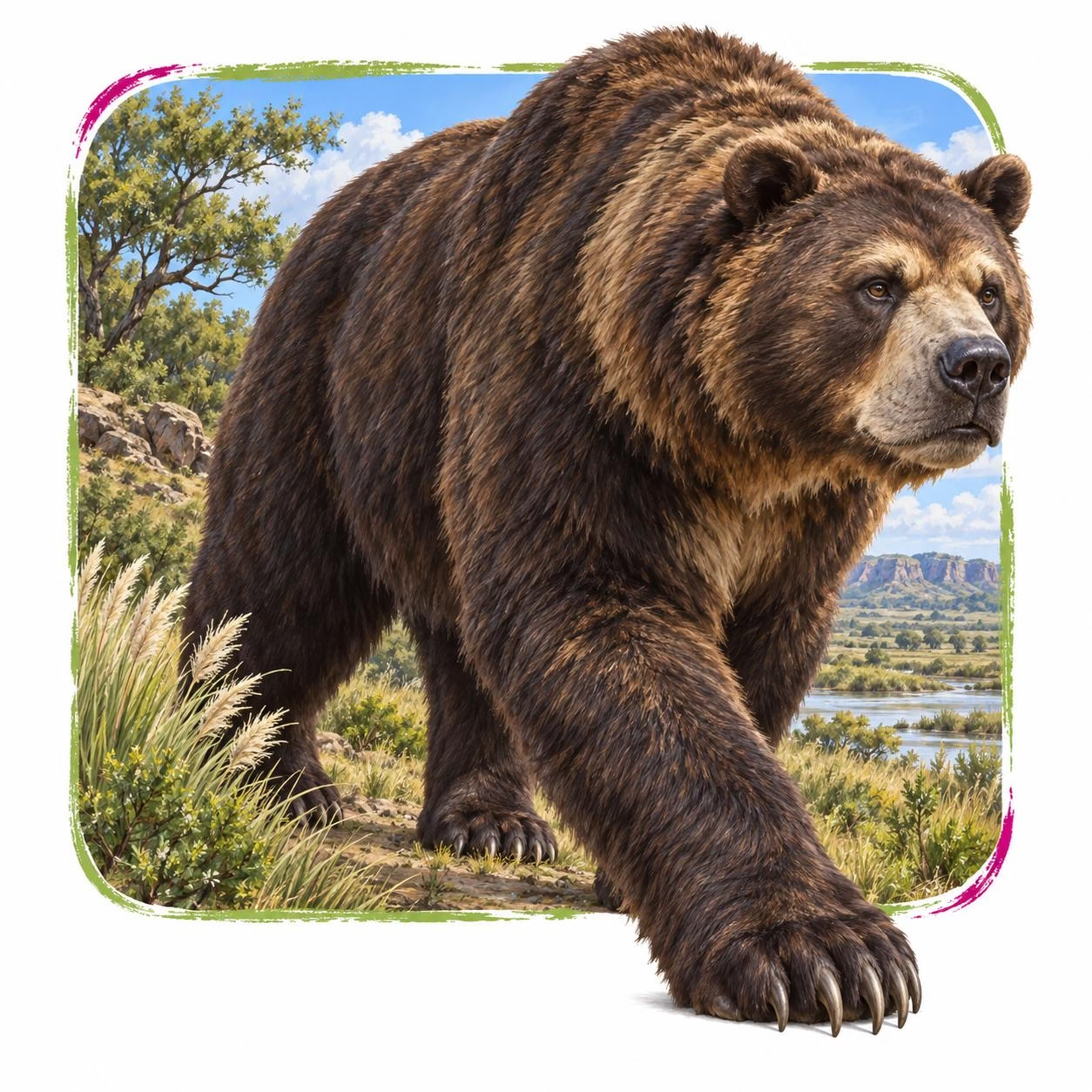
Arctotherium in its natural Pleistocene pampas, open grasslands, wooded savannas, river floodplains, rocky shelters, dens, and varied terrestrial habitats across South America habitat