
Eryops Facts for Kids
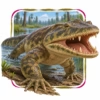
Eryops was a large, sturdy temnospondyl that lived in what is now the southern United States during the Early Permian. It was not a dinosaur. Its broad skull carried many pointed teeth and large fangs on the palate, while heavily built limbs and strong muscle attachments allowed it to support itself on land better than many more aquatic temnospondyls.
Quick Eryops Facts
- Animal Type: Extinct amphibian-grade tetrapod
- Group: Eryopid temnospondyl
- Known For: Broad skull, large mouth, palatal fangs, heavily ossified skeleton, strong limbs, and semi-terrestrial movement
- Lived During: Early Permian, about 295–272 million years ago
- Diet: Fish, small tetrapods, and other animals
What You’ll Learn
Explore 10 sturdy eryops facts for kids about strong limbs, broad skulls, sharp teeth, swamp habitats, and Permian life, with a quiz, glossary, and activity
Easy explanations make them fun for children, families, teachers, and young fossil lovers.
10 Fun Eryops Facts for Kids
1. Eryops Was a Temnospondyl
Eryops belonged to a large extinct group of early tetrapods often described as amphibian-grade animals.
Kid Decode: It was neither reptile nor modern frog, but an older branch with its own sturdy style.
2. It Lived in Early Permian North America
Many fossils come from the red-bed deposits of Texas and nearby parts of the southern United States.
Kid Decode: Its ancient floodplain home now sits beneath famous fossil country.
3. It Grew Around Two Metres Long
Large Eryops megacephalus individuals were roughly 1.5 to 2 metres long, with a heavy body and a very large head.
Kid Decode: Much of that impressive length came with a head built for serious bites.
4. Its Name Means Drawn-Out Face
The name Eryops refers to its elongated facial region and broad, forward-projecting skull.
Kid Decode: The scientific name politely points out that its face kept going.
5. It Had Many Pointed Teeth
Rows of sharp teeth lined the jaws, and additional large fangs on the palate helped trap slippery prey.
Kid Decode: The roof of its mouth joined the jaws in the prey-holding business.
6. Its Limbs Were Strong
The shoulder and hip regions were heavily built, and the limb bones had large surfaces for powerful muscles.
Kid Decode: This animal did not skip limb day during the Permian.
7. It Could Move on Land
Joint studies show that its hind limbs could probably perform salamander-like walking poses, supporting regular movement across land.
Kid Decode: It may not have sprinted, but it could haul its heavy body beyond the shoreline.
8. It Was Probably Semi-Aquatic
Eryops combined land-capable limbs with a broad aquatic-predator skull, suggesting a life split between water and land.
Kid Decode: Its lifestyle kept one foot in the pond and the others ready for shore duty.
9. Young Eryops Changed as They Grew
Research on eryopid life cycles indicates that juveniles were more aquatic and adults developed stronger land-going features.
Kid Decode: Growing up may have meant trading nursery water for heavier adventures on land.
10. Its Fossils Are Well Known
Numerous skulls and skeletons have made Eryops one of the best-studied large temnospondyls from the Early Permian.
Kid Decode: This fossil celebrity left scientists more than a few mysterious scraps.
The Weirdest Eryops Fact
Eryops had large fangs not only along its jaws but also on the roof of its mouth, helping create a cage-like trap for prey.
Try This Eryops Activity
Eryops Drawing Activity
Draw Eryops moving from an Early Permian riverbank onto land. Add a broad heavy skull, many pointed teeth, palatal fangs in a cutaway bubble, sturdy shoulders and hips, four-toed front feet, five-toed hind feet, a thick body, fish, ferns, and red floodplain mud.
Quick Eryops Quiz
- Was Eryops a dinosaur? Answer: No, it was a temnospondyl.
- Where are many Eryops fossils found? Answer: Texas and nearby parts of the southern United States.
- How long did large individuals grow? Answer: Roughly 1.5 to 2 metres.
- What helped Eryops move on land? Answer: Strong, heavily built limbs and girdles.
- Where did some of its large fangs occur? Answer: On the palate, or roof of the mouth.
Mini Glossary
- Temnospondyl: A member of a diverse extinct group of early tetrapods.
- Eryopid: A member of the temnospondyl family containing Eryops and close relatives.
- Palatal Fang: A large tooth growing from the roof of the mouth.
- Semi-Aquatic: Spending substantial time both in water and on land.
- Ossified: Hardened or formed into bone.
 Jackal Facts for Kids
 Leafy Seadragon Facts for Kids
 Woodcock Facts for Kids
 Dinomischus Facts for Kids
More Animal Facts for Kids
Visit the full animal facts library or explore a focused animal group.
More Extinct Animal Facts for Kids
Discover dinosaurs, Ice Age giants, prehistoric sea creatures, recently extinct species, and other animals from the past.
Fact check note: Fact checked with Pawley and Warren’s study of the Eryops appendicular skeleton, Herbst and colleagues’ 2022 hindlimb pose analysis, Schoch’s research on eryopid life cycles, and Early Permian red-bed fossil studies.

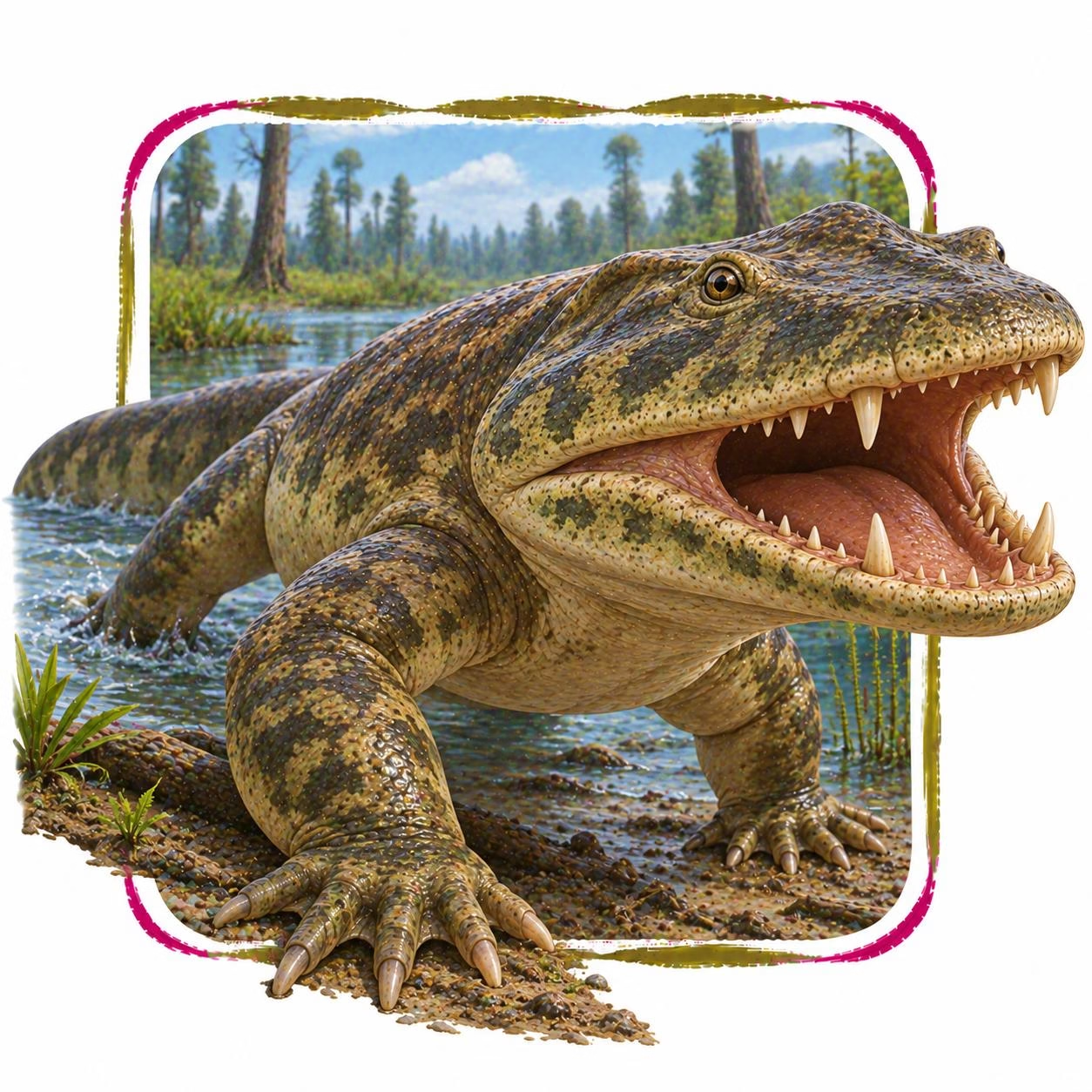
Eryops in its natural Early Permian rivers, floodplains, ponds, seasonal wetlands, muddy shorelines, wooded lowlands, and semi-aquatic habitats of the southern United States habitat