
Scutosaurus Facts for Kids
Scutosaurus was a massive plant-eating pareiasaur that lived in what is now European Russia near the end of the Permian Period. It was not a dinosaur, turtle, or mammal. A short skull covered in knobs, a barrel-shaped body, thick limbs, and many bony plates embedded in the skin gave this one-ton herbivore a heavily armored appearance.
Quick Scutosaurus Facts
- Animal Type: Extinct herbivorous parareptile
- Group: Pareiasaur
- Known For: Bony skin plates, skull bosses, barrel-shaped body, enormous weight, and strong sprawling limbs
- Lived During: Late Permian, roughly 259–252 million years ago
- Diet: Tough, high-fibre terrestrial plants
What You’ll Learn
Discover 10 fascinating scutosaurus facts for kids about heavy armor, powerful legs, plant-eating, and life in the Permian, plus a quiz, glossary, and activity
These simple facts are made for kids, parents, teachers, and curious little fact-hunters.
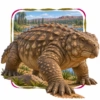
10 Fun Scutosaurus Facts for Kids
1. Scutosaurus Was a Pareiasaur
Scutosaurus belonged to Pareiasauria, a group of large herbivorous parareptiles that spread widely during the Permian.
Kid Decode: It joined a global club of barrel-bodied plant eaters with skulls that looked carved from rock.
2. It Was Not a Dinosaur
Scutosaurus lived before the first dinosaurs and belonged to a separate early amniote branch called Parareptilia.
Kid Decode: It carried armor through the Permian without ever becoming a dinosaur or turtle.
3. It Grew Around Three Metres Long
Large adults were roughly 2.5 to 3 metres long, with a short tail and extremely deep trunk.
Kid Decode: It was not especially long, but almost every metre arrived heavily built.
4. It Weighed About 1.16 Tonnes
A three-dimensional study estimated about 1,160 kilograms for a well-preserved large adult, with plausible models ranging from about 1 to 1.46 tonnes.
Kid Decode: It packed roughly black-rhino weight into a body shorter than many cars.
5. Its Body Was Barrel-Shaped
A broad rib cage created room for a long digestive system capable of processing low-quality, fibrous vegetation.
Kid Decode: Its torso was a walking plant-fermentation tank.
6. Bony Plates Armored Its Skin
Separate osteoderms embedded in the skin protected parts of the body, especially around the back, shoulders, and hips.
Kid Decode: It wore many small shields rather than one solid turtle shell.
7. Its Skull Was Covered in Knobs
Bosses, pits, ridges, and cheek projections gave the skull a rough, heavily ornamented surface.
Kid Decode: Its face looked as though evolution had decorated it with rocky door handles.
8. It Had Multi-Cusped Plant Teeth
Leaf-shaped teeth with several points helped crop and shred vegetation before it entered the enormous gut.
Kid Decode: Each tooth worked like a tiny serrated garden tool.
9. Its Limbs Were Thick and Sprawling
Massive limb bones and broad muscle attachments supported its weight in a traditional sprawling posture.
Kid Decode: It walked low and wide while carrying more than a tonne of Permian bulk.
10. Its Bones Recorded Seasonal Growth
Bone tissues show changes through growth and suggest that young animals grew faster before growth slowed in large adults.
Kid Decode: Its skeleton kept a quiet diary of fast youth and slower heavyweight adulthood.
The Weirdest Scutosaurus Fact
Scutosaurus weighed about as much as a black rhinoceros even though it was only around 3 metres long, thanks to its enormous barrel-shaped body and robust skeleton.
Try This Scutosaurus Activity
Scutosaurus Drawing Activity
Draw Scutosaurus crossing a Late Permian Russian floodplain. Add a short knob-covered skull, cheek projections, a giant barrel-shaped body, separate bony osteoderms, thick sprawling limbs, a short tail, leaf-shaped multi-cusped teeth in a cutaway bubble, fibrous plants, and a black-rhino weight comparison.
Quick Scutosaurus Quiz
- Was Scutosaurus a dinosaur? Answer: No, it was a pareiasaur parareptile.
- How long did large adults grow? Answer: Roughly 2.5 to 3 metres.
- What was its best-supported mass estimate? Answer: About 1,160 kilograms.
- What protected parts of its skin? Answer: Bony plates called osteoderms.
- What did Scutosaurus eat? Answer: Tough terrestrial plants.
Mini Glossary
- Pareiasaur: A large plant-eating parareptile from the Permian Period.
- Parareptile: A member of an extinct early amniote branch separate from synapsids and most living reptiles.
- Osteoderm: A bony plate that develops within the skin.
- Boss: A rounded or raised bony knob on a skull.
- Volumetric Estimate: A body-mass calculation based on the reconstructed three-dimensional volume of an animal.
 Bengal Tiger Facts for Kids
 Meadow Vole Facts for Kids
 Bison Facts for Kids
 Pinta Island Tortoise Facts for Kids
More Animal Facts for Kids
Visit the full animal facts library or explore a focused animal group.
More Extinct Animal Facts for Kids
Discover dinosaurs, Ice Age giants, prehistoric sea creatures, recently extinct species, and other animals from the past.
Fact check note: Fact checked with Romano and colleagues’ 2021 three-dimensional body-mass reconstruction, Boitsova and colleagues’ 2019 bone-histology study, Lee’s anatomical work on Scutosaurus, and pareiasaur feeding research.

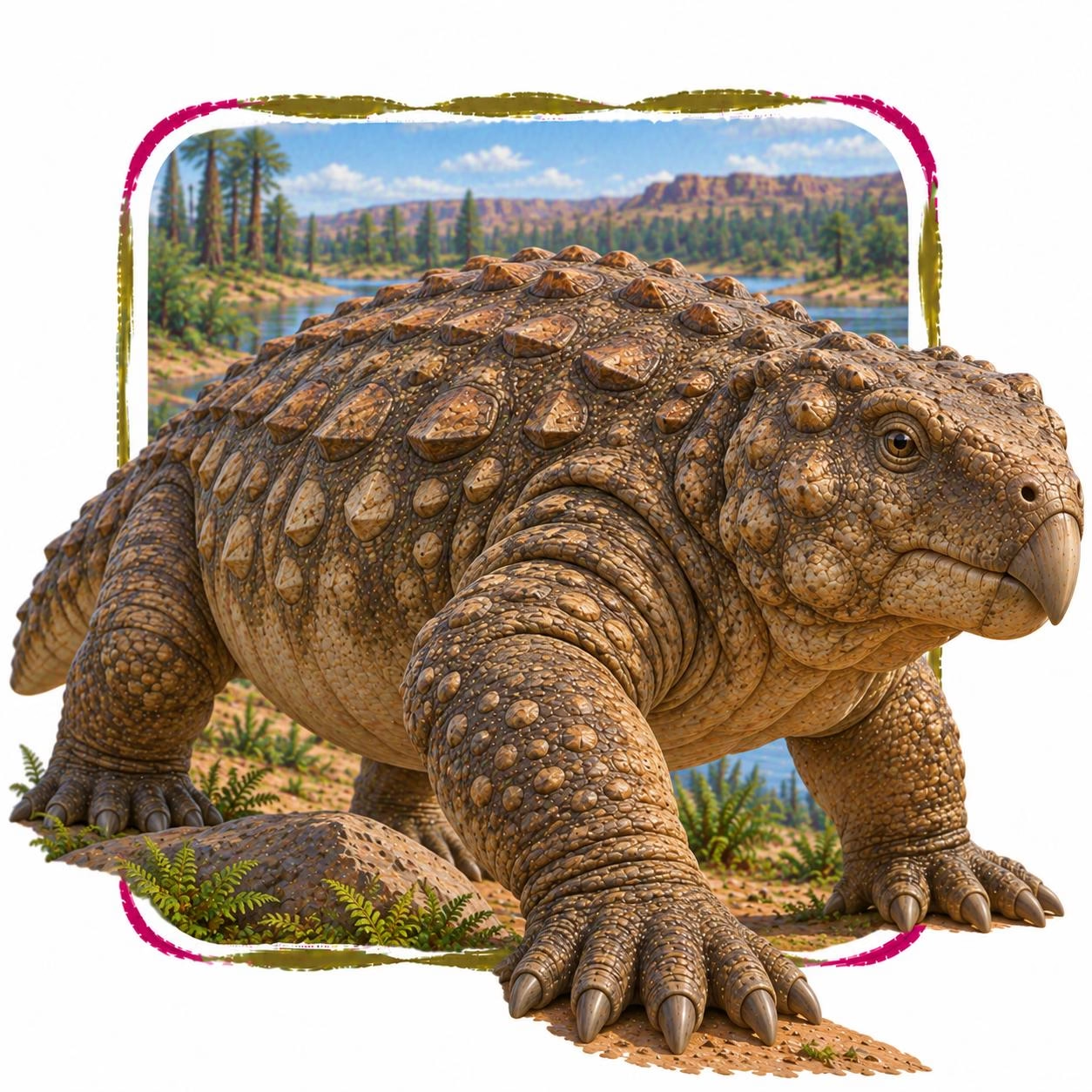
Scutosaurus in its natural Late Permian seasonal floodplains, river plains, semi-arid lowlands, wooded valleys, dry terrestrial basins, and plant-rich habitats of northern European Russia habitat